

What revenue do you need for a $1 million business loan?
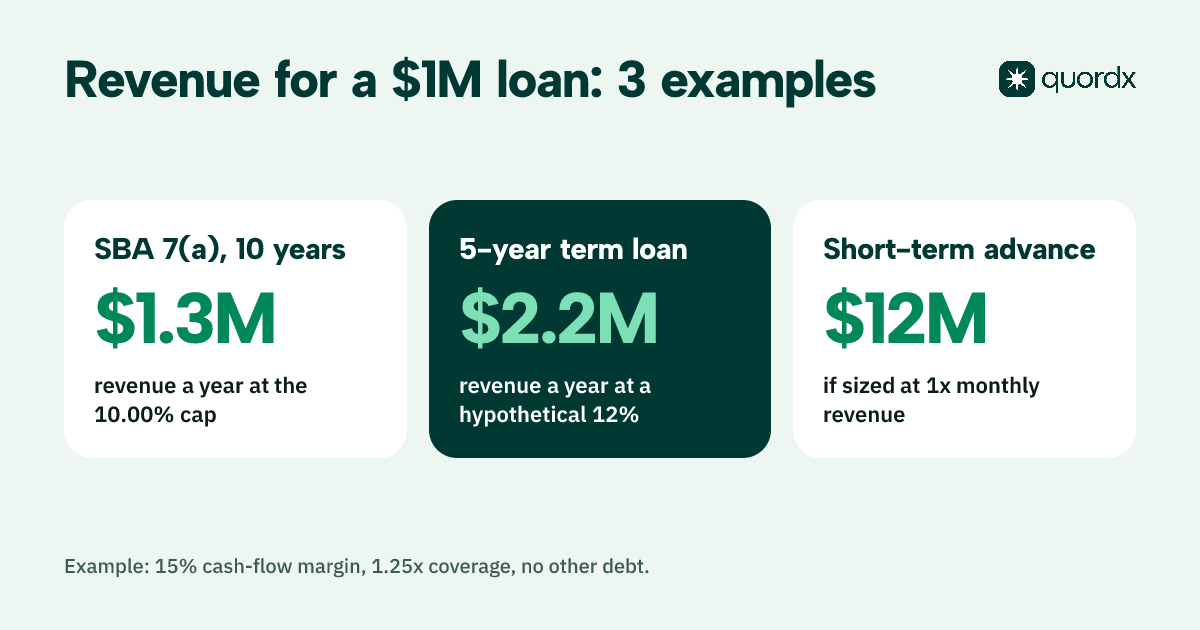
There is no fixed revenue minimum for a $1 million business loan, because lenders size a loan this big from cash flow, not sales. As a worked example, at a 15% cash-flow margin a 10-year SBA 7(a) loan at today's 10.00% maximum rate works with about $1.32 million a year in revenue, while a 5-year term loan at a hypothetical 12% needs about $2.22 million. Products sized off monthly sales sit in a different league: if a lender capped an advance at one month of revenue, $1 million would take $12 million a year.
The short version: Take the yearly payment on the loan you want, add the payments you already make, multiply by the coverage the lender wants (this page uses a hypothetical 1.25x), and divide by your cash-flow margin. That is your revenue bar. If you fall short, a longer term or real estate collateral closes the gap faster than more sales do, and a short-term product almost never does at this size.
Part of our guide to Business Loans.
Last updated · Reviewed by Cody Dreis
50+ Lenders|Funding in as little as 24 hours
How lenders decide whether your revenue supports $1 million
Banks and SBA lenders don't start from revenue. They start from the payment. The test is debt service coverage: the cash your business produces in a year divided by every loan payment it owes in that year, the new loan included.
SBA spells out the definitions in its February 2026 procedural notice on 7(a) Small loans. Operating cash flow is EBITDA (earnings before interest, taxes, depreciation and amortization), and debt service is the required principal and interest on all business debt, including the new SBA loan. For 7(a) Small loans, which stop at $350,000, the ratio must be at least 1.10:1. A $1 million request is a Standard 7(a) loan with its own underwriting rules, and lenders set their own coverage targets on top.
Revenue matters only through margin: Two companies with $3 million in sales can land on opposite sides of a $1 million decision if one keeps 20 cents of each dollar and the other keeps 6. Revenue is the starting number; cash flow is the one that gets underwritten.
Short-term lenders work another way. They read your bank deposits, size the offer against monthly revenue, and check that the daily or weekly debit won't swamp the account. Both methods are worked through below.
The formula for revenue needed on a $1 million loan
Revenue needed = (new yearly payments + existing yearly payments) × coverage target ÷ cash-flow margin.
The rate in the SBA rows comes from SBA's cap. Prime is 7.00% as of October 2026, after the Federal Reserve raised its target range a quarter point at its September 15-16, 2026 meeting. For 7(a) loans over $350,000, the maximum variable rate is prime plus 3.0%, so 10.00% is the ceiling on $1 million (SBA 7(a) terms). Lenders can charge less.
Worked example, $1 million SBA 7(a) over 10 years at 10.00%: the payment formula is P × r ÷ (1 − (1 + r)^−n), with P = 1,000,000, r = 0.10 ÷ 12 = 0.0083333 and n = 120. That gives $8,333.33 ÷ 0.63059 = $13,215.07 a month, or $158,580.88 a year. Multiply by a hypothetical 1.25x target and you need $198,226 of cash flow. Divide by a 15% margin: about $1.32 million of annual revenue, assuming no other debt.
| $1,000,000 loan | Yearly payments | Revenue needed at 10% margin | At 15% margin | At 20% margin |
|---|---|---|---|---|
| SBA 7(a), 25 years (real estate), 10.00% | $109,044 | $1,363,000 | $909,000 | $682,000 |
| SBA 7(a), 10 years, 10.00% | $158,581 | $1,982,000 | $1,322,000 | $991,000 |
| Term loan, 5 years, hypothetical 12% | $266,933 | $3,337,000 | $2,224,000 | $1,668,000 |
| Term loan, 3 years, hypothetical 12% | $398,572 | $4,982,000 | $3,321,000 | $2,491,000 |
The term does most of the work: Going from 3 years to 10 cuts the yearly payment from $398,572 to $158,581, which lowers the revenue bar by about 60%. The rate matters less than you might think: the same 10-year loan at 12% instead of 10% raises the yearly payment by about 9%.
To test other amounts or terms, the business loan payment calculator gives the monthly payment; multiply it by 12 and drop it into the formula.
See what you could qualify for
Four answers about your business. No credit pull.
How existing debt changes the revenue you need
Every payment you already make draws on the same cash flow, so it comes off the top. SBA's definition of debt service covers all business debt. If you also carry a daily or weekly advance, annualize its debits and include them in your own check, because they leave the same account.
Example: a business with $3 million in revenue and a 12% cash-flow margin produces $360,000 a year. It already pays $8,000 a month ($96,000 a year) on other loans. At a hypothetical 1.25x target, total payments can't exceed $288,000 a year, which leaves $192,000, or $16,000 a month, for new debt.
That room fits the $1 million SBA loan above, with coverage of 1.41x ($360,000 ÷ $254,581). It doesn't fit a $1 million 5-year term loan at a hypothetical 12%, where coverage falls to 0.99x. On the 5-year structure, $16,000 a month supports only about $719,000.
- If coverage is short, stretch the term first. It is the cheapest fix on paper, though it adds total interest.
- If one old debt carries a heavy payment, ask the lender whether part of the new loan can retire it, so that payment drops out of the calculation.
- If you are still short, request the amount your coverage supports now and come back for more once a stronger year is on your tax return.
- If you own real estate or are buying it, see the next sections, because a 25-year term changes the math.
For the ratio itself and how lenders adjust the inputs, see debt service coverage ratio explained.
Revenue needed for a $1 million short-term loan or cash advance
Short-term lenders mostly skip the coverage formula. They pull several months of bank statements, average the deposits, and tie the offer to that average. Each lender sets its own sizing, so every multiple below is made up to show the arithmetic.
- Sized at 1x monthly revenue (hypothetical): $1 million needs $1 million of average monthly deposits, or $12 million a year.
- Sized at 1.5x (hypothetical): $666,667 a month, or $8 million a year.
- Payment check (hypothetical): say the offer carries a $1.25 million total payback over 12 months. That is $104,167 a month in debits, or $24,038 a week. If a lender wanted those debits under 15% of deposits, you would need about $694,444 a month, or $8.33 million a year.
Set those beside the SBA example, which needed about $1.32 million of revenue at a 15% margin. At $1 million, short-term money asks for roughly 6 to 9 times the sales. A business doing $8 million a year at that margin has $1.2 million of cash flow, about six times what the 10-year SBA example requires, so the longer loan is the better first call.
If a short-term offer is already on the table, compare its total payback with the SBA interest above before signing; what a merchant cash advance really costs walks through the conversion. Lenders confirm deposits from statements, not from your P&L, which is why how lenders verify business revenue is worth a read first.
When collateral lowers the revenue bar
Real estate: SBA allows up to 25 years when a 7(a) loan finances real estate. In the table, that dropped the revenue needed at a 15% margin from about $1.32 million to $909,000, because the yearly payment fell to $109,044.
SBA 504 for owner-occupied buildings: A bank lends at least 50% of the project, a Certified Development Company lends up to 40% through an SBA-backed debenture, and the borrower puts in at least 10%. The 504 rate is pegged to 10-year Treasury yields, with terms of 10, 20 or 25 years. Lenders still test cash flow, but the long term keeps the payment low.
Equipment: The machine secures the loan, which helps a thinner file, but the payment still comes out of cash flow, so run the formula with the equipment note's term. See how equipment financing works.
Venture backing: Venture debt is underwritten mainly on investor support and growth, so the margin-based formula above doesn't describe it well. It suits funded companies whose revenue is growing faster than their profit.
What else a lender checks on a $1 million SBA loan
- Ownership. Since March 1, 2026, every direct and indirect owner of a 7(a) or 504 applicant must be a U.S. citizen or U.S. national with a principal residence in the United States. As of October 2026, lawful permanent residents can't hold any share.
- Size. The business must be small under SBA rules. If it is over its industry standard, the alternative test can still work: tangible net worth of $20 million or less and average net income after federal taxes of $6.5 million or less over the last two fiscal years, affiliates included.
- The guaranty fee. For FY 2027, SBA guarantees up to 75% of loans over $150,000, and the upfront fee on a $1 million loan is 3.5% of the guaranteed part: $750,000 × 3.5% = $26,250 (SBA Information Notice 5000-881797). The 0% fee for manufacturers, listed food supply chain businesses and rural businesses stops at $700,000, so it doesn't reach this loan.
- Credit elsewhere. The lender has to document why you can't get similar credit on reasonable terms without the SBA guaranty.
- Room for the full ask. The lender also sizes against SBA's 7(a) loan limits, your collateral and your use of funds.
Asking for a number your file supports matters. In the Federal Reserve's 2025 Small Business Credit Survey, 42% of applicants got the full amount they sought, 36% got some or most, and 22% got none (2026 Report on Employer Firms). Running the coverage math before you apply is the cheapest way to land in the first group.
Where Quordx fits on a $1 million request
Quordx is a broker, not a lender, and at seven figures the honest answer depends on the structure. Through its lender panel, Quordx can reach SBA 7(a) loans of roughly $400,000 and up, larger term loans and working capital, big-ticket equipment financing, and real estate bridge loans in some states.
It does not place SBA 504 loans or bank commercial mortgages. If the $1 million buys a building you will occupy, a Certified Development Company or a local bank is the better route.
For the rest, the application takes about 10 minutes, most options can be checked without a hard credit pull, and the lenders set terms and make every decision. Quordx's compensation comes from the lender when a deal funds, not from you. Bring your coverage math: a request that already shows how it clears the payment is easier to place. You can start an application here; Quordx does not serve businesses in Virginia, Connecticut, Missouri or North Dakota.
Questions Business Owners Ask Before Applying
Can a business with $1 million in revenue get a $1 million loan?
Only in narrow cases. At a 20% cash-flow margin, $1 million of revenue produces $200,000, which covers the $158,581 yearly payment on a 10-year SBA loan at 10.00% about 1.26 times, with no other debt. A 25-year real estate loan raises that to 1.83x; a short-term structure doesn't come close.
Do lenders look at revenue or profit for a $1 million loan?
Both, for different products. SBA and bank lenders underwrite cash flow, which SBA defines as EBITDA, so profit drives the answer. Short-term lenders size off average monthly deposits. See whether lenders use gross or net revenue.
What debt service coverage ratio do lenders want on $1 million?
SBA sets a 1.10:1 floor for 7(a) Small loans of $350,000 or less. A $1 million loan is a Standard 7(a) loan, and each lender applies its own target on top of SBA's rules, so ask for the number before you apply. This page uses 1.25x purely as a hypothetical.
How much is the SBA guaranty fee on a $1 million loan?
For loans approved from October 1, 2026 through September 30, 2027, it is $26,250: 3.5% of the $750,000 guaranteed portion. The separate 0.55% annual service fee is charged to the lender, and SBA says lenders may not pass it on to the borrower.
How long does a $1 million SBA loan take?
SBA's published processing time for Standard 7(a) loans is 5 to 10 business days, and that covers only SBA's own step. The lender's underwriting, any appraisal and the closing come on top. See how long an SBA loan takes.
Apply for Funding
No obligation · Initial inquiry doesn't impact credit · Takes about 10 minutes
Sources
- SBA Procedural Notice 5000-876777, Sunset of SBSS Score for 7(a) Small Loans: Supplemental Guidance (Feb 20, 2026)
- SBA, 7(a) loan program terms, conditions and eligibility
- SBA Information Notice 5000-881797, 7(a) fees for FY 2027
- Federal Reserve, FOMC minutes, September 15-16, 2026
- Federal Reserve Banks, 2026 Report on Employer Firms (2025 Small Business Credit Survey)

Written by
Cody Dreis
Founder, Quordx Capital
Read full bio
Related articles
Keep exploring business loans
Quordx Capital is a business funding broker, not a lender. Lenders make every credit decision and set the rate, fees and terms, and not every business qualifies. Quordx may be paid by a lender when a deal funds. Full disclosures