

How much is the monthly payment on a $100k business loan?
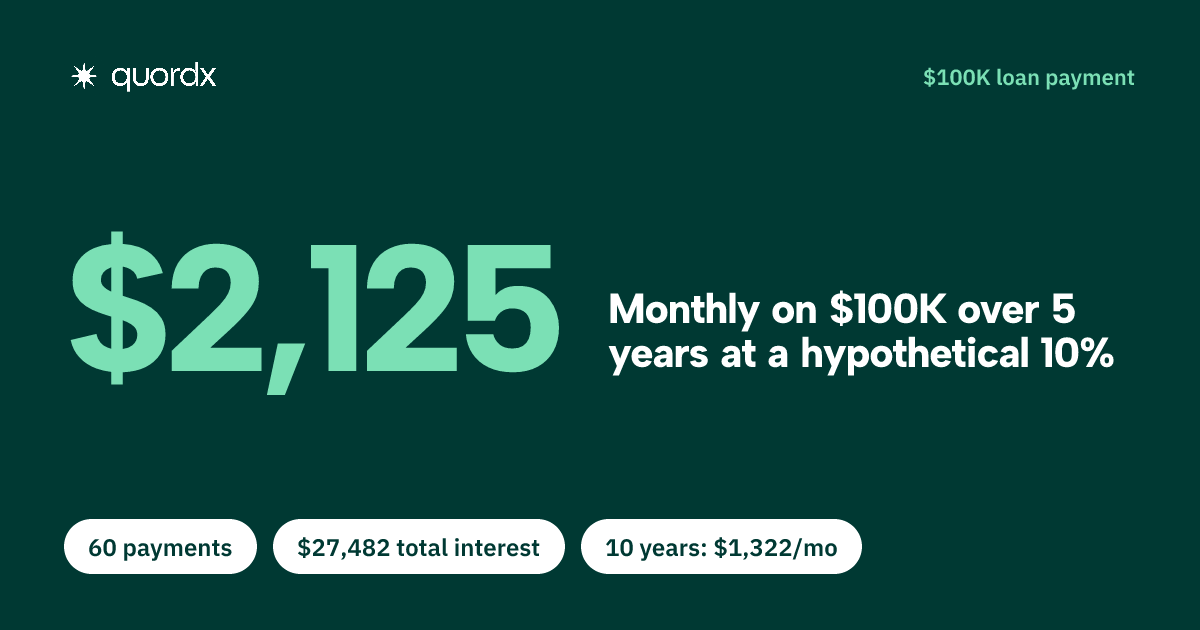
At a hypothetical 10% interest rate, a $100,000 business loan costs $3,226.72 a month over 3 years, $2,124.70 over 5 years and $1,321.51 over 10 years. The term moves the payment far more than the rate does: on a 5-year loan, going from 8% to 15% adds $351 a month, while stretching a 10% loan from 3 years to 10 cuts the payment by $1,905.
The short version: Pick the term first, because it sets most of the payment, then shop the rate, because it sets most of the total cost. Longer terms lower the monthly hit but cost more in interest: $27,482 of interest over 5 years at 10% becomes $58,581 over 10 years. Before you sign, convert any weekly or daily schedule into a monthly figure and check it against your real cash flow.
Part of our guide to Business Loans.
Last updated · Reviewed by Cody Dreis
50+ Lenders|Funding in as little as 24 hours
$100,000 loan payment table by rate and term
Every figure below is a standard fully amortizing loan: equal monthly payments, no balloon, no fees added. The rates are hypothetical round numbers chosen to show the spread, not quotes or market averages. Your offer will depend on the lender, the product and your file.
| Rate (hypothetical) | 2 years | 3 years | 5 years | 7 years | 10 years |
|---|---|---|---|---|---|
| 8% | $4,522.73 | $3,133.64 | $2,027.64 | $1,558.62 | $1,213.28 |
| 10% | $4,614.49 | $3,226.72 | $2,124.70 | $1,660.12 | $1,321.51 |
| 12% | $4,707.35 | $3,321.43 | $2,224.44 | $1,765.27 | $1,434.71 |
| 15% | $4,848.66 | $3,466.53 | $2,378.99 | $1,929.68 | $1,613.35 |
| Rate (hypothetical) | 2 years | 3 years | 5 years | 7 years | 10 years |
|---|---|---|---|---|---|
| 8% | $8,545 | $12,811 | $21,658 | $30,924 | $45,593 |
| 10% | $10,748 | $16,162 | $27,482 | $39,450 | $58,581 |
| 12% | $12,976 | $19,572 | $33,467 | $48,283 | $72,165 |
| 15% | $16,368 | $24,795 | $42,740 | $62,093 | $93,602 |
Read the two tables together: The 10-year column has the smallest payments and the biggest interest bills. At 12%, the 10-year loan costs $72,165 in interest, more than three and a half times the 3-year loan's $19,572, in exchange for a payment that is $1,887 a month lower.
The loan payment formula, with one worked example
Every payment on this page comes from the standard amortization formula:
Payment = P × r ÷ (1 − (1 + r)^−n): where P is the amount borrowed, r is the annual rate divided by 12, and n is the number of monthly payments.
Worked example, $100,000 over 5 years at 10%: P = 100,000, r = 0.10 ÷ 12 = 0.0083333, and n = 60. (1.0083333)^−60 = 0.60779, so the bottom of the formula is 1 − 0.60779 = 0.39221. The top is 100,000 × 0.0083333 = 833.33. Divide: 833.33 ÷ 0.39221 = $2,124.70 a month.
To run your own numbers, including a different amount, the business loan payment calculator does the same math. For how lenders apply the rate day to day, see how business loan interest is calculated.
Run the numbers on your loan
Pick a product, set the amount and term, and see a typical payment.
Amortization schedule: $100,000 over 5 years at 10%
The payment never changes, but what it pays for does. In month one, $833.33 of the $2,124.70 goes to interest and $1,291.37 goes to principal. By the final year, interest is down to about $111 a month on average.
| Year | Paid that year | Interest | Principal | Balance at year end |
|---|---|---|---|---|
| 1 | $25,496.40 | $9,269.63 | $16,226.77 | $83,773.23 |
| 2 | $25,496.40 | $7,570.48 | $17,925.92 | $65,847.31 |
| 3 | $25,496.40 | $5,693.41 | $19,802.99 | $46,044.32 |
| 4 | $25,496.40 | $3,619.77 | $21,876.63 | $24,167.69 |
| 5 | $25,496.70 | $1,329.01 | $24,167.69 | $0.00 |
| Total | $127,482.30 | $27,482.30 | $100,000.00 |
Why this matters if you might pay early: after two years you have paid $50,992.80 but still owe $65,847.31, because the early payments were interest-heavy. Paying off early on an amortizing loan saves the interest you haven't been charged yet, which is why prepayment terms are worth reading before you sign.
What changes the monthly payment on a business loan
Term: The biggest lever, as the tables show. Terms tend to follow the use: SBA, for example, caps working capital and most equipment at 10 years and real estate at 25.
Rate: Moves total cost more than the payment on short loans, and both on long ones. On a 10-year $100,000 loan, the gap between 8% and 15% is $400 a month and $48,009 of total interest.
Interest-only months: Say the lender gives 12 months of interest-only at 10%, then 48 months of full payments. You pay $833.33 a month in year one, then $2,536.26 a month after, and total interest rises to $31,740 versus $27,482 on a straight 5-year schedule.
A balloon: If a 5-year loan is amortized as though it ran 10 years, the payment drops to $1,321.51, but $62,197.23 is still owed at the end of year five and must be paid or refinanced.
Fees taken from the proceeds: An origination fee deducted at closing doesn't change the payment, but it changes what you get. Say a lender charges a hypothetical 3%: you receive $97,000 and repay on $100,000.
Variable rates: If the rate floats, so does the payment. The next section shows what a 0.25% move does on an SBA loan.
SBA 7(a) loan payment on $100,000
SBA 7(a) loans can carry a low monthly payment on $100,000 because SBA allows long terms. SBA sets the general maximum at 10 years for working capital and equipment (longer for equipment with a longer useful life) and 25 years for real estate, per its 7(a) terms and conditions.
The rate ceiling is tied to prime: The prime rate is 7.00% as of October 2026, after the Federal Reserve raised its target range by a quarter point at its September 15-16, 2026 meeting. For a 7(a) loan between $50,001 and $250,000, the maximum variable rate is prime plus 6.0%, so the ceiling on a $100,000 loan is currently 13.00%. Lenders can charge less, and the next Fed meeting is October 27-28, 2026, so check prime again before you compare quotes.
| $100,000 SBA 7(a), 10 years | Rate | Monthly payment | Total interest |
|---|---|---|---|
| At the SBA maximum (prime + 6.0%) | 13.00% | $1,493.11 | $79,172.89 |
| Hypothetical quote (prime + 2.75%) | 9.75% | $1,307.70 | $56,924.29 |
SBA fees on a $100,000 loan for FY 2027
SBA's FY 2027 fee notice covers loans approved from October 1, 2026 through September 30, 2027 (Information Notice 5000-881797). For a loan of $150,000 or less with a maturity over 12 months, the upfront guaranty fee is 2% of the guaranteed portion. SBA guarantees up to 85% of loans this size, so on $100,000 that is $85,000 × 2% = $1,700.
- 0% upfront fee on loans of $700,000 or less to manufacturers (NAICS 31-33), listed food supply chain businesses, and businesses in rural areas.
- $0 upfront fee on SBA Express loans to businesses owned by a veteran or a veteran's spouse.
- 0.25% upfront fee if the maturity is 12 months or less.
- The 0.55% annual service fee is charged to the lender on the guaranteed balance, and SBA says lenders may not pass it on to the borrower.
- Two or more 7(a) loans within 90 days are treated as one loan for the fee calculation, so splitting a loan doesn't lower the fee.
Ask the lender whether the $1,700 is paid at closing or financed into the loan, because financing it nudges the payment up slightly. SBA's prepayment fee applies only to loans with maturities of 15 years or more, so a 10-year $100,000 working capital loan doesn't carry it. For limits on larger requests, see the maximum SBA 7(a) loan amount.
What a prime rate change does to the payment
Take the hypothetical 9.75% loan above. If prime rises 0.25% after two years, the rate becomes 10.00% on the remaining $86,935.57, and the payment for the last 96 months goes from $1,307.70 to $1,319.17. That is $11.47 a month: small per move, but rate changes stack.
Daily and weekly payment business loans: how the math changes
Some short-term products don't use the amortization formula at all. Instead of an interest rate on a declining balance, the lender states a fixed total payback, then divides it into equal daily or weekly debits from your bank account.
Example with made-up numbers: say an offer of $100,000 comes with a total payback of $125,000 over 52 weeks. The weekly debit is $125,000 ÷ 52 = $2,403.85, which is about $10,416.67 a month. On a daily schedule of 250 business days, it would be $500 a day.
Because you start paying back principal immediately, you have the full $100,000 for only a moment. Converted to an annual percentage rate, that example works out to roughly 46%. For contrast, a 12-month loan at a hypothetical 12% with monthly payments costs $8,884.88 a month and $6,618.55 in total interest.
- Paying early may not save anything. With a fixed payback, the cost is often set on day one. Ask in writing whether early payoff reduces the total.
- Merchant cash advances work differently again. They buy a share of future sales and collect a percentage of receipts, so the debit rises and falls with revenue. See how merchant cash advance payments are calculated and what a factor rate is.
- Weekly amortizing loans are not the same thing. A true amortizing loan paid weekly at 10% over 5 years costs $489.11 a week, about $2,119.48 a month, almost identical to the monthly version.
The Federal Reserve's 2026 Report on Employer Firms found that 60% of firms that borrowed from online lenders said actual borrowing costs were higher than expected. Converting every daily or weekly schedule to a monthly figure and an annual rate before signing is the simplest way not to be one of them.
How much payment can your business afford?
Lenders compare the new payment with the cash your business has left after expenses and existing debt payments. Do the same check yourself before you apply, using bank statements rather than a forecast.
Example: suppose your business has $4,000 a month left after expenses and current debt payments. A 3-year loan at a hypothetical 10% ($3,226.72) leaves $773.28 of cushion. The 5-year version leaves $1,875.30, and the 10-year version leaves $2,678.49. One slow month wipes out the first cushion; the third survives it.
- If the money buys something that earns back its cost quickly, take the shorter term and keep total interest low.
- If cash flow is tight or seasonal, take the longer term and prepay in strong months, after confirming there is no prepayment penalty.
- If you don't need all $100,000 at once, compare a line of credit, which charges interest only on what you draw. See line of credit vs business loan.
Getting real payment quotes on $100,000
The tables tell you the shape of the decision; only a quote tells you your rate. Quordx is a broker, not a lender. One application of about 10 minutes goes to a network of 50+ lenders, and most options can be explored without a hard credit pull. Lenders set the rate and make the decision, and those lenders typically return decisions in 24 to 48 hours.
It is free to the business owner; lenders pay Quordx when a deal funds. When you have offers, put each one through the formula above, convert any weekly schedule to monthly, and compare total cost, not just the payment. You can start an application here.
Questions Business Owners Ask Before Applying
What is the monthly payment on a $100,000 loan over 10 years?
At a hypothetical 10%, it is $1,321.51 a month, with $58,580.88 of total interest. At 8% it is $1,213.28, and at 12% it is $1,434.71. Your actual rate depends on the lender and your file.
What is the payment on a $100,000 SBA loan?
On a 10-year 7(a) loan, the payment is $1,493.11 at the current SBA maximum of 13.00% (prime of 7.00% plus 6.0%, as of October 2026). A lower hypothetical quote of 9.75% gives $1,307.70. Budget for an upfront guaranty fee of $1,700 unless your business qualifies for a 0% exception.
Does a longer loan term cost more?
Yes, in total interest, even at the same rate. At 10%, $100,000 costs $27,482 in interest over 5 years and $58,581 over 10 years. The longer term buys a lower payment, not a cheaper loan.
Is a weekly payment cheaper than a monthly payment?
On a true amortizing loan at the same rate, barely: $489.11 a week at 10% over 5 years totals about $27,169 of interest versus about $27,482 paid monthly. The big differences come from fixed-payback products, where the cost is set up front and the short term pushes the annual rate much higher.
Who pays the SBA's 0.55% annual service fee?
The lender. SBA's FY 2027 notice sets it at 0.55% of the guaranteed portion's outstanding balance and states that lenders may not pass it on to the borrower. The upfront guaranty fee is the SBA fee to plan for.
Apply for Funding
No obligation · Initial inquiry doesn't impact credit · Takes about 10 minutes
Sources

Written by
Cody Dreis
Founder, Quordx Capital
Read full bio
Related articles
Keep exploring business loans
Quordx Capital is a business funding broker, not a lender. Lenders make every credit decision and set the rate, fees and terms, and not every business qualifies. Quordx may be paid by a lender when a deal funds. Full disclosures