

Business line of credit vs business loan: which is better?
A business loan is better when you know the amount and the purpose today, and a line of credit is better when the need comes and goes. The loan hands you a lump sum and charges interest on all of it from the first day, while a line lets you draw only what you need and charges interest only on the drawn balance. That one difference drives almost everything else: how you repay, what it costs when the money sits idle, and what happens when the agreement ends.
The short version: Use a term loan for a one-time cost with a price tag, like equipment, a buildout or an acquisition, and match the term to how long the thing pays you back. Use a line for gaps you can't time, like payroll before receivables land or inventory before a busy season. If you only need $30,000 of a $100,000 facility most of the year, a line usually costs far less in interest. If you need the full amount for years, a loan's fixed schedule is cheaper to live with and has no renewal to worry about.
Part of our guide to Business Loans.
Last updated · Reviewed by Cody Dreis
50+ Lenders|Funding in as little as 24 hours
Line of credit vs term loan: the side-by-side
Start here. Most borrowers can pick the right product from this table alone, then use the rest of the page to check the math.
| Business line of credit | Business term loan | |
|---|---|---|
| Fits best when | You don't know exactly how much you'll need or when | You know the amount and the use today |
| How you get the money | Draw what you need, up to a limit, as often as you need it | One lump sum at closing |
| How interest is charged | Only on the drawn balance; an unused limit accrues no interest | On the full amount borrowed, from day one |
| How repayment works | A minimum payment on what you owe; repaid amounts become available to draw again | Fixed payments that pay the balance to zero by the end of the term |
| Renewal | Has a draw period or annual review; the lender can renew, shrink or close it | No renewal; it simply pays off |
| Costs besides interest | Ask about annual, draw and maintenance fees | Ask about origination and prepayment terms |
| Typical uses | Payroll timing, seasonal inventory, receivables gaps, a cash cushion | Equipment, buildouts, expansions, acquisitions, refinancing |
A quick decision rule: if you can write the dollar amount on a purchase order today, price a loan first. If the honest answer is "somewhere between $10,000 and $60,000, depending on the month," price a line first.
How interest works on a $100,000 line vs a $100,000 loan
Here is the core difference in dollars. To isolate the structure, both examples use the same hypothetical rate: say the lender quotes 12% a year. That is an illustration, not a market rate, and real quotes for a line and a loan rarely match.
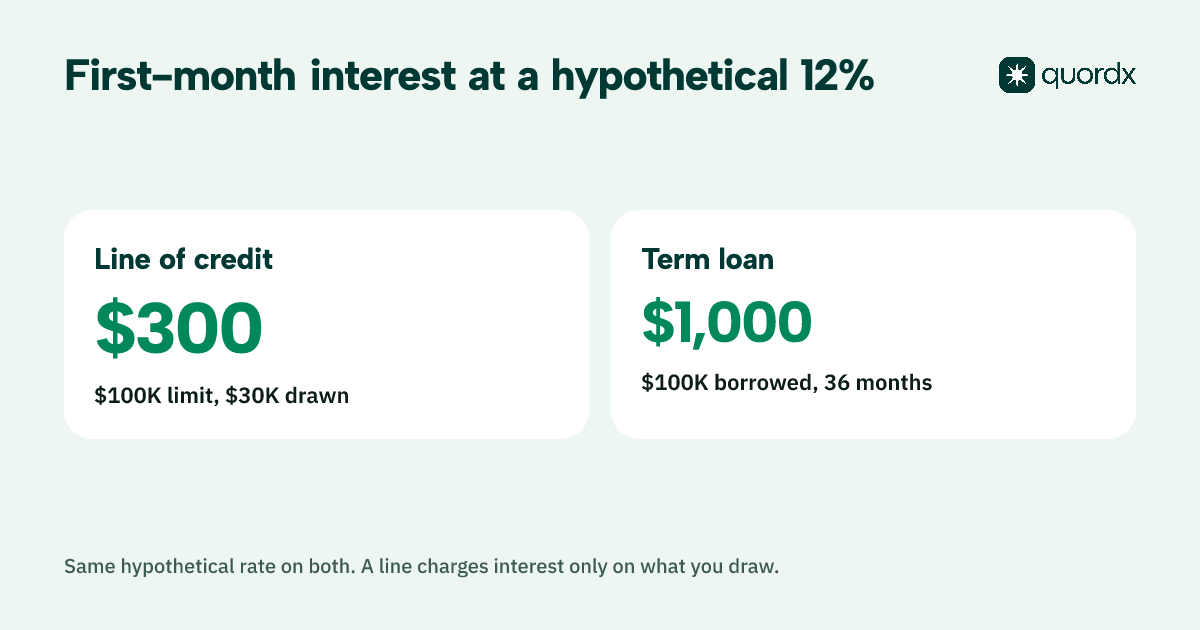
The line: you have a $100,000 limit and draw $30,000. Interest runs on the $30,000 only: $30,000 × 12% ÷ 12 = $300 a month. The other $70,000 costs nothing in interest until you draw it. Lenders that accrue daily will bill slightly differently month to month (a 30-day month works out to $295.89), but $300 is the right ballpark.
The loan: you borrow $100,000 and receive all of it. The first month's interest is $100,000 × 12% ÷ 12 = $1,000, whether you spend the money that month or not. Paid off over 36 months, the fixed payment is $3,321.43, and total interest over the life of the loan comes to $19,571.52.
| Hypothetical 12% rate | $100,000 line, $30,000 drawn | $100,000 term loan, 36 months |
|---|---|---|
| Balance you pay interest on | $30,000 | $100,000 (falling as you repay) |
| Interest, first month | $300 | $1,000 |
| Required payment, first month | Depends on the lender's minimum (see below) | $3,321.43 |
| Interest over the first 12 months | $3,600 if $30,000 stays drawn all year | $10,415.62 |
| Balance after 12 months | Whatever you choose to leave drawn | $70,558.44 |
The catch: if you take the $100,000 loan but only need $30,000, you pay about $700 a month in first-month interest on $70,000 you are not using. If you truly need the whole $100,000 for three years, the line's advantage disappears, and its renewal risk and fees come along for nothing.
A seasonal year on the same $100,000 line
Lines earn their keep when the balance moves. Suppose a landscaping company draws $30,000 in March for equipment rentals and payroll, tops up to $50,000 in May and June, then pays down as fall invoices clear: $40,000 in July, $20,000 in August, $10,000 in September and zero from October on.
Add the month-end balances and you get $230,000 of "balance months." At 1% a month (12% ÷ 12), that is $2,300 of interest for the year, on an average balance of about $19,167. A $100,000 term loan at the same rate would charge $10,415.62 in interest over its first 12 months, because interest runs on the full borrowed amount from the start.
What a line costs when you aren't using it
No interest on an unused limit does not always mean no cost. Some lines charge an annual fee whether you draw or not, and some waive it if you use the line enough. Say the $100,000 line carries a hypothetical $250 annual fee: that is $250 a year for availability, on top of interest on whatever you draw. Ask every lender for its full fee list before you compare a line's rate to a loan's rate.
Compare your options side by side
Enter your revenue and see how each type of funding sizes up.
How repayment works on each
A term loan amortizes: Each payment is the same, part interest and part principal, and the last payment brings the balance to zero. Early payments are mostly interest; later ones are mostly principal. You always know the payoff date. To see how the payment moves with rate and term, the monthly payment breakdown for a $100,000 business loan runs the numbers.
A line has a minimum payment, not a payoff schedule: A common structure is accrued interest plus a small share of the balance. Say the minimum is a hypothetical interest plus 1% of the outstanding balance: on the $30,000 example, that is $300 of interest plus $300 of principal, so $600 in the first month. Pay more and the balance drops faster; whatever you repay becomes available to draw again.
Some lines work more like a string of small loans: With some online lenders, each draw turns into its own fixed installment schedule over a set number of months, sometimes with weekly payments instead of monthly. Read the agreement to see which kind you have, because it changes your cash flow. How a revolving line of credit works covers the mechanics in more detail.
The trap with minimum payments: paying only the minimum on a line keeps the balance high for a long time, and the interest keeps running. If a draw paid for something that lasts years, you are using a line to do a loan's job.
Renewals: what happens when a line of credit ends
A term loan has an end date and nothing to renew. A line has a draw period, after which the lender decides what happens next. Some lines pair a multi-year draw period with a set repayment period afterward, during which you can no longer draw and the remaining balance pays down.
Some lines are also reviewed during the draw period. At review, the lender looks at your current financials and can renew the line as is, lower the limit, change the pricing or close it to new draws. A line that was easy to get in a strong year can shrink in a weak one, which is exactly when you'd want it.
Decision rule: never fund something that takes years to pay off with a line that comes up for review sooner. If the asset needs five years to earn back its cost, give it five years of fixed financing.
Which is easier to get: a line of credit or a business loan?
There is no published approval-rate figure that splits lines from term loans. The Federal Reserve's 2026 Report on Employer Firms groups loans, lines of credit and cash advances together (38% of firms applied for one of them in the prior 12 months). So the honest answer depends on what backs the deal and how much you ask for.
A line is an open-ended promise: The lender commits to the whole limit, not just today's balance, and can't see what you'll draw it for. That is why lenders tend to underwrite a line on the full limit and why some banks offer lines only to existing business banking customers.
A term loan with collateral can be the easier yes: When the money buys a specific asset, the lender knows the use and can take a lien on it. Equipment and real estate loans lean on that collateral, so the asset itself does part of the qualifying.
- If your cash flow is uneven but steady over a year, a modest line sized to your largest seasonal gap is usually an easier ask than a large lump sum.
- If you are buying a hard asset, a loan secured by that asset is usually the cleaner application.
- If you have a thin file or a short history, a smaller line or a secured line is a common starting point. See secured vs unsecured lines of credit.
- If you want the strongest odds of full approval, the Fed's survey found applicants at small banks were more likely to be fully approved (57%) than applicants at other lenders.
Either way, lenders look at the same core items: time in business, revenue and bank deposits, existing debt payments, personal and business credit, and what the money is for. A clear use of funds helps more on a loan application; steady deposits and low existing debt help more on a line.
Typical uses: which one fits which expense
| What you're paying for | Better fit | Why |
|---|---|---|
| Equipment or vehicles | Term loan or equipment financing | Fixed cost, long useful life, the asset can secure it |
| Buildout or expansion | Term loan | Known budget, pays back over years |
| Buying a business | Term loan (often SBA 7(a)) | Large, one-time, long payback |
| Payroll while waiting on receivables | Line of credit | Short gap that repeats; repay when customers pay |
| Seasonal inventory | Line of credit | Draw before the season, repay after it |
| Emergency cushion | Line of credit | Costs little or nothing in interest until used |
| Refinancing expensive debt | Term loan | Replaces a balance with a fixed schedule |
Lines can be SBA-backed too. SBA lists revolving lines under SBA Express with maturities up to 10 years, alongside CAPLines for working capital, on its 7(a) terms and conditions page.
When it makes sense to carry both
Plenty of businesses run a term loan and a line at the same time, and the combination is often cleaner than stretching one product to do both jobs. The loan pays for the planned investment on a fixed schedule. The line covers what the plan didn't predict.
Order matters: Lenders count your existing payments when they size new credit, so a large term loan taken first can shrink the line you qualify for later. If you know you'll want both, tell the lender up front and have them sized together.
Mistakes to avoid when choosing
- Borrowing a lump sum you won't use for months. You pay interest on idle cash from the first day.
- Buying a long-lived asset with a line. A review or non-renewal can cut off the facility while the balance is still large.
- Comparing a line's rate to a loan's rate and stopping there. Add annual, draw and origination fees before you compare.
- Treating the minimum payment as the plan. Set your own payoff target for each draw.
- Ignoring variable pricing. A line's rate may float with the prime rate, which was 7.00% as of October 2026 after the Fed's September 2026 decision. When prime moves, your cost moves with it.
Comparing real offers for both
The fastest way to settle line vs loan for your business is to see actual offers side by side, priced for your numbers. Quordx is a broker, not a lender: one application of about 10 minutes reaches a network of 50+ lenders that offer both products, and most options can be explored without a hard credit pull. Lenders make the credit decisions and set the pricing.
It is free to the business owner; lenders pay Quordx when a deal funds. If you are still weighing structure, how business loan interest is calculated and the business line of credit guide go deeper, and you can start an application when the numbers make sense.
Questions Business Owners Ask Before Applying
Do you pay interest on an unused business line of credit?
No interest accrues on the part of the limit you haven't drawn. Some lines do charge an annual or maintenance fee whether you use them or not, so ask for the fee schedule. On a $100,000 line with $30,000 drawn at a hypothetical 12%, interest runs on the $30,000 only.
Can I use a line of credit to buy equipment?
You can, but it is usually the wrong tool for a large, long-lived purchase. A line can be reviewed, reduced or closed while the balance is still high, and paying only the minimum keeps interest running for years. A term loan or equipment financing matched to the asset's life is the safer structure.
Is a business line of credit rate fixed or variable?
It depends on the agreement. A variable line moves with an index such as the prime rate, which was 7.00% as of October 2026. Some online lines instead price each draw as its own fixed installment schedule. The agreement will say which, and it is worth asking how often the rate can change.
What happens if the lender doesn't renew my line?
You can no longer draw, and the remaining balance moves into repayment on the terms in your agreement. Some agreements give a fixed repayment period after the draw period ends, so check yours before the end date. Keep the balance low going into a review date to give yourself room.
Can I have a line of credit and a term loan from different lenders?
Yes. Each lender will count the other debt's payments when it decides how much to offer, and some agreements limit additional borrowing, so read the covenants. Telling both lenders about the other facility up front avoids surprises at closing.
Apply for Funding
No obligation · Initial inquiry doesn't impact credit · Takes about 10 minutes
Sources

Written by
Cody Dreis
Founder, Quordx Capital
Read full bio
Related articles
Keep exploring business loans
Quordx Capital is a business funding broker, not a lender. Lenders make every credit decision and set the rate, fees and terms, and not every business qualifies. Quordx may be paid by a lender when a deal funds. Full disclosures