

How do business loan brokers get paid?
Most business loan brokers are paid by the lender, as a commission on the amount that funds, and they get nothing if the deal doesn't close. Some charge you instead, either as an upfront fee or as a fee taken out of your loan proceeds, and on merchant cash advances the broker's pay is often built into the price you're quoted. Which model you're in changes what the money costs you, so ask before you hand over a single bank statement.
The short version: Ask every broker three things in writing: who pays you, how much, and is any of it in my rate or taken from my proceeds. A broker who wants money before you're funded is the biggest red flag in this business. On SBA 7(a) and 504 loans, every broker fee has to appear on SBA Form 159, which you sign, and several states make the lender disclose broker pay on certain offers.
Part of our guide to Business Loans.
Last updated · Reviewed by Cody Dreis
50+ Lenders|Funding in as little as 24 hours
The three ways business loan brokers are paid
Broker pay comes from one of two pockets, the lender's or yours, and it reaches the broker in one of three ways. The table shows what each looks like from your side of the deal.
| Lender-paid commission | Pay built into your price | Borrower-paid fee | |
|---|---|---|---|
| Who pays the broker | The lender, out of its own revenue | The lender, out of the spread between its base price and the price you accept | You |
| When | When the deal funds | When the deal funds | Upfront, at closing, or deducted from proceeds |
| Where you see it | Often nowhere, unless your state or the SBA requires disclosure | In a higher factor rate or interest rate than the lender's base price | As a line item on an agreement or closing statement |
| Where it shows up | Term loans, lines of credit, equipment, SBA referrals | Merchant cash advances and some equipment deals | Consulting and loan packaging work, and some brokers who charge both sides |
| What to ask | How much, and does it change which lender you send me to? | What is the lender's base price, and how much above it am I paying? | What exactly do I get, when is it due, and is it refundable? |
Lender-paid commission is the standard model: The lender treats the commission as the cost of finding a qualified borrower, the same way it pays for advertising. The amount varies by lender and by product, so two lenders can pay one broker very different sums for the same size deal.
Pay built into your price is where the conflict is sharpest: In the merchant cash advance business, a funder often sets a base price called the buy rate and lets the broker sell the advance at a higher factor rate. The broker's pay grows with the markup, which means the broker earns more when you pay more.
Worked example: what a broker commission costs you
Here is one hypothetical deal run three ways. Every rate and percentage below is made up to show the math. None of them is a quote or a market rate.
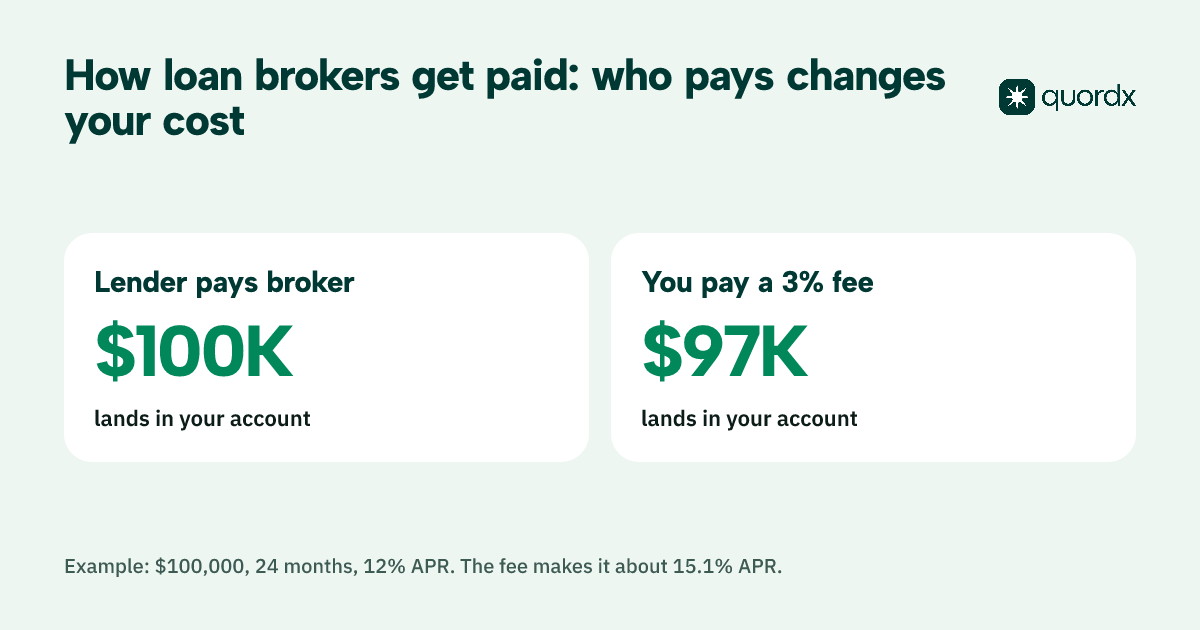
Assumptions: a $100,000 term loan over 24 months at 12% APR, which makes the payment about $4,707.35 a month and total interest about $12,976. The broker's pay is 3% of the loan, or $3,000.
| Lender pays the broker 3% | You pay the broker 3% from proceeds | |
|---|---|---|
| Cash in your account | $100,000 | $97,000 |
| Monthly payment | $4,707.35 | $4,707.35 |
| Total interest | $12,976 | $12,976 |
| Broker fee you pay | $0 | $3,000 |
| Your total cost | $12,976 | $15,976 |
| APR on the cash you receive | 12.0% | about 15.1% |
Why the fee raises your APR by about 3 points, not 3%: You pay interest on $100,000 but only get to use $97,000, and the $3,000 is squeezed into two years instead of spread over a longer term. The shorter the loan, the bigger that jump gets.
The merchant cash advance version: Say a funder prices a $50,000 advance at a 1.25 factor before broker pay, so $62,500 is owed. If the broker sells it at 1.30 instead, you owe $65,000, and the $2,500 difference comes from you, though you never see it as a fee. The only defense is to ask what the funder's base price is, and to compare offers from more than one source. Our guide to what a factor rate means shows how to turn either number into an APR.
Estimate your funding
Answer a few questions about your business to see a likely range.
Do you pay more when you use a broker?
Not necessarily, but you can't assume either way: A lender's price has to cover what it spends to win business, and broker commissions are one of those costs, just as a direct lender's marketing budget is. Whether a given lender quotes the same price through a broker and direct is something only that lender can tell you.
The test is a side-by-side quote: If you can get an offer from a lender directly and the same lender through a broker, compare the cash you receive, the total you repay, and every fee. Our page on whether to use a loan broker or go straight to a bank covers when going direct makes more sense.
Where a broker earns its pay: it's by knowing which lenders will look at your file, so you aren't paying for declines in time and credit inquiries. If you want to see how many applications actually make sense, see how many lenders to apply to.
Upfront broker fees: when a fee is a red flag
A fee before you're funded is the classic scam signal: The FTC's guidance on advance-fee loans says any upfront fee a lender wants before granting the loan is a cue to walk away, especially one labeled insurance, processing or paperwork. The SBA's Inspector General gives the same warning for anyone who promises SBA loan approval but requires payment up front.
Some states ban it outright: Florida's commercial financing law says a broker may not assess, collect or solicit an advance fee from a business for broker services. The same section bars false or misleading statements and requires a broker's ads to show its actual address and phone number. It still lets a broker ask you to pay an independent third party directly, by check or money order, for real application costs like a credit report or an appraisal.
Not every borrower-paid fee is a scam: SBA's own form lists loan packaging and consulting paid by the applicant as legitimate services that just have to be disclosed. The difference is that a legitimate fee is in writing before you owe it, it pays for specific work, and it isn't a condition of being told you're approved.
If a company is pushing for money first, run it through our checklist on how to know if a business funding company is legit before you pay anything.
SBA loans: Form 159 and the rules on referral fees
SBA loans have the clearest broker pay rules in business lending. SBA Form 159, the Fee Disclosure and Compensation Agreement, is used on 7(a) and 504 loans, and its instructions say it must be completed whenever an agent is paid by the applicant or by the SBA lender for help with the loan application.
- You sign it. The lender, the applicant and the agent all sign, and the form tells applicants not to sign until all services and fees are filled in.
- Broker and referral fees count, whether the applicant or the SBA lender pays them. Each agent gets its own form.
- Over $2,500 must be itemized. If one agent's total pay exceeds $2,500, it has to be broken down with the actual services performed and whether it's hourly or a percentage of the loan.
- No double dipping. An agent may not be paid by both the applicant and the lender for the same service, and the lender certifies that the referral fees it paid were not charged to the applicant directly or indirectly.
- Unreasonable fees get refunded. Both the agent and the lender agree to refund you any fee SBA decides was unreasonable or prohibited. Under 13 CFR 103.4, a fee with no reasonable relationship to the services provided is grounds for SBA to suspend or revoke an agent.
Hypothetical example: an SBA lender pays a broker a referral fee of 1% on a $500,000 7(a) loan, which is $5,000. That fee goes on Form 159 under the lender's column, and because it's over $2,500 it must come with an itemized explanation. The lender must also tell you in writing that you aren't required to hire an agent at all. If you're starting an SBA application, how to apply for an SBA loan covers the rest of the paperwork.
State laws on broker pay, registration and fees
Most state rules in this area come from commercial financing disclosure laws, and many of them cover merchant cash advances (sales-based financing) rather than every kind of loan. These are the ones we checked against the state's own text in October 2026.
| State | What it requires | What it covers |
|---|---|---|
| New York | If a broker is involved, the provider must tell you in writing how, and by whom, the broker is paid. A broker must pass along the provider's disclosure unaltered before presenting an offer. | Commercial financing up to $2,500,000 |
| Virginia | The disclosure must state whether the provider pays the broker directly for the offer, and how much. Brokers must register with the State Corporation Commission. | Sales-based financing |
| Texas | The provider's disclosure must state whether it pays the broker directly, and the amount. Brokers already in business must register with the Office of Consumer Credit Commissioner by December 31, 2026. | Sales-based financing |
| Florida | Brokers may not take advance fees or make false or misleading representations, and their ads must show a real address and phone number. | Commercial financing of $500,000 or less |
| Connecticut | Commercial financing providers and brokers must register with the Banking Commissioner (deadline October 1, 2024). | Commercial financing as defined in Conn. Gen. Stat. 36a-861 to 36a-872 |
| Missouri | Brokers must register with the Division of Finance and post a $10,000 surety bond. | Commercial loans, receivables purchases and open-end credit; deals over $500,000 exempt |
Sources: New York's 23 NYCRR 600.21; Virginia Code 6.2-2230 and 6.2-2231; Texas HB 700, Finance Code 398.051 and 398.053; Florida 559.9614; Connecticut's Department of Banking; Missouri RSMo 427.300.
What this means in practice: In New York, Virginia and Texas, the offer paperwork on a covered deal should already tell you whether the broker is paid and by whom, so read that line before you sign. Elsewhere, nothing may require it, which is why asking in writing matters. Other states have their own rules, so your state's financial regulator is the place to check.
Questions to ask a broker about how they're paid
- Who pays you on this deal, and how much? A straight answer names a payer and a number or percentage.
- Is any of your pay in my rate or factor rate? If yes, ask for the lender's base price.
- Will anything be deducted from my proceeds? Get the net amount that will land in your account.
- Do you charge anything if I don't fund? The answer you want is no.
- Does a lender that pays you more get my file first? Ask how lenders are chosen for your application.
- On an SBA loan: will you be on Form 159? Any paid broker should be.
For the questions to ask the lender itself once an offer arrives, see questions to ask a business lender.
How Quordx gets paid
Quordx is a broker, not a lender, and it works on the lender-paid model: the lender pays Quordx when a deal funds, and the business owner pays Quordx nothing. The amount depends on the lender and the product, which is exactly why the questions above apply to Quordx as much as to anyone. On an SBA loan, any fee a lender pays Quordx has to appear on the Form 159 you sign.
Lenders make every credit decision and set every price, and the application takes about 10 minutes, with most options explorable without a hard credit pull. Quordx doesn't serve businesses based in Virginia, Connecticut, Missouri or North Dakota, and California applicants see a state notice before they start.
Questions Business Owners Ask Before Applying
Do business loan brokers charge the borrower?
Some do, but most are paid by the lender when the loan funds. A borrower-paid fee should be in writing before you owe it and tied to specific work. A fee demanded before you're funded is a red flag, and Florida bans broker advance fees outright.
How much commission does a business loan broker make?
It varies by lender, product and deal size, and no neutral source publishes a reliable range. Ask the broker directly. In New York, Virginia and Texas, covered offers must disclose broker pay, and on SBA loans it goes on Form 159.
Is the broker's commission added to my loan?
On a lender-paid commission, the lender pays it from its own revenue, though its pricing has to cover that cost. On a merchant cash advance, the broker's pay can come from a markup on your factor rate, which you do pay. Ask whether any of the broker's pay is in your price.
Can an SBA lender pay a broker a referral fee?
Yes. SBA Form 159 lists broker and referral services paid by the SBA lender, and the fee must be disclosed on the form you sign. The lender certifies the fee wasn't charged to you, and total pay over $2,500 must be itemized.
Is a broker fee taken from loan proceeds legal?
In many cases yes, if it's disclosed. It still raises your cost: in our hypothetical, a 3% fee from proceeds turned a 12% APR loan into about 15.1% on the cash you actually received. Get the net funded amount in writing.
Apply for Funding
No obligation · Initial inquiry doesn't impact credit · Takes about 10 minutes
Sources
- SBA Form 159: Fee Disclosure and Compensation Agreement (7(a) and 504)
- New York DFS, 23 NYCRR 600: commercial finance disclosure regulation, including 600.21 on brokers
- Code of Virginia, Title 6.2, Chapter 22.1: Sales-Based Financing Providers and Brokers
- Florida Statutes section 559.9614: prohibited acts for commercial financing brokers
- Texas H.B. 700 (2025): commercial sales-based financing, Finance Code chapter 398

Written by
Cody Dreis
Founder, Quordx Capital
Read full bio
Related articles
Keep exploring business loans
Quordx Capital is a business funding broker, not a lender. Lenders make every credit decision and set the rate, fees and terms, and not every business qualifies. Quordx may be paid by a lender when a deal funds. Full disclosures