

How to Get Inventory Financing
To get inventory financing, match the product to how your stock sells, then give the lender clean inventory records, because inventory lenders advance against what your goods would bring in a forced sale, not what you paid for them. Smaller businesses usually fund inventory with a term loan or line of credit sized to their revenue; dealers of vehicles and equipment use floor plan lines; distributors and manufacturers with solid reporting borrow against a borrowing base under an asset-based line. Whichever route you take, expect the lender to discount your stock and to exclude anything it could not easily sell.
The short version: For a small or one-off buy, a revenue-based term loan or line is simplest and needs no appraisal. If you sell titled units such as vehicles, boats or equipment, a floor plan line is built for you, so read the curtailment schedule before you sign. If you carry a large, steady stock and can report on it monthly, an asset-based line gives you the most borrowing power, but availability will be a fraction of book value, as the example below shows.
Last updated · Reviewed by Cody Dreis
50+ Lenders|Funding in as little as 24 hours
Inventory financing options compared
There is no single inventory loan. Several products can pay for stock, and they differ mainly in what sets the amount: your revenue, the value of the goods, or one specific unit or order.
| Option | What sets the amount | Best for | Watch for |
|---|---|---|---|
| Term loan or line of credit (not secured by the stock) | Your revenue, deposits and credit | Small or one-off buys, seasonal restocks | Payments are due whether or not the stock sells |
| Inventory loan or inventory line | A share of the inventory's liquidation value | Wholesalers and retailers with steady, sellable stock | Appraisals, counts and regular reporting |
| Asset-based line (ABL) | A borrowing base of receivables plus inventory | Distributors and manufacturers with clean books | Field exams, frequent reporting, higher fees |
| Floor plan line | Each unit is financed on its own | Dealers of vehicles, boats, equipment and similar goods | Curtailments on aged units, floor checks |
| SBA Seasonal CAPLine or 7(a) Working Capital Pilot | Seasonal inventory and receivables, or a monitored borrowing base | Established businesses with an SBA lender | SBA paperwork and the lender's timeline |
| SBA microloan | Up to $50,000 through a nonprofit lender | A small first buy | Small amounts |
| Purchase order financing | One confirmed customer order | An order too large to fund yourself | Fees for every period the money is out |
SBA covers inventory in several ways: The Seasonal CAPLine finances seasonal increases in receivables and inventory, and the 7(a) Working Capital Pilot lets a small business borrow against its receivables and inventory (SBA). SBA also lists inventory as an allowed use of a microloan, which tops out at $50,000 (SBA microloans); see what an SBA microloan is.
Online sellers have their own routes: Marketplace payout timing, Q4 buys and seller-account health change how lenders size an Amazon business, and we cover that on business loans for Amazon sellers. If the stock is for one confirmed order rather than general demand, purchase order financing is the closer fit.
How lenders value inventory
An inventory lender asks one question: if it had to take and sell your stock, what would it get, after the costs of selling it? The answer is the net orderly liquidation value (NOLV), usually set by an appraiser, and it is almost always well below your cost.
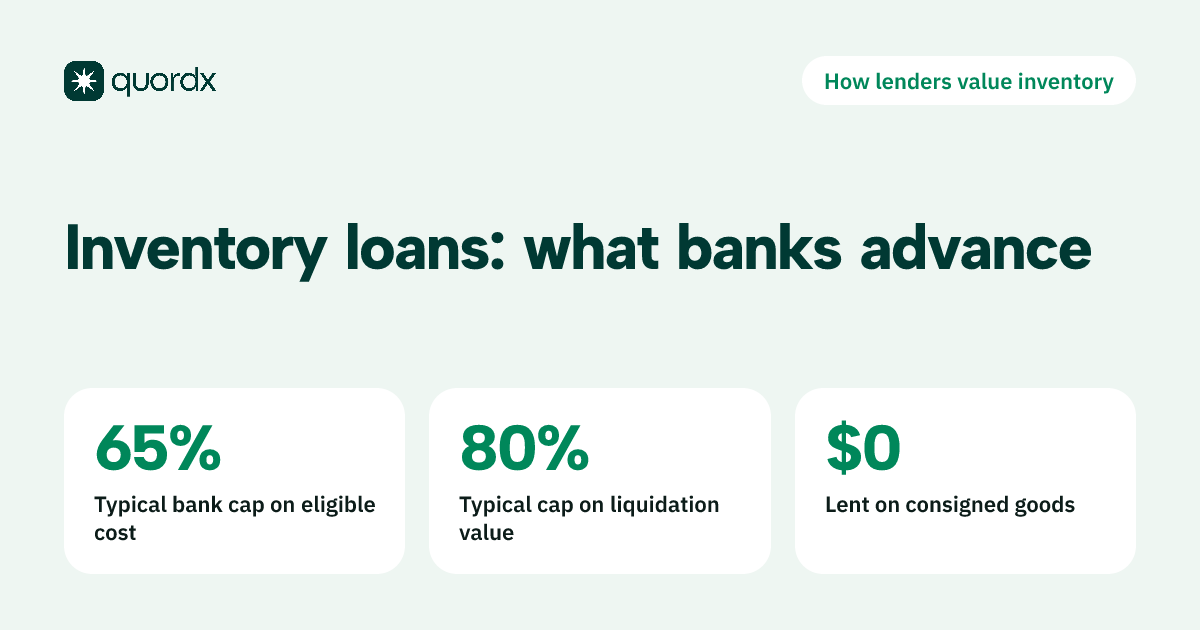
Inventory gets a lower advance than receivables: The bank regulator's examiner handbook puts it plainly: a receivable only needs collecting, while a product may need finishing and must still be sold and paid for. It adds that a bank typically advances up to 65% of the book value of eligible inventory, or 80% of the NOLV (OCC, Asset-Based Lending). Those are regulator benchmarks for banks, not a quote; non-bank lenders and individual deals differ.
What counts as eligible inventory
- Finished goods and commodity-like raw materials usually get the highest advance, because they are easiest to sell. Goods with an established market beat specialized or perishable goods.
- Specialized raw materials can have only nominal resale value. The handbook contrasts iron ore, which is easy to resell, with specialty paint pigments, which are not.
- Work in process is often excluded, because it needs more production before anyone will buy it.
- Old or obsolete stock is excluded by age or another obsolescence test, which matters most in fashion-sensitive goods.
- Location matters. A lender may count stock at one site and not another, and may advance less on goods spread across many locations.
- Consigned goods are ineligible, because someone else owns them.
- Supplier liens can come first. In some industries and states a supplier can hold a purchase money security interest in the goods it sold you, with priority over the lender.
Worked example: what $500,000 of inventory supports
The NOLV rates below are hypothetical, chosen to show the method. Say the loan agreement advances the lower of 65% of eligible cost or 80% of NOLV, using the regulator's benchmarks as the example terms.
| Inventory | Cost on your books | Eligible cost | Example NOLV rate | NOLV |
|---|---|---|---|---|
| Finished goods, current | $290,000 | $290,000 | 55% | $159,500 |
| Finished goods over 12 months old | $40,000 | $0 | excluded | $0 |
| Raw materials | $90,000 | $90,000 | 35% | $31,500 |
| Work in process | $50,000 | $0 | excluded | $0 |
| Consigned goods you hold | $30,000 | $0 | excluded | $0 |
| Total | $500,000 | $380,000 | $191,000 |
The math: 65% of $380,000 of eligible cost is $247,000. 80% of $191,000 of NOLV is $152,800. The lower figure wins, so you can borrow up to $152,800, about 31% of the $500,000 on your balance sheet.
The fastest way to raise that number is to shrink the excluded rows: Clearing aged stock, finishing work in process before the appraisal, and keeping consigned goods out of your counts all raise eligible inventory without buying anything new.
Turnover: the number lenders check first
Inventory turnover is cost of sales divided by average inventory, and inventory days are 365 divided by turnover (OCC). A business with $1,200,000 of cost of goods sold and $300,000 of average inventory turns its stock 4 times a year, or about every 91 days. Rising inventory days, or days well above your industry's norm, tell a lender your goods are getting harder to sell.
See what you could qualify for
Four answers about your business. No credit pull.
Floor plan financing: how dealer inventory lines work
Floor plan lending is inventory financing for a dealer in which each advance is made against one specific item, and that advance is repaid when the item sells (OCC, Floor Plan Lending). The regulator's list of commonly financed goods includes cars, trucks, RVs, boats, construction and farm equipment, manufactured homes and large appliances.
Curtailments are the cost most dealers underestimate: A floor plan agreement normally requires a set principal paydown on any unit that has not sold within a set time, so stale stock starts pulling cash out of the business. Many facilities also include a manufacturer agreement to buy back unsold units within set limits.
Floor checks and sold out of trust: Lenders inspect the lot, sometimes without notice, to confirm every financed unit is there or has been paid off. A dealer sells out of trust when it sells a unit and does not immediately send the money to the lender, which the handbook treats as a serious sign of cash trouble.
A curtailment example
In one sample case in the OCC handbook, a boat dealer's line advanced 100% of invoice on new units and 95% of wholesale value on used units, with a 10% monthly curtailment on used units after six months. Apply those terms to a hypothetical used unit worth $40,000 wholesale: the advance is $38,000. If the unit sells at the end of month eight, you will have paid two curtailments of $3,800, or $7,600 of your own cash, plus interest every month it sat.
Asset-based lines: borrowing against inventory and receivables together
An asset-based line sets your borrowing limit from a borrowing base, usually eligible receivables plus eligible inventory, and you report on both regularly. The regulator notes that ABL gives seasonal and cyclical businesses liquidity during slow periods and inventory buildups, and that it is often more expensive than other commercial lending, with higher rates and fees and the cost of monitoring (OCC).
Receivables usually carry the base: An ABL borrowing base is usually weighted toward receivables, and agreements may cap how much inventory can count. Lenders treat a base that shifts from receivables toward inventory as a warning sign, so a business whose stock is piling up while sales slow will see its line tighten.
For how these facilities are structured, including field exams and cash control, see what asset-based lending is.
How to get inventory financing, step by step
- Size the gap. Work out how much stock you need, when you pay the supplier, and how many days until it sells and the cash comes back. That is the amount and the term you are financing.
- Match the product to the turn. If the goods sell in 90 days, do not finance them over five years, and do not fund slow-turning stock with a product that takes daily payments.
- Clean up your inventory records. Lenders want counts that tie to your books, an aging by item, and ideally a perpetual inventory system. Do a physical count before you apply.
- Search your own liens. Pull a UCC search on your business. A bank or cash advance provider with a blanket lien, or a supplier with a purchase money interest, has to agree before a new lender can take the inventory.
- Gather the file. Expect financial statements, recent bank statements, inventory reports, and receivables and payables agings. SBA's Working Capital Pilot, for example, asks for timely financial statements, agings and inventory reports.
- Plan for an appraisal and field exam on any inventory-secured line, and ask up front who pays for them and how often they repeat.
- Compare offers on availability, not the headline limit. A $500,000 line that only lets you draw $150,000 against your actual stock is a $150,000 line.
Which inventory financing fits your business
If you need under about $50,000 for a first buy: look at an SBA microloan or supplier terms before anything secured by the stock.
If you restock on a cycle and have a year or more of steady deposits: a line of credit sized to revenue is usually simpler than an inventory-secured line; see business line of credit and seasonal working capital.
If you sell titled units off a lot: start with your manufacturer's finance program or a bank floor plan group.
If you carry a large stock and can report on it monthly: an asset-based line or SBA Working Capital Pilot gives the most room, at the price of reporting and exams.
If your stock is mostly custom, perishable or in process: inventory lenders will discount it heavily. Fund it from revenue-based credit instead, or finance the receivables once the goods are sold.
Inventory financing mistakes that shrink what you can borrow
- Expecting to borrow against cost. Lenders lend on liquidation value. Plan your purchase around the example above, not your balance sheet.
- Letting aged stock pile up. Old units drop out of the borrowing base and, on a floor plan, trigger curtailments.
- Mixing consigned goods into your counts. They are not yours, and a lender that finds them will question everything else in the report.
- Missing reporting deadlines. On an asset-based line or a monitored SBA line, late reports can freeze availability.
- Selling a floor-planned unit without paying it off. That is selling out of trust. It leaves the lender partly unsecured, so expect a fast and serious response.
- Stacking a daily-payment advance on top of an inventory line. It drains the cash that is supposed to rebuild your stock, and it can breach the line's terms.
Where Quordx fits for inventory financing
Quordx is a broker, and its lender panel has no inventory lenders, floor plan providers or asset-based lenders today, so it cannot place an inventory-secured line or a dealer floor plan. For a floor plan, start with your manufacturer's captive finance program or a bank with a dealer floor plan group. For an inventory or asset-based line, talk to a bank with an asset-based lending group or a non-bank ABL lender, and for SBA's Seasonal CAPLine or Working Capital Pilot, an SBA lender.
What Quordx can place is credit sized to your revenue that you then spend on stock: term loans, lines of credit and working capital advances, generally for businesses with about a year of steady deposits. If you sell to other businesses on terms, its panel also includes factors, which turn the invoices your inventory becomes into cash. The application takes about 10 minutes, Quordx is paid by the lender only if a deal funds, and Quordx does not serve businesses in Virginia, Connecticut, Missouri or North Dakota.
Questions Business Owners Ask Before Applying
How much can I borrow against my inventory?
Usually a share of its net orderly liquidation value, not its cost. The OCC's examiner handbook says a bank typically advances up to 65% of eligible book value or 80% of NOLV, and work in process, aged stock and consigned goods are often excluded. In our example, $500,000 of inventory supported $152,800.
Can I use a regular business loan to buy inventory?
Yes. A term loan, line of credit or SBA microloan can be spent on stock, and the amount is set by your revenue and credit rather than an appraisal. That is often the simplest route for smaller or one-off buys, as long as the repayment schedule fits how fast the goods sell.
What is a floor plan curtailment?
A required principal paydown on a floor-planned unit that has not sold within a set time. It keeps the loan balance in line with the unit's falling value, and it comes out of your cash until the unit sells.
Can a new business get inventory financing?
Inventory-secured lenders want a record of turning stock and reliable inventory reports, which a new business rarely has. Newer businesses usually start with supplier terms, an SBA microloan, or purchase order financing on a firm order, then move to an inventory line once they have history.
What is the difference between inventory financing and purchase order financing?
Inventory financing funds stock you hold or plan to hold for general demand, sized to the stock's value or your revenue. Purchase order financing funds one confirmed customer order, paying the supplier and getting repaid from that customer's payment.
Does my existing bank loan affect inventory financing?
It can. If your bank holds a blanket lien on business assets, it usually has first claim on your inventory, and a new lender will need the bank to subordinate or be paid off. Check your loan agreement before you apply elsewhere, because pledging the same stock twice can put you in default.
Apply for Funding
No obligation · Initial inquiry doesn't impact credit · Takes about 10 minutes
Sources
- Office of the Comptroller of the Currency: Comptroller's Handbook, Asset-Based Lending (version 1.1, January 2017)
- Office of the Comptroller of the Currency: Comptroller's Handbook, Floor Plan Lending (version 1.2)
- U.S. Small Business Administration: Types of 7(a) loans (CAPLines, Working Capital Pilot)
- U.S. Small Business Administration: Microloans

Written by
Cody Dreis
Founder, Quordx Capital
Read full bio
Related articles
Quordx Capital is a business funding broker, not a lender. Lenders make every credit decision and set the rate, fees and terms, and not every business qualifies. Quordx may be paid by a lender when a deal funds. Full disclosures