

Is it hard for an LLC to get a loan?
No, being an LLC doesn't make a loan harder to get, and it doesn't make one easier either. Lenders decide on the business inside the LLC: how long it has operated, what its deposits and tax returns show, and how its owners handle credit. Where LLC owners do hit walls, it's usually because they expected the entity to do something it can't, like add time in business, replace their personal credit, or keep their name off the loan.
The short version: An LLC changes who borrows and what paperwork you hand over, not the credit decision. Forming one doesn't restart your business history, but you have to document that history yourself. A single-member LLC files taxes like a sole proprietor, so the lender reads your Schedule C. And on most small business loans, every significant owner still signs a personal guarantee.
Part of our guide to Business Loans.
Last updated · Reviewed by Cody Dreis
50+ Lenders|Funding in as little as 24 hours
What an LLC changes for a lender, and what it doesn't
An LLC is a legal wrapper. It decides whose name is on the note and which assets a creditor can normally reach. It doesn't create revenue, credit history or a track record, and those are what underwriting runs on.
| Question the lender asks | Does the LLC change the answer? | What actually decides it |
|---|---|---|
| Who is the borrower? | Yes | The LLC signs the note in its legal name |
| Can creditors reach the owners' personal assets? | Usually not for ordinary business debts | Any personal guarantee you sign reaches past the LLC |
| How long has the business operated? | No | Operating history you can document, not the filing date |
| Can the business repay? | No | Deposits, profit and existing debt payments |
| Do the owners have good credit? | No | Each guarantor's personal credit history |
| Which tax return does the lender read? | Yes, through the LLC's tax classification | Schedule C, a partnership return or a corporate return |
| What documents prove the business exists? | Yes | Articles of organization, operating agreement, EIN |
The one real advantage is clean records: An LLC pushes you to run money through an account in the business's name, and a separate account is what lets a lender read your revenue without sorting out your grocery bills. That helps, but you could get the same benefit as a sole proprietor with a dedicated business account.
The liability shield is real, with limits: SBA's guide to choosing a business structure says LLCs protect owners from personal liability in most instances. A loan you personally guarantee is the main exception a borrower creates on purpose.
Does forming an LLC reset your time in business?
Time in business is a test of the business, not the filing. A lender wants to know how long this operation has brought in revenue and paid its bills. Your state's online business search shows the date your LLC was formed, though, so if the business is older than the LLC, it's on you to prove it.
Worked example: Maria has run a bookkeeping practice as a sole proprietor since March 2021. She formed a single-member LLC in February 2026 and moved her business bank account into the LLC's name. When she applies in October 2026, the LLC is 8 months old, but the practice is 5 years and 7 months old.
What carries her history across is evidence that it's the same business: Schedule C returns for 2021 through 2025 for the same practice, statements from the old business account showing the same clients paying, and the new account picking up where the old one left off. Because a single-member LLC still reports on the owner's Schedule C, her 2026 return will look like the five before it. Lenders weigh this differently, so ask each one directly whether it counts the sole proprietorship years.
When the clock really does restart: a change of ownership
Buying an existing business into a new LLC is different. The business has history, but you don't have history running it. One of the largest US banks measures its two-year requirement under current ownership and says an applicant short of two years should look at SBA loans instead. Expect other lenders to ask the same question in their own way.
- If you converted your own sole proprietorship, apply with your full history and attach the older returns and statements without being asked.
- If you bought the business, apply with the seller's financials plus your own experience in the industry, and expect lenders to treat you as a newer owner.
- If the LLC and the business are both new, the honest answer is that options narrow. Our page on whether an LLC can get a loan without income covers what's left.
Estimate your funding
Answer a few questions about your business to see a likely range.
Personal guarantees on LLC loans
This is where the LLC disappoints people most. A personal guarantee is a separate promise, signed by you, to repay the business's loan if the business can't. The LLC shields you from the company's debts in general; the guarantee is your own debt, so the shield doesn't cover it.
On SBA loans the rule is written down: Under 13 CFR 120.160, anyone holding at least 20% of the business generally must guarantee the loan, and SBA or the lender can require guarantees from other people too. Outside SBA, each lender sets its own rule; one large bank, for example, requires a guarantee from anyone owning 20% or more.
For a multi-member LLC, read the ownership table before you apply: Each guarantor's credit gets pulled and each one signs, so a member with weak credit or no appetite for the risk can stall the deal. Settle who will sign before a lender asks.
We cover the mechanics in what a personal guarantee on a business loan means, the SBA version in are SBA loans personally guaranteed, and the narrow cases where lenders drop it in small business loans without a personal guarantee.
Single-member LLC loans: what the lender sees
For federal income tax, a single-member LLC owned by one person is a disregarded entity unless it elects otherwise. The IRS says its activity goes on the owner's own return, usually Schedule C, the same form a sole proprietor files.
So to an underwriter, a single-member LLC reads almost exactly like a sole proprietorship: The tax return is yours, the profit on it is your income, and your personal credit carries the file. What differs is that the bank account, contracts and loan documents are in the LLC's name.
Watch the ID numbers: The IRS says a disregarded LLC generally uses the owner's Social Security number or EIN for income tax reporting, even if the LLC has its own EIN for payroll or banking. That means the number on your tax return may not match the number on your bank account. It's normal, but give the lender both and make sure the business name lines up everywhere.
The trap specific to single-member LLCs is mixing money: With one owner, it's easy to pay personal bills from the LLC account or deposit business income into your personal one. Lenders read deposits; revenue that lands in a personal account is revenue they may not count.
How LLC tax treatment changes what lenders read
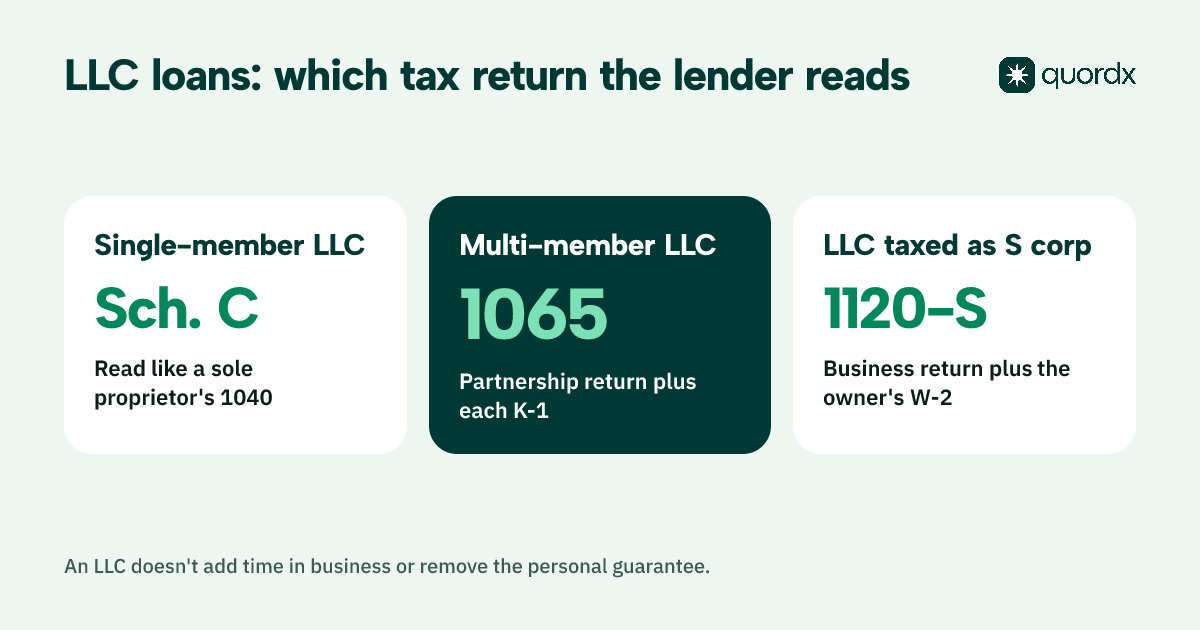
The IRS has no tax category called LLC. Per its LLC guidance, an LLC is taxed as part of the owner's return, as a partnership, or as a corporation, depending on how many members it has and what it elects. Each path hands the lender a different set of documents.
| How the LLC is taxed | Return the lender reads | What to watch |
|---|---|---|
| One member, default (disregarded) | Owner's Form 1040 with Schedule C | The net profit also has to cover your household |
| Two or more members, default (partnership) | Form 1065 plus each member's Schedule K-1 | Lenders often want each guarantor's personal return too |
| Elected S corporation (Form 2553) | Form 1120-S, the K-1 and the owner's W-2 | Your salary is an expense, so lenders look at salary and profit together |
| Elected C corporation (Form 8832) | Form 1120 | Profit is taxed at the company level before anything reaches you |
Changing the election doesn't change the business: The IRS says a switch to corporation or S corporation status doesn't require a new EIN, and lenders still compare year over year. Expect questions if profit suddenly drops in the year you started paying yourself a W-2 salary, and have the answer ready.
How lenders turn these returns into a cash flow number, including add-backs, is covered in do lenders look at gross or net revenue.
When it really is hard for an LLC to get a loan
The LLC isn't the problem in any of these cases, but they come up often enough with LLCs to name them.
- The LLC is new and so is the business. No deposits and no returns leave a lender little to underwrite. Equipment financing and microloans are the usual starting points.
- Revenue runs through a personal account. The LLC exists on paper, but the money doesn't show up in its name.
- The operating agreement limits who can borrow. If it requires member consent for debt, the lender will want that consent in writing before closing.
- A member can't or won't guarantee. If that member holds 20% or more, an SBA loan can't move forward without them.
- An owner isn't a US citizen or national. Since March 1, 2026, every direct and indirect owner of an SBA 7(a) or 504 borrower must be a US citizen or US national whose principal residence is in the US. As of October 2026, an LLC with a green card holder as a member doesn't qualify for SBA, though other loans may still work.
If none of these apply and you're still getting declined, the reason is in the numbers, not the entity. Ask. Under Regulation B, a lender that turns down a business applicant has to tell you, and for businesses with gross revenue of $1 million or less you have a right to the specific reasons.
Where Quordx fits for an LLC
Quordx is a broker, not a lender, and on the lenders it works with, entity type is rarely the gate. The gates are revenue and history: cash-flow lenders it submits to generally start around $17,000 a month in deposits and usually want 12 months in business. Each lender decides how it counts that history, which is why your pre-LLC records are worth sending.
If your LLC is under that line, an application through Quordx isn't the right next step yet. For a small SBA loan, SBA Lender Match connects you with SBA-approved lenders in your area. Over the line, one application of about 10 minutes goes to lenders whose criteria fit, and they make every decision. For the paperwork side, see how to get a business loan with an LLC.
Questions Business Owners Ask Before Applying
Do banks lend to single-member LLCs?
Yes. A single-member LLC is one of the most common small business borrowers. Because it usually reports on the owner's Schedule C, the bank underwrites it much like a sole proprietorship, with the owner's personal credit and a personal guarantee.
Does an LLC need its own credit history to get a loan?
Not for most small business loans, which lean on the owners' personal credit. A business credit file starts to matter when you want terms based on the company alone. Our page on small business loans with EIN only explains how to build one.
Can an LLC get a loan if one member has bad credit?
Sometimes. If that member owns less than 20%, a lender may not need their guarantee, though it can still ask. If they own 20% or more, their credit is part of the file on an SBA loan and on many others, so it can lower the offer or block it.
Should I form an LLC before applying for a business loan?
If you plan to form one, do it before you apply, not while a lender is underwriting, because the borrower's legal name goes on every document. If you need money soon and have solid history as a sole proprietor, you can apply as you are. The documents for each route are on our page about getting a business loan with an LLC.
Is it harder for a multi-member LLC to get a loan?
Not inherently, but there are more people to qualify. Each owner at or above the lender's guarantee threshold has their credit reviewed and signs, and the operating agreement has to show who can authorize the loan. One reluctant or weak-credit member can slow the whole application.
Apply for Funding
No obligation · Initial inquiry doesn't impact credit · Takes about 10 minutes
Sources

Written by
Cody Dreis
Founder, Quordx Capital
Read full bio
Related articles
Keep exploring business loans
Quordx Capital is a business funding broker, not a lender. Lenders make every credit decision and set the rate, fees and terms, and not every business qualifies. Quordx may be paid by a lender when a deal funds. Full disclosures