

Small business loans without a personal guarantee: when they are realistic
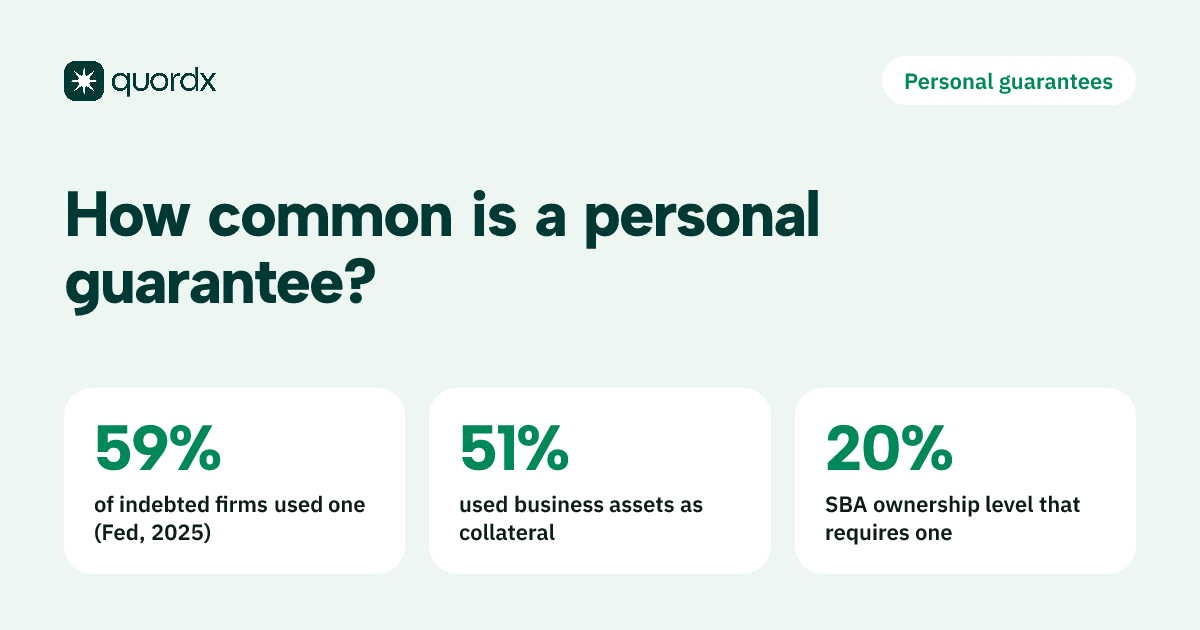
Most small business loans require a personal guarantee, and SBA loans require one from every owner who holds 20% or more of the business. Financing without a personal guarantee does exist, but it mostly goes to established companies with strong financials, or to deals where the lender can collect from an asset directly, such as invoice factoring, asset-based lines and some equipment financing. For everyone else, the realistic goal is usually a smaller guarantee rather than none: a cap on the dollar amount, a time limit, or a narrow validity guarantee that only applies if something was misrepresented.
The short version: If you own 20% or more and want an SBA loan, you will sign an unlimited personal guarantee. If you sell to other businesses on invoice terms, own equipment or receivables a lender can lend against, or have a few years of solid financials, ask about no-guarantee or limited-guarantee structures. And whatever you sign, negotiate the cap, the release terms and who has to sign before you close.
Part of our guide to Business Loans.
Last updated · Reviewed by Cody Dreis
50+ Lenders|Funding in as little as 24 hours
Do small business loans require a personal guarantee?
Usually, yes: In the Federal Reserve's 2025 Small Business Credit Survey, 59% of firms with debt said they used a personal guarantee to secure it, and 51% used business assets. Some used both, since the two figures add up to more than 100%. That leaves a real share of indebted firms that did not sign one, though the survey doesn't break out which products they used.
Why lenders ask: An LLC or corporation limits your personal liability for the company's debts. A personal guarantee is a separate contract that sets that protection aside for one loan: if the business doesn't pay, the lender can come after you. For a small company that depends heavily on one or two owners, the guarantee ties the owners' own finances to the loan being repaid.
What that means for you: Asking a lender to drop the guarantee is asking it to take more risk for the same price. You get further by offering something else that reduces its risk, which is what every no-guarantee structure below has in common. For the basics of what you are signing, see what a personal guarantee on a business loan is.
The SBA personal guarantee rule for 20% owners
The rule is in federal regulation: Under 13 CFR 120.160(a), holders of at least a 20% ownership interest generally must guarantee an SBA loan. SBA or a delegated lender may also require other people or entities to give full or limited guarantees, regardless of how much they own.
The guarantee is unlimited: SBA's Form 148 states that owners of 20% or more must provide an unlimited personal guaranty. Owners below 20% may provide a limited or full guaranty using Form 148L, where the lender spells out the limit.
Worked example: three partners own 45%, 40% and 15% of a company applying for a 7(a) loan. The 45% and 40% owners each sign an unlimited guarantee. The 15% owner isn't automatically required to, but the lender can still ask for a full or limited guarantee if it decides the credit needs it.
Restructuring ownership won't get you around it: Because the lender can require a guarantee from anyone it considers necessary, splitting ownership so no one crosses 20% doesn't reliably remove the requirement. If avoiding a guarantee is the priority, SBA is the wrong product. Our page on whether SBA loans are personally guaranteed covers the SBA side in more depth.
Estimate your funding
Answer a few questions about your business to see a likely range.
When a business loan without a personal guarantee is realistic
A lender drops or shrinks the guarantee when something else covers its risk. These are the situations where that happens, and what usually takes the guarantee's place.
| Situation | Why the lender may not need a full guarantee | What usually replaces it |
|---|---|---|
| Larger, established company | Years of financial statements and a balance sheet that can carry the debt on its own | Financial covenants, business assets, reporting requirements |
| Asset-based line of credit | The lender lends against a borrowing base of receivables and inventory it monitors | A lien on those assets, regular collateral reports, sometimes a validity guarantee |
| Invoice factoring | The factor buys your invoices and collects from your customers, whose credit it underwrites | Ownership of the invoices, sometimes with a validity guarantee instead of a full one |
| Equipment financing | The equipment itself secures the loan and can be repossessed and resold | A lien on the equipment; some lenders still ask for a guarantee |
| Cash-secured loan or line | A deposit or CD held by the lender covers the balance | The pledged deposit |
Larger established companies
The guarantee matters less to a lender when the business, not the owner, is clearly able to repay. Companies with several years of clean financial statements, meaningful equity and steady cash flow are the ones most likely to negotiate it away, usually in exchange for financial covenants the business has to keep meeting. A young company with thin financials will rarely get that conversation.
Asset-based lending
An asset-based line advances against a borrowing base, a set share of your eligible receivables and inventory that the lender recalculates as your balances change. Because the lender is watching collateral it can collect, it may accept a narrower guarantee than a cash-flow lender would. Expect more reporting in return. Our guide to asset-based lending explains how the borrowing base works.
Invoice factoring: validity guarantees vs full guarantees
In factoring, you sell your invoices and the factor collects from your customers, so the factor cares most about whether your customers pay and whether the invoices are real. That is why a factoring agreement may use a validity guarantee instead of a full one, particularly when the business has several owners or a corporate parent. eCapital, a factoring company, describes a validity guarantee as one that makes the signer liable for fraud or misrepresentation, but not for credit losses on a non-recourse facility.
In plain terms: if an invoice turns out to be fake, already paid or disputed because of something you did, you are on the hook. If your customer simply goes under on a non-recourse deal, you are not. On a recourse deal, you buy back unpaid invoices, so read which kind you are signing. See recourse vs non-recourse factoring for the difference.
Equipment financing
Equipment that holds its value and can be resold gives the lender a recovery path, which is why some equipment lenders will reduce or drop the guarantee for an established business. Others ask for one regardless. Ask the question directly at the quote stage, because it is easier to negotiate before you have committed to a lender. More in our equipment financing guide.
Limited vs unlimited personal guarantees
An unlimited guarantee covers everything the business owes on the loan if it defaults: the unpaid balance, interest and the lender's collection costs. A limited guarantee caps your exposure in a way the contract spells out. A validity guarantee is narrower still: it only applies if you broke specific promises, such as the accuracy of your invoices.
| Type | What you owe if the business defaults | Where you see it |
|---|---|---|
| Unlimited | The full shortfall, plus interest and collection costs | SBA loans for 20%+ owners; common on other bank and online loans |
| Limited by amount | Up to a stated dollar cap or share of the loan | Minority owners; negotiated deals |
| Limited by time | Applies for a set period, then ends if the loan is current | Some SBA 148L guarantees; negotiated deals |
| Validity guarantee | Nothing for ordinary non-payment; losses from fraud or misrepresentation | Factoring and asset-based lending |
Worked example: a business borrows $400,000 and defaults with $300,000 still owed. Under an unlimited guarantee, the owner can be pursued for the whole $300,000 plus costs. Under a guarantee capped at $100,000, the owner's exposure stops at $100,000. Under a validity guarantee with no fraud or misrepresentation, it is zero.
Watch the joint and several language: When several owners sign, a joint and several guarantee lets the lender pursue any one of them for the full shortfall, regardless of ownership share. If you own 25% and your partners can't pay, you could end up covering the rest.
How to negotiate a personal guarantee
Outside SBA loans, the guarantee is a term like any other, and lenders differ in how far they will move. These are the asks worth making.
- Ask for a cap. A guarantee limited to a dollar amount or a share of the original loan keeps your downside defined.
- Ask for a release trigger. For example, the guarantee ends after a set number of years of on-time payments, or once the balance falls below an agreed amount.
- Offer specific collateral instead. Pledging a particular asset in exchange for a smaller guarantee gives the lender a recovery path without reaching everything you own.
- Limit who signs. Ask whether minority owners can sign limited guarantees, or none at all.
- Keep your spouse off it if you qualify alone. Under the Equal Credit Opportunity Act's Regulation B, a lender can't require your spouse's signature if you meet its credit standards on your own.
- In factoring, ask for a validity-only guarantee and a non-recourse structure if your customers have strong credit.
- Get the final language reviewed by your attorney before closing, because the signed document controls, not the conversation.
Decision rule: if a lender won't move on any of these and the guarantee would put your home at risk for a loan the business doesn't strictly need, it is worth comparing offers from other lenders before you sign.
Can you get a business loan without a personal credit check?
This is a different question from the guarantee, and the honest answer is: rarely for a loan, more often for asset-backed products. A guarantee is about who pays if the business can't. A credit check is about how the lender decides whether to approve you, and most lenders look at the owner's personal credit for a small business, especially when the owner will be a guarantor.
SBA lenders, for example, may consider the credit history of guarantors: when they underwrite a 7(a) loan, per SBA's published terms. Where personal credit matters least is in products secured by something other than you: factoring, which underwrites your customers' ability to pay, and asset-based lending, which leans on collateral. Even there, ask whether the owners' credit will be pulled, because practices differ.
If your personal credit is the obstacle, our guide to small business loans with bad credit covers which products weigh it least.
Comparing guarantee terms across lenders
Guarantee terms vary by lender as much as rates do, and you only see them by getting real offers. Quordx is a broker, not a lender: one application of about 10 minutes reaches lenders in a network of 50+, and most options can be explored without a hard credit pull. Lenders decide whether to approve and what guarantee they require.
Quordx is free to the business owner; lenders pay Quordx when a deal funds. When offers come back, compare the guarantee language alongside the rate, because a slightly higher rate with a capped guarantee can be the better deal.
Questions Business Owners Ask Before Applying
Does my LLC protect me if I sign a personal guarantee?
Not for that loan. The LLC still shields you from the company's other debts, but the guarantee is a separate contract in which you personally promise to repay. If the business defaults, the lender can pursue your personal assets up to the limits of the guarantee.
Can I get an SBA loan without a personal guarantee?
Not if you own 20% or more of the business. SBA rules require those owners to sign an unlimited personal guarantee, and lenders can ask other people to guarantee too. If you can't accept a guarantee, look at factoring, asset-based lending or equipment financing instead.
Is a validity guarantee the same as a personal guarantee?
It is a narrow form of one. A validity guarantee makes you personally liable only for things like fraud or misrepresenting your invoices, not for ordinary non-payment by a customer on a non-recourse deal. Read the trigger language closely, because the wording varies by factor.
Can I get released from a personal guarantee later?
Only if the lender agrees or the contract includes a release trigger, such as a time limit or a balance threshold. Another way out is refinancing the debt with a lender that doesn't require one, or requires a smaller one. That is why it pays to negotiate release terms before you sign.
Does a personal guarantee show up on my personal credit report?
It depends on the lender and the product, since some lenders report business debt to the owner's personal credit file and others don't. Ask each lender how it reports, both while the loan is current and if it goes into default. Our page on whether a business loan affects personal credit covers how reporting works.
Apply for Funding
No obligation · Initial inquiry doesn't impact credit · Takes about 10 minutes
Sources
- 13 CFR 120.160: Loan conditions (personal guarantees of 20% owners)
- SBA Form 148: Unconditional Guarantee
- Federal Reserve Banks, 2026 Report on Employer Firms (2025 Small Business Credit Survey)
- CFPB Regulation B, 12 CFR 1002.7: signature of spouse or other person
- eCapital: What is a validity guarantee?

Written by
Cody Dreis
Founder, Quordx Capital
Read full bio
Related articles
Keep exploring business loans
Quordx Capital is a business funding broker, not a lender. Lenders make every credit decision and set the rate, fees and terms, and not every business qualifies. Quordx may be paid by a lender when a deal funds. Full disclosures