

Are SBA loans personally guaranteed?
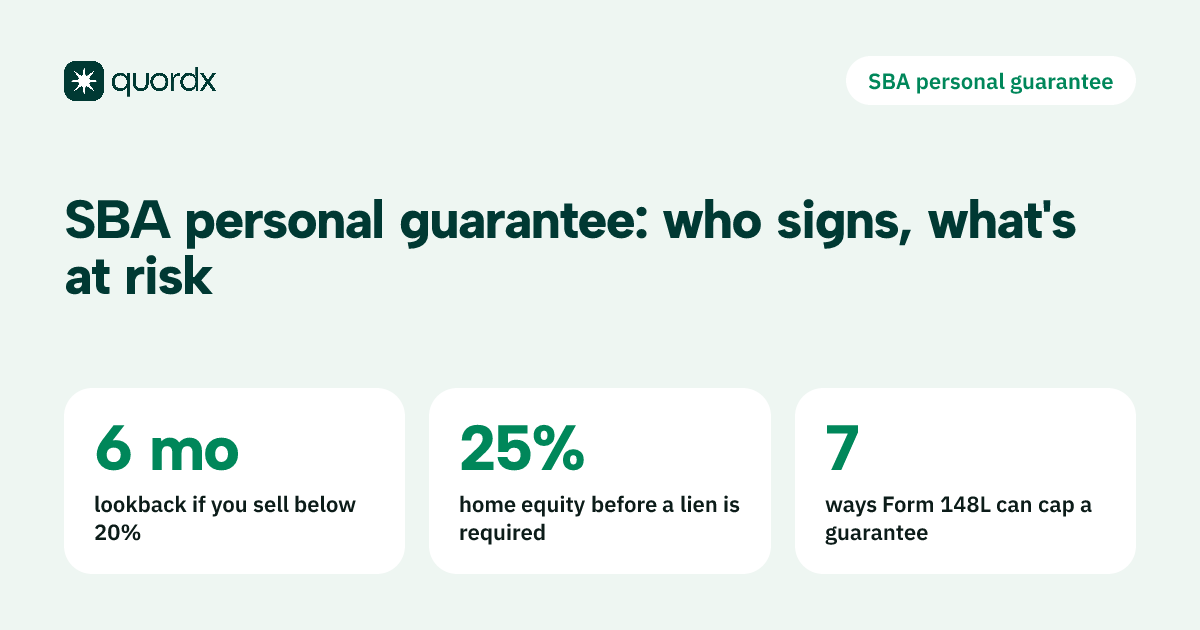
Yes. Every SBA 7(a) and 504 loan must be guaranteed by at least one person or entity, and anyone who owns 20% or more of the business, directly or through another company, must sign an unlimited personal guarantee. The lender can ask other people to guarantee too, regardless of how much they own, and on larger 7(a) loans it can also take a lien on your home if the business's own assets don't cover the loan.
The short version: If you own 20% or more, plan on signing SBA Form 148 (or the lender's version), which covers the whole loan until it's paid off. Owners under 20% sign only if the lender asks, and then it can be a limited guarantee on Form 148L. Spouses who together own 20% or more both sign in full. Ask about collateral on day one, because the guarantee and a lien on your house are two separate asks.
Part of our guide to Business Loans.
Last updated · Reviewed by Cody Dreis
50+ Lenders|Funding in as little as 24 hours
The SBA personal guarantee rule: 13 CFR 120.160(a)
The rule is short. Under 13 CFR 120.160(a), holders of at least a 20% ownership interest generally must guarantee the loan. SBA, or a lender with delegated authority, may also require other people or entities to give full or limited guarantees, whatever their ownership.
SBA's lending rulebook, SOP 50 10 8.1 (effective October 1, 2026), fills in the details: every loan needs at least one guarantor, and any individual with 20% or more, counting direct and indirect ownership, gives an unlimited full guaranty. Entities and trusts that own 20% or more guarantee too. If nobody reaches 20%, at least one owner must still sign a full guaranty.
This is not a lender preference: It is the same at Live Oak, Chase or a community bank. Shopping lenders can change your rate and collateral, but not the rule that 20% owners sign.
Who has to sign an SBA personal guarantee
| Who | Must they guarantee? | What they sign |
|---|---|---|
| Individual owning 20% or more, directly or indirectly | Yes | Unlimited guaranty (Form 148 or lender's version) |
| Owner under 20% | Only if the lender requires it | Full guaranty, or a limited one on Form 148L |
| Spouses whose combined stake (with minor children) is 20% or more | Yes, each spouse in full | Unlimited guaranty |
| Spouse who owns nothing | No guaranty of the loan, but signs collateral documents on jointly held property | A guaranty limited to their interest in that collateral |
| Company or trust owning 20% or more | Yes; for a trust, the person who set it up signs too | Unlimited guaranty |
| No one owns 20% | At least one owner | Full unconditional guaranty |
| Someone who sold down below 20% in the 6 months before applying | Yes, unless they fully exited the business | Same as when they held 20% |
Example: ownership through a holding company
Dana owns 40% of a holding company, and the holding company owns 60% of the business applying for the loan. Dana's indirect stake is 40% x 60% = 24%, so she signs an unlimited guarantee even though her name isn't on the applicant's ownership list. Her partner, who owns the other 60% of the holding company, has a 36% indirect stake and signs too. The holding company itself owns 60%, so it signs an entity guarantee.
Example: trimming ownership right before applying
Raj owned 25% of a dental practice and transferred 10 points to his partner three months before the practice applied for a 7(a) loan. SBA's six-month lookback still treats him as a 20% owner, so he signs. The only way out is complete divestiture: giving up every share and any role in the business, including as an employee, for the life of the loan.
Example: no one owns 20%
Seven partners each own about 14% of an engineering firm. None of them hits the 20% line, but SBA requires at least one owner to give a full unconditional guarantee, and the lender can ask for more. Expect a conversation about which partners sign, not whether anyone does.
Run the numbers on your loan
Pick a product, set the amount and term, and see a typical payment.
SBA Form 148 vs Form 148L
Form 148 is the unlimited one: SBA's Form 148 says the guarantor unconditionally guarantees all amounts owing under the note, that it stays in effect until the note is paid in full, and that the lender doesn't have to seek payment from anyone else before demanding it from you. For 7(a) loans, lenders may use their own form instead, as long as it carries SBA's required language.
Form 148L is the limited one: It's for guarantors the lender chooses to cap, usually owners under 20%. The lender checks exactly one of seven limits on Form 148L:
- Balance reduction: the guarantee ends once the total owed drops below a set dollar amount, if the loan isn't in default.
- Principal reduction: the same, measured on principal only.
- Maximum liability: a flat dollar cap.
- Percentage: a set share of what's owed when the lender first makes demand, plus that share of later interest and costs.
- Time: the guarantee runs for a set number of years from the note date, and longer if the loan is in default at the end.
- Collateral or recourse: liability is limited to what the lender recovers from specific collateral you pledge.
- Community property or spousal interest: liability is limited to your community property or spousal interest in the pledged collateral.
Worked example: a 12% owner signs a 148L with a 12% percentage limit on a $900,000 loan. The business defaults and $640,000 is owed when the lender makes demand. Her exposure is 12% x $640,000 = $76,800, plus 12% of interest and costs that build up after that. Her partner with 88% signed Form 148 and owes the rest of the shortfall without a cap.
Read the waivers: Both forms waive a long list of defenses, to the extent the law allows. The lender can release other guarantors, settle with them, or release collateral without your consent, and that doesn't reduce what you owe. If you're one of several guarantors, assume you could be the one the lender calls first.
SBA personal guarantees and your spouse
Outside SBA lending, the Equal Credit Opportunity Act's Regulation B generally bars a lender from requiring your spouse's signature if you qualify on your own. It does let a lender require a spouse's signature where state law needs it to make pledged property available if you default.
SBA loans work differently. SBA's SOP says its programs qualify as special-purpose credit programs under that law, so lenders can consider a spouse's finances for eligibility and can get a spouse's signature when federal or state law requires it, to get a valid lien on collateral, or to protect SBA's and the lender's interests.
- Combined ownership counts. Luis owns 14% and his wife Ana owns 9%. Neither reaches 20% alone, but together they hold 23%, so each signs a full guarantee.
- A non-owner spouse signs the collateral documents. If the lender takes a lien on a home Marcus owns jointly with his wife, she signs the mortgage paperwork, and any guaranty from her is limited to her interest in that collateral.
- Recent transfers don't hide property. Real estate an owner moved to a non-owner spouse or minor children within six months before applying still counts as available collateral.
Collateral on top of the guarantee: can the SBA take your house?
The guarantee and collateral are separate. The guarantee makes you personally liable; collateral gives the lender a lien on specific property. On a Standard 7(a) (over $350,000), SBA expects the loan to be fully secured by the business's fixed assets as far as they go, valued with haircuts set in SBA's SOP:
| Asset | Counts toward fully secured at |
|---|---|
| Improved real estate | Up to 85% of market value |
| Unimproved land | Up to 50% of market value |
| New machinery and equipment | Up to 75% of price, minus prior liens |
| Used machinery and equipment | Up to 50% of net book value (80% with a liquidation appraisal), minus prior liens |
| Furniture and fixtures | Up to 10% of book or appraised value |
| Receivables and inventory, if the lender takes them | Up to 10% of current book value |
If there's a shortfall: the lender must take available equity in real estate owned by 20% owners and required guarantors, including homes and investment property, and must consider property they own jointly with a spouse. It doesn't have to when the equity is under 25% of the property's market value, and the lien can be capped at the amount of the shortfall.
Worked example: two owners borrow $1.2 million to buy a landscaping company with no real estate. Used equipment with a book value of $500,000 counts as $250,000, and $200,000 of receivables and inventory counts as $20,000. Business collateral totals $270,000, leaving a $930,000 shortfall.
- Owner A (70%): a home in his name worth $900,000 with a $540,000 mortgage. Equity is $360,000, or 40% of value, so the lender takes a lien on it.
- Owner B (30%): home worth $500,000 with a $400,000 mortgage. Equity is $100,000, or 20% of value, under the 25% line, so SBA doesn't require a lien. Both owners still sign unlimited guarantees.
Smaller loans are lighter: SBA doesn't require collateral on 7(a) Small or SBA Express loans of $50,000 or less. Above that, a 7(a) Small loan needs a first lien on what the loan buys, and a lien on all business fixed assets if half or more of the money is for working capital. The lender may take your home on these loans only under its own policy. SBA also bars lenders from declining a loan just because collateral is short.
One more requirement: if a Standard 7(a) loan isn't fully secured and the business depends on one owner, the lender must require life insurance on that owner for the amount of the shortfall.
What the guarantee means if the business can't pay
If the loan defaults, the lender can demand payment from you in writing and doesn't have to go after the business or the collateral first. For an unlimited guarantor, everything still owed under the note can be pursued against personal assets. A limited guarantor owes up to the cap they signed.
The LLC doesn't help here: Your company still shields you from its other debts, but the guarantee is your own contract. For what happens step by step, see what happens if you default on an SBA loan.
Can you get an SBA loan without a personal guarantee?
Not if you own 20% or more, and the six-month lookback stops anyone from trimming their stake just before applying. What you can still influence:
- Limited owners can ask for a 148L. If you own under 20% and the lender wants your guarantee, ask for a percentage, dollar cap or time limit instead of a full one.
- Collateral is negotiable at the margins. Bringing more business collateral shrinks the shortfall, which shrinks what the lender needs from your home.
- Pay it down. A 148L balance-reduction or principal-reduction option ends the guarantee once the loan falls below a set amount, if you're current.
- Choose a different product. If no personal guarantee is the priority, SBA is the wrong tool. Our guide to small business loans without a personal guarantee covers factoring, asset-based lines and other structures where a guarantee can shrink or disappear.
Decision rule: if the business needs long-term money at an SBA-capped rate and you can live with the guarantee, sign it with eyes open and negotiate collateral. If the guarantee would put your household at risk for money the business doesn't strictly need, look at a smaller loan or a product secured by the asset itself. For the basics of guarantees on any loan, see what a personal guarantee is.
Where Quordx fits on an SBA loan
Quordx is a broker, not a lender. For SBA, it can submit 7(a) requests of roughly $400,000 and up to an SBA lender it works with, and the guarantee rules above apply there exactly as they do anywhere else. It can't place smaller 7(a), SBA Express, 504 or microloans; for those, SBA's Lender Match is the faster start, and our list of the best SBA lenders shows who lends at each size.
If the guarantee is the sticking point, Quordx can also show non-SBA options, such as invoice factoring for B2B companies and equipment financing, where the invoices or the equipment carry more of the risk. Guarantee terms still vary by lender, and the lender decides. Lenders pay Quordx when a deal funds.
Questions Business Owners Ask Before Applying
Do all owners have to sign an SBA personal guarantee?
Everyone with 20% or more, counting ownership held through other companies, must sign an unlimited guarantee. Owners under 20% sign only if the lender asks. If no one reaches 20%, at least one owner must still give a full guarantee.
Does my spouse have to sign my SBA loan?
If your spouse owns part of the business and your combined stake is 20% or more, both of you sign full guarantees. A spouse who owns nothing signs documents for liens on jointly held property, with liability limited to their interest in that property. SBA loans are special-purpose credit programs, so the usual Regulation B limits on spouse signatures work differently.
Is the SBA personal guarantee unlimited?
For 20% owners, yes: Form 148 covers all amounts owed under the note until it's paid in full. Smaller owners the lender chooses to cap can sign Form 148L with a dollar, percentage, time or collateral limit.
Will the SBA take my house if I default?
Only if the lender took a lien on it. On a Standard 7(a), a collateral shortfall requires a lien on available equity in personal real estate of 20% owners and guarantors, unless equity is under 25% of the property's value. Even without a lien, an unlimited guarantor's personal assets can be pursued for the shortfall.
Can I sell my stake below 20% to avoid the guarantee?
Not just before applying. SBA's six-month lookback keeps the guarantee requirement on anyone who held 20% or more in the six months before the application, unless they fully exit the business and any role in it for the life of the loan.
Apply for Funding
No obligation · Initial inquiry doesn't impact credit · Takes about 10 minutes
Sources

Written by
Cody Dreis
Founder, Quordx Capital
Read full bio
Related articles
Keep exploring business loans
Quordx Capital is a business funding broker, not a lender. Lenders make every credit decision and set the rate, fees and terms, and not every business qualifies. Quordx may be paid by a lender when a deal funds. Full disclosures