

How to use an SBA loan to buy a business
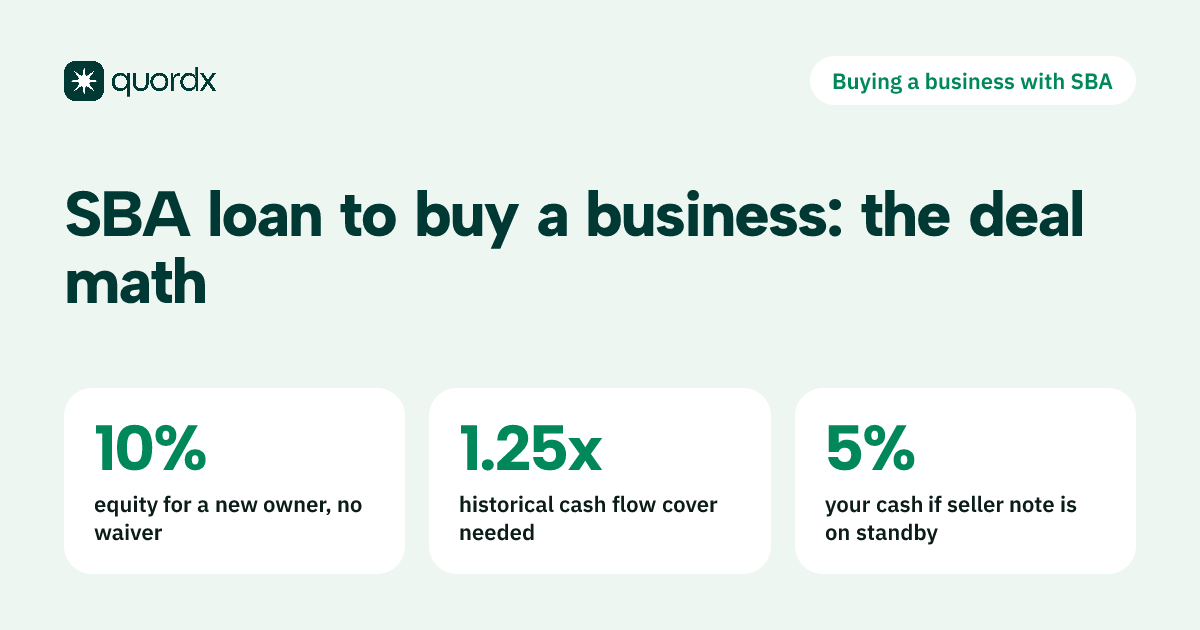
You use an SBA 7(a) loan to buy a business by putting in at least 10% of the total project cost, financing the rest over no more than 10 years, and showing that the business's own historical cash flow covers every debt payment at least 1.25 times. Under SBA's rulebook in force since October 1, 2026 (SOP 50 10 8.1), a seller note can supply up to half of your 10%, but only if the seller takes no payments of principal or interest for the life of the SBA loan. The lender, not the seller, orders the business valuation, and anything you pay above the appraised value comes out of your pocket.
The short version: Budget for 10% of the purchase price plus working capital and closing costs, with at least 5% from your own unborrowed cash or a gift. Ask the seller early whether they'll accept a fully deferred note or want payments, because that choice changes both your cash and your coverage. And take your deal's last full year of EBITDA, divide it by the new loan payment plus any seller payments, and make sure the answer is 1.25 or higher before you sign a letter of intent.
Part of our guide to Business Loans.
Last updated · Reviewed by Cody Dreis
50+ Lenders|Funding in as little as 24 hours
SBA rules for buying a business in 2026
SBA calls an acquisition a change of ownership, and SOP 50 10 8.1 sorts every one into four types. The type sets your minimum equity and the cash flow test, so find yours first.
| Type | What it is | Minimum equity | Can the lender waive it? | Cash flow test |
|---|---|---|---|---|
| Initial Acquisition | A new majority or largest owner buys the business (the default category) | 10% of total project cost | No | 1.25x |
| Business Expansion | A business with 2 full fiscal years under current owners buys another in the same 4-digit NAICS group | 10% | Yes, if liquidity is sufficient | 1.15x |
| Owner Buyout | Existing owners or 24-month employees buy out an owner, in full or in part | 10% of the purchase price | Yes, if liquidity is sufficient | 1.25x |
| ESOP or cooperative | Employees buy a controlling interest (51% or more) | None for an ESOP | Not applicable | 1.25x |
Some rules apply to every type: The business must be the borrower or a co-borrower, since a 7(a) loan can't go to an individual alone. Every owner of 20% or more after the sale personally guarantees the loan. Every owner, direct or indirect, must be a U.S. citizen or U.S. national living in the U.S., and the buyer and the business being bought must together fit SBA's size standard.
Cash flow means history, not your plan: The lender tests coverage on the last fiscal year or the average of the last two, using EBITDA against all debt payments after the deal. It must look at your projections but can't rely on them to pass the test. The one exception is a special-purpose property such as a hotel or self-storage site whose appraised value fully secures the loan.
How much down payment you need to buy a business with an SBA loan
For an Initial Acquisition, the 10% is figured on total project cost: purchase price plus working capital, closing costs and anything else needed to operate, whoever funds it. On a $1.3 million project that's $130,000, and SBA doesn't let the lender reduce it.
What counts as your equity
- Your cash, with no limit, as long as it isn't borrowed. Savings and a documented gift both work.
- A personal loan, but only if you can show it will be repaid from something other than the business's cash flow. Your salary from the business doesn't count.
- Grants with no repayment or clawback during the loan.
- Prepaid deal costs the lender verifies with paid invoices, including what you spent on the valuation or quality of earnings report.
- Limited sources, capped at half your required equity together: a seller note or other debt on full standby, and investors who own under 20% and have no control.
Fees you paid an agent or for education and advisory services don't count. Neither does money you plan to borrow against the business itself.
Decision rule: if your unlimited sources (unborrowed cash, gifts, a qualifying personal loan, grants) add up to less than 5% of total project cost, the deal doesn't work as an Initial Acquisition no matter what the seller offers, because limited sources can never cover more than half. Shrink the project, find more cash, or, if you already work in the business, look at a partial buyout. Our page on the SBA loan down payment covers injection for other loan types.
Run the numbers on your loan
Pick a product, set the amount and term, and see a typical payment.
Seller notes in an SBA acquisition
A seller note can do two different jobs, and the rules for each are strict.
As equity: the note must be subordinated to the lender and on full standby, meaning no principal or interest payments for the entire term of the SBA loan. Interest can accrue and be paid after the 7(a) loan is gone. In that form it can supply up to half of your 10%.
As regular debt: if the seller wants payments, the note isn't equity, so you need the full 10% from other sources. Its payments go into the cash flow test, and the SBA loan plus any seller debt that isn't on full standby can't exceed the business valuation. If the note is interest-only, the lender tests it as if it amortized over no more than 10 years.
- No earnouts. SBA bans seller earnouts, though a rebate to the buyer based on performance is allowed and must be applied to the loan balance.
- The seller leaves. In an Initial Acquisition or Business Expansion, the seller can't stay as an owner, officer or employee. They can consult for up to 24 months in total.
- Refinancing later. A seller note can be refinanced into SBA debt once it has been in place and current, not on standby, for 36 months.
Worked example: a $1.2 million business bought with an SBA 7(a) loan
Assumptions, all invented for the example: a buyer purchases a service company for $1,200,000 with no real estate. The lender's valuation supports the price. Adjusted EBITDA in the last fiscal year was $240,000, so the price is 5 times earnings in this example. The buyer adds $80,000 of working capital and $20,000 of closing and due diligence costs, for a total project of $1,300,000.
| A: seller note on full standby | B: seller note with payments | |
|---|---|---|
| Buyer's cash | $65,000 (5%) | $130,000 (10%) |
| Seller note | $65,000, no payments for 10 years | $200,000 at 6% over 5 years: $3,866.56 a month |
| SBA 7(a) loan | $1,170,000 | $970,000 |
| SBA payment, 10 years at the 10.00% cap | $15,461.64 a month | $12,818.62 a month |
| Total annual debt service | $185,540 | $200,222 |
| Coverage on $240,000 EBITDA | 1.29x: passes 1.25 | 1.20x: fails 1.25 |
| FY 2027 upfront SBA fee | $30,712.50 | $25,462.50 |
Read it this way: Scenario A asks the buyer for half the cash and passes the coverage test, but the seller waits a decade for their $65,000. Scenario B pays the seller sooner, needs twice the buyer cash, and fails, because the short seller note adds $46,399 a year of payments. To pass with B, the business would need about $250,278 of EBITDA, or the seller would have to stretch the note.
If the valuation comes in low: say at $1,100,000, the extra $100,000 of price has to be covered by equity. SBA lets more seller debt on full standby fill that gap; without it, the buyer's cash in Scenario A rises from $65,000 to $165,000. Renegotiating the price is the other option. In year one of Scenario A, interest on the SBA loan is about $113,770 and the balance falls to about $1,098,230.
Business valuation and due diligence for an SBA acquisition
The lender orders the valuation and can't use one prepared for you or the seller. Above a $350,000 business purchase price, it must come from an independent appraiser holding one of SBA's listed credentials (ASA, CBA, ABV, CVA or BCA). At $350,000 or less, the lender may value the business itself unless buyer and seller are closely related.
- Real estate is valued separately. Its appraised value comes out of the price before the business valuation threshold is applied.
- At $3 million or more, an Initial Acquisition or Business Expansion also needs a quality of earnings report with a cash proof that ties bank statements to the income statement and tax returns, and the lender must use its earnings in the coverage test.
- The seller's numbers get checked against the IRS. The lender verifies the financials behind the valuation against the seller's tax transcripts.
- Goodwill is financeable. A 7(a) loan can cover intangibles such as goodwill and customer lists, as long as the valuation supports them.
Before you sign a letter of intent: pull three years of the seller's tax returns and compare them to the profit the listing advertises. Large add-backs the returns don't show are where valuations fall short, and a shortfall becomes your equity.
Using an SBA loan for a partner buyout or partial change of ownership
An Owner Buyout lets existing owners, or employees who have worked in the business for at least 24 consecutive months, buy out another owner. The 10% equity is figured on the purchase price, and the lender may cut or waive it if the business has the liquidity to keep running and positive net worth.
In a partial change: at least one original owner stays on and guarantees the loan. Every new owner, even one getting 1%, must be a co-borrower. A selling owner who keeps under 20% gives a guarantee for at least two years after the final disbursement, and SBA doesn't require that person to pledge a home.
Outsiders have a ceiling: In any Owner Buyout, someone not employed by the business for 24 months can buy less than 50% and can't become the largest owner. A deal that breaks that line is underwritten as an Initial Acquisition, with its 10% equity that can't be waived and the full valuation rules. Structures that bring in a new owner by forming a new holding company over the business aren't eligible.
Loan terms, collateral and documents for a business purchase
The part of the loan that pays for the business, working capital and soft costs can't amortize over more than 10 years, and there's no balloon. If you're also buying the building, finance it as a separate loan up to 25 years, including through the 504 program, or blend the two terms by use of proceeds. A working capital line of credit can sit alongside the term loan.
Because acquisition loans follow Standard 7(a) collateral rules, the lender takes the business's assets and, if they fall short of the loan amount after SBA's discounts, a lien on owners' real estate with at least 25% equity. Are SBA loans personally guaranteed explains the haircuts.
- The signed purchase agreement with all schedules
- The seller's financial statements for three fiscal years plus interim statements, dated within 120 days
- A pro forma balance sheet for the business as of the transfer date
- Your personal financial statement (SBA Form 413 or the lender's version) and IRS Form 4506-C so the lender can pull tax transcripts
- Proof of your equity: bank statements, gift letters, a signed standby agreement for any seller note
- Any franchise agreement, if the business operates under a brand
The lender also must visit the business, or document a virtual check for an online business. How to finance a business acquisition compares SBA with other ways to fund a purchase.
Where Quordx can help with an acquisition loan
If your SBA request is roughly $400,000 or more, Quordx can submit it to an SBA lender it works with, and that lender runs the valuation, the 1.25 test and the equity check above and makes the decision. Quordx is a broker, not a lender, and the lender pays it if the loan funds.
For a purchase needing well under $400,000 of SBA financing, Quordx isn't the right route; SBA's Lender Match connects you with participating lenders, with a summary of interested ones two business days after you submit. Quordx does not serve Virginia, Connecticut, Missouri or North Dakota. If your deal is roughly $400,000 or more, start an application; it takes about 10 minutes.
Questions Business Owners Ask Before Applying
Can I buy a business with an SBA loan and no money down?
Not as a new owner. An Initial Acquisition needs 10% of total project cost, which the lender can't waive, and at least half of that must come from sources like your own unborrowed cash. Only Business Expansions and Owner Buyouts allow the lender to reduce or waive the equity.
How much can an SBA loan cover when buying a business?
A single 7(a) loan can be up to $5 million, and SBA's guarantee to one business and its affiliates is capped at $3.75 million. In practice the limit is the lower of what the valuation supports and what the historical cash flow covers at 1.25 times, after your 10% equity.
Can the seller stay on after an SBA acquisition?
In an Initial Acquisition or Business Expansion, not as an owner, officer or employee. The business can hire the seller as a consultant for up to 24 months in total. In a partial buyout, the selling owner may stay.
How long are SBA loans to buy a business?
Up to 10 years for the business itself, working capital and soft costs, fully amortizing with no balloon. Real estate bought in the same deal can go up to 25 years as a separate loan or a blended term.
Can I use SBA Express or a 7(a) Small loan to buy a business?
Yes, with the same coverage minimums and equity rules. The main difference is that the lender may value a business priced at $350,000 or less itself instead of hiring an outside appraiser. Express loans go up to $500,000 and 7(a) Small up to $350,000.
Do I need experience in the industry?
SBA's rules don't set an experience minimum, but the lender must describe your industry experience and management team and show you can run the business. A buyer with no related experience should expect closer questions about who will run the business day to day.
Apply for Funding
No obligation · Initial inquiry doesn't impact credit · Takes about 10 minutes
Sources

Written by
Cody Dreis
Founder, Quordx Capital
Read full bio
Related articles
Keep exploring business loans
Quordx Capital is a business funding broker, not a lender. Lenders make every credit decision and set the rate, fees and terms, and not every business qualifies. Quordx may be paid by a lender when a deal funds. Full disclosures