

Can you get a business loan to buy a franchise?
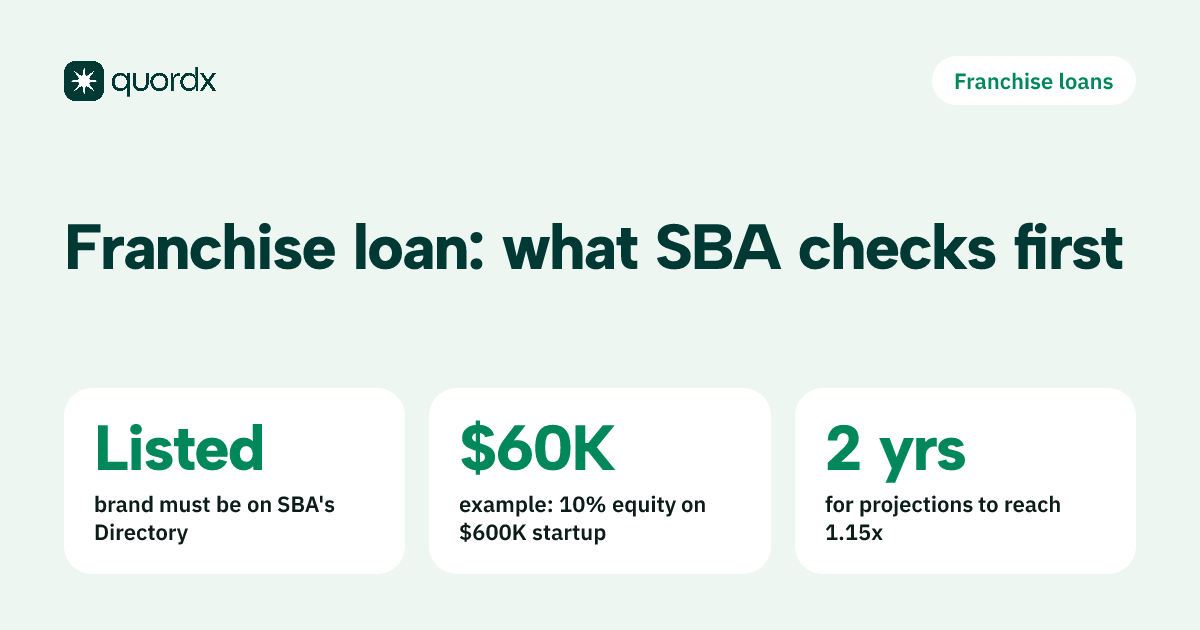
Yes. Most new franchisees use an SBA 7(a) loan, and the first thing the lender checks is whether your brand is listed on the SBA Franchise Directory, because if a brand that meets the FTC's definition of a franchise isn't listed, the lender can't approve or submit the loan. Because a new unit is a startup, SBA then requires you to put in at least 10% of the total project cost, and the lender underwrites on projections that must show your cash flow covering all debt payments at least 1.15 times within two years (1.10 within one year on a 7(a) loan of $350,000 or less).
The short version: Search the brand on SBA's Franchise Directory before you sign anything; the current list took effect October 9, 2026. Then build your budget from Item 7 of the franchise disclosure document, add a cash reserve, and plan on 10% of the total from your own money. Equipment can be financed separately, and the franchisor may offer financing in Item 10, but neither shrinks the 10% you owe on the whole project.
Part of our guide to Business Loans.
Last updated · Reviewed by Cody Dreis
50+ Lenders|Funding in as little as 24 hours
Check the SBA Franchise Directory first
SBA keeps the Franchise Directory, a downloadable list of brands it has reviewed and found eligible. Under SOP 50 10 8.1, in force since October 1, 2026, a brand that meets the FTC definition of a franchise must be on the list to get 7(a) or 504 financing, and the lender must check it before approving or sending the file to SBA. Listing isn't an endorsement and says nothing about whether the brand will succeed.
- Listed: the lender relies on the Directory and doesn't have to review the franchise documents for eligibility, though it still gets a signed copy of the agreement before disbursing.
- Not listed: the franchisor can send its agreement and disclosure document to franchise@sba.gov for review. SBA reviews brands in the order received, so build in time for the wait.
- Listed with a flag: some entries note extra items for the lender, such as reviewing a third-party management agreement.
Some structures are ineligible regardless: A master franchise or franchise development agreement, where your income is royalties from other people's units, is treated as passive and can't get SBA financing. An area development agreement, where you build and run your own units, can. And if the company managing your unit is the franchisor or its affiliate, the unit isn't eligible, because it isn't operating as an independent small business.
What lenders read in your franchise disclosure document
The FTC's Franchise Rule requires every franchisor to give you a disclosure document with numbered items. Four of them drive the loan.
| FDD item | What it shows | Why the lender cares |
|---|---|---|
| Item 7: Estimated Initial Investment | A table of every pre-opening cost, with amounts and when they're due | It's the starting point for your total project cost and your 10% |
| Item 10: Financing | Every financing arrangement the franchisor or its affiliates offer, and what each covers | Franchisor money can count against your need for SBA credit |
| Item 19: Financial performance | Sales or earnings figures, if the franchisor chooses to give them | Your projections should tie to it; the lender must review franchisor-provided projections |
| Item 20: Outlets and franchisee information | Units opened, transferred and closed over three years | SBA tells lenders to review the number of failed franchisees |
Decision rule: if Item 19 is blank, build your projections from local costs and comparable units you can verify, and expect the lender to test them hard. Projections that beat the franchisor's own numbers with no explanation are the fastest way to a decline.
Estimate your funding
Answer a few questions about your business to see a likely range.
Worked example: a $600,000 franchise startup budget
Assumptions, invented for the example: a quick-service unit in a leased space, with the line items a franchisor's Item 7 table might show. Your Item 7 will differ; use its numbers.
| Cost | Amount | Longest SBA term for this use |
|---|---|---|
| Initial franchise fee | $45,000 | Paid at signing in this example |
| Build-out (leasehold improvements) | $260,000 | 10 years, plus up to 12 months to finish the work |
| Equipment, furniture, signage | $140,000 | 10 years, or up to 15 if the IRS useful life supports it |
| Opening inventory | $20,000 | 10 years |
| Grand opening marketing | $15,000 | 10 years |
| Deposits, permits, training travel, professional fees | $25,000 | 10 years |
| Working capital reserve | $95,000 | 10 years |
| Total project cost | $600,000 |
- Equity: 10% of $600,000 is $60,000. If you paid the $45,000 fee at signing, ask the lender whether it counts as a verified prepaid expense; SBA lets those count toward injection when backed by paid invoices or bank statements. Then you'd bring $15,000 more in cash.
- Loan: $540,000 is a Standard 7(a). At SBA's 10.00% cap for loans over $350,000 (prime is 7.00% as of October 2026), a 10-year payment is $7,136.14 a month, or $85,633.68 a year.
- Fee: the FY 2027 upfront fee is 3% of the $405,000 guaranteed portion, or $12,150, per SBA Information Notice 5000-881797.
- Cash flow bar: your projections must show EBITDA of at least $98,479 a year within two years of funding (1.15 times the payment), more if you carry other business debt.
Don't cut the reserve to shrink the loan: The $95,000 line is what pays rent and payroll while sales ramp. A lender will ask how many months it covers, and SBA requires it to analyze your working capital for at least the next 12 months.
Franchisor financing: what to compare
Some franchisors finance part of the package, such as the fee, equipment or build-out, directly or through an affiliate, and Item 10 must list each arrangement and what it covers. Compare its rate, term, prepayment terms and default triggers with an SBA quote line by line.
It changes the SBA math in two ways: First, SBA lenders must certify that you can't get the credit elsewhere, and a franchisor's commitment to provide financial help counts as credit available elsewhere. Second, a franchisor note can count toward your 10% only if it's on full standby: no principal or interest payments for the whole life of the SBA loan, subordinated to the lender. A note with payments is just more debt in your coverage test.
Tell your SBA lender about any franchisor offer at the start, so the loan is sized with it in view.
Financing franchise equipment separately
You can fund the $140,000 of equipment with an equipment loan or lease and use SBA for the rest. That can make sense if the equipment lender moves faster or the franchisor has a preferred vendor program. See how equipment financing works for the mechanics.
Two catches: SBA's 10% applies to total project cost regardless of who funds each piece, so splitting doesn't lower your equity. And SBA bars piggyback structures: if another lender's loan for the same project is approved within 90 days and takes collateral the SBA loan has a junior position on, or none, the SBA lender can't make the loan that way. Get both lenders to agree on the collateral before you sign either.
What the split does to cash flow: using a hypothetical equipment rate: a $400,000 SBA loan at the 10.00% cap is $5,286.03 a month, and $140,000 of equipment over 5 years at a hypothetical 11% is $3,043.94. Together that's $99,960 a year against $85,634 for the single SBA loan, so the EBITDA you must project rises to about $114,954. Shorter equipment terms cost coverage.
Buying an existing franchise unit instead
Buying a unit that's already open is a change of ownership, not a startup. SBA's acquisition rules apply: 10% equity for a new owner that the lender can't waive, a business valuation the lender orders, and historical cash flow covering debt payments at least 1.25 times. The brand still has to be on the Directory, and the franchise agreement's transfer terms decide what the franchisor must sign off on.
Item 20 shows how many units changed hands, which tells you how active the resale market is. Our guide to using an SBA loan to buy a business walks through seller notes and a full deal example.
What else lenders look at for a franchise loan
- Your experience. The lender must describe your management experience and how you'll be involved in daily operations. If you plan to hire a manager, expect questions.
- Personal guarantees. Every owner of 20% or more guarantees the loan in full. See whether SBA loans are personally guaranteed.
- Ownership. All owners must be U.S. citizens or U.S. nationals whose principal residence is in the U.S.
- Collateral. On a 7(a) over $350,000 the lender takes available business assets and, if they fall short, equity in owners' real estate.
- The lease. The lender gets a copy, and for a 7(a) the lease term plus renewal options that only you can exercise should be at least as long as the loan.
For concept-specific budgets, see our pages on restaurant business loans and financing a gym or fitness studio.
Where Quordx fits in franchise financing
Quordx is a broker, not a lender. For a franchise startup, the useful part is narrow: it can send an SBA 7(a) request of roughly $400,000 or more to an SBA lender it works with, which decides whether it will finance your brand and your projections, and it can look for equipment financing for the kitchen, fitness gear or vehicles your concept needs.
It doesn't place franchisor financing programs, SBA 504 or Express loans, or 7(a) loans under roughly $400,000; for those, SBA's Lender Match is the better start. Its term loan and line of credit lenders generally want about a year of operating history, so they suit an existing franchisee adding a unit more than a first-time buyer. Quordx does not serve Virginia, Connecticut, Missouri or North Dakota; elsewhere, the application takes about 10 minutes, and the lender pays Quordx if a deal funds.
Questions Business Owners Ask Before Applying
Is the SBA Franchise Directory still required in 2026?
Yes. SOP 50 10 8.1 requires lenders to check it for any brand that meets the FTC definition of a franchise, and SBA's current list is effective October 9, 2026. If the brand isn't listed, the lender can't approve or submit the loan until SBA adds it.
How much money do I need to buy a franchise with an SBA loan?
At least 10% of the total project cost, meaning every cost to open, not just the franchise fee. On a $600,000 project that's $60,000, and verified prepaid costs such as a fee you already paid may count toward it if the lender accepts them.
What is a franchise business loan?
It's any loan used to open or buy a franchised unit: most often an SBA 7(a), sometimes with separate equipment financing or franchisor financing. Lenders look at the brand's record and your projections alongside your credit and experience, because a new unit has no history of its own.
Can a franchise use an SBA 504 loan?
Yes, if the project is a building, land or long-life equipment, and the brand is on the Directory. A 504 can't pay for working capital or inventory, so most new units pair it with a 7(a) or cash for those costs.
Can I get a franchise loan with no experience in the industry?
SBA sets no experience minimum, but the lender must assess your management background and who will run the unit daily. Franchisor training, a strong general management record or an experienced operating partner all give the lender more to work with.
Apply for Funding
No obligation · Initial inquiry doesn't impact credit · Takes about 10 minutes
Sources

Written by
Cody Dreis
Founder, Quordx Capital
Read full bio
Related articles
Keep exploring business loans
Quordx Capital is a business funding broker, not a lender. Lenders make every credit decision and set the rate, fees and terms, and not every business qualifies. Quordx may be paid by a lender when a deal funds. Full disclosures