

Small Business Loan With No Revenue: Options When Sales Drop or Stop
An existing business whose revenue has dropped or stopped can still get a small business loan, but rarely an unsecured one based on cash flow. What still works is borrowing against what the business owns or is owed: unpaid customer invoices, equipment, real estate, and the lender you already bank with. If the business has never had revenue at all, the lenders and the rules are different, and our guide to a startup business loan with no revenue covers that case.
The short version: Call your current lender before you miss a payment, not after. Then list what the business owns: receivables can be factored, paid-off equipment can be refinanced, and property equity can back a bridge loan. Don't take on daily-debit debt to cover losses with no end date, and if a declared disaster caused the drop, check SBA's disaster loans first.
Part of our guide to Business Loans.
Last updated · Reviewed by Cody Dreis
50+ Lenders|Funding in as little as 24 hours
Why a revenue drop closes the cash-flow door
Term loans, lines of credit and working capital advances are sized from your recent bank deposits. When those deposits fall, the loan you qualify for falls with them, and when they stop, a cash-flow lender has nothing to size a payment from. The trend matters as much as the total, because an underwriter reading six months of statements sees the direction you're heading. Our page on how lenders verify business revenue explains what they pull.
Example: the same business, read two ways
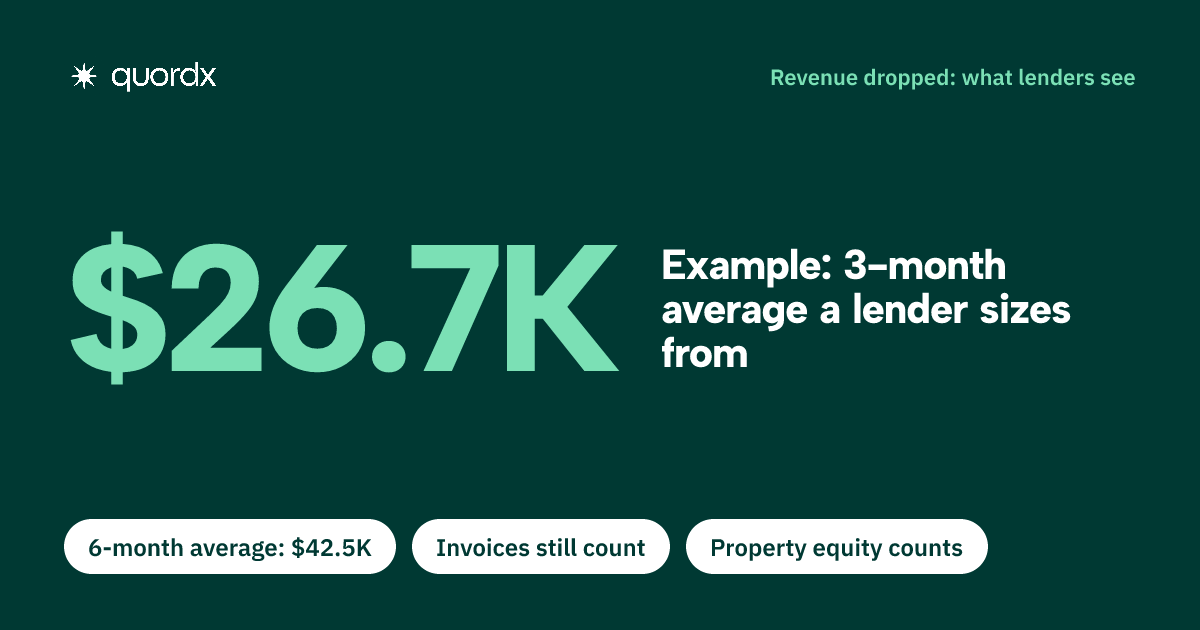
Take a contractor whose monthly deposits over the last six months were $60,000, $60,000, $55,000, $30,000, $25,000 and $25,000.
| Window a lender reads | Average monthly deposits | Payment at 10% of deposits (example) |
|---|---|---|
| Last 6 months | $42,500 | $4,250 |
| Last 3 months | $26,700 | $2,670 |
| Last month only | $25,000 | $2,500 |
What this means: the business that could have carried a $4,250 payment six months ago may now be sized at closer to $2,500, and some lenders will pass entirely until deposits stabilize. Decision rule: if your last three months are well below your six-month average, expect offers sized to the recent months, and apply with a written explanation of the drop and what changes it.
Start with the lender you already have
Your current lender knows your history and has more to lose from a default than a new lender has to gain from a loan. A lender that hears about the problem from you, with numbers and a plan, has options it loses once a payment bounces.
What to ask for
- A payment deferral for a set number of months, with the skipped payments added to the end.
- Interest-only payments for a period, so principal waits until revenue recovers.
- A longer term on the existing loan, which lowers the monthly payment.
- Access to your line of credit. Read the agreement first: some line agreements let the lender reduce or freeze the limit when your finances change, so draw what you need while it's open and only for a gap you can see the end of.
Bring a 13-week cash forecast: every dollar you expect in and out, week by week, plus the reason for the drop and the date you expect it to turn. That one document answers most of the questions a lender will ask. If you'd like help building it, SBA's resource partners, including Small Business Development Centers and SCORE mentors, offer counseling.
Estimate your funding
Answer a few questions about your business to see a likely range.
Asset-based routes: borrowing against what the business owns
When revenue can't carry the loan, an asset can. In the Federal Reserve's 2025 survey, 51% of small employer firms with debt had used business assets to secure it, so this is a normal way to borrow, not a last resort. The lender's question changes from "what do you earn" to "what is this worth if we have to collect."
| What you have | Route | What the lender looks at | Main risk |
|---|---|---|---|
| Unpaid invoices to other businesses | Invoice factoring or receivables financing | Your customers' credit and the invoices themselves | With recourse, you buy back invoices your customers don't pay |
| Equipment you own outright | Equipment refinance or sale-leaseback | Resale value, age and condition | You can lose equipment you need to operate |
| Commercial or investment property with equity | Bridge loan, hard money or cash-out refinance | Property value and how you'll repay or refinance | Short terms, higher cost, and the property is on the line |
| Inventory plus receivables in a larger business | Asset-based line of credit | Monthly borrowing base reports and field exams | The line shrinks as inventory and receivables shrink |
| Cash or certificates of deposit | Cash-secured loan | The deposit you pledge | Adds liquidity timing, not new capital |
| Equity in your home | Home equity line in your name | Your personal credit and home value | Your house now backs a business problem |
Example: factoring when sales are down but customers still owe you
A distributor's new orders have fallen by half, but it has $80,000 of open invoices to established customers due in 30 to 60 days. Say a factor offers $60,000 now, charges $2,400, and releases the remaining $17,600 when the customers pay (hypothetical terms, for the math only).
- Cash today: $60,000 against money already earned.
- Cost: $2,400 to receive that cash roughly six weeks early.
- Why it works with falling sales: the factor is underwriting your customers' ability to pay, not your sales trend. See how invoice factoring works.
Example: borrowing against a building with equity
A business owns its building, worth $800,000, with $300,000 left on the mortgage. Say a lender will go up to 65% of the value in total debt (an assumption for the example). That's $520,000, which leaves up to $220,000 of new money before costs.
The catch is the exit: Bridge and hard money loans run short and cost more than a bank mortgage, so you need a believable way out: a refinance once revenue recovers, or a sale. Our explainer on what a bridge loan is covers terms to check. For larger businesses with inventory, an asset-based line of credit works on the same idea with ongoing reporting.
If a disaster caused the drop: SBA economic injury loans
When the revenue loss comes from a declared disaster, SBA's Economic Injury Disaster Loan is built for exactly this. It's working capital for bills the business can't meet because of the disaster, such as rent, utilities and fixed debt payments, and it's available even without property damage.
- Who qualifies: small businesses physically located in the declared disaster area, directly affected, and unable to cover expenses or debt payments.
- What doesn't count: SBA says lost profits or a sales decline alone don't meet its test for substantial economic injury.
- Credit elsewhere: the loan is available only when SBA determines you can't get credit elsewhere.
- Terms SBA publishes: a fixed rate of no more than 4%, up to 30 years, and the first payment deferred 12 months with no interest building in that time. Combined physical and economic injury loans are capped at $2 million.
- Limits: collateral is required above $50,000, and the money can't refinance existing debt or expand the business.
For a disaster that just happened, our guide to emergency business funding covers what to do in the first 72 hours.
Should you borrow at all when revenue has dropped?
A loan doesn't fix a revenue problem. It buys time, and time is only worth paying for if something specific happens during it.
- Borrow to bridge a dip with a known end: a seasonal low, a large customer paying late, a signed contract that starts next quarter, an insurance claim in process.
- Don't borrow to cover losses with no end date. If the business loses $15,000 a month and nothing is scheduled to change, six months of borrowing is $90,000 of new debt plus the payments on it, still owed after the money is gone.
- Cut costs before you add debt. Every recurring expense you remove lowers the amount you need to borrow and the payment you have to make.
- Avoid daily-debit advances to cover a slump. A merchant cash advance pulls from your account every business day whether sales came in or not. If you're already in one, read what to do if you can't pay back a merchant cash advance.
Know what you're signing: In the same Fed survey, 59% of firms with debt had used a personal guarantee to secure it. A guarantee signed to rescue a struggling business follows you if the business closes.
Small business loans without revenue: the pre-revenue case
If you're asking because the business hasn't made its first sale yet, the answer above doesn't apply: you have no trend to explain and usually no assets to borrow against. Lenders underwrite the owner instead, through SBA microloans, CDFI loan funds, SBA 7(a) loans for startups and equipment financing.
Our startup business loan with no revenue guide walks through each route with the math, and our list of the best startup business loans for 2026 names specific lenders.
What Quordx can place when revenue has dropped
Quordx is a broker, not a lender, and whether it can help depends on what the business still has. The lender always makes the decision.
- Invoices to other businesses: factoring lenders that work with general B2B companies, including trucking, and construction subcontractors. They read your customers, so a sales dip matters less.
- Equipment: lenders for larger equipment deals, including some that weigh the story behind the numbers instead of a score alone.
- Real estate with equity: bridge, hard money and commercial real estate lenders, in some states.
- Cash-flow loans and lines: these generally need around $17,000 a month in revenue and usually 12 months in business, so a business below that today won't fit until deposits recover.
What Quordx can't do here: asset-based lines against inventory, inventory financing and purchase order financing aren't available through it, so go to a bank or a specialist lender directly. Quordx doesn't serve Virginia, Connecticut, Missouri or North Dakota. If you have receivables, equipment or property to work with, the application at apply.quordx.com takes about 10 minutes.
Questions Business Owners Ask Before Applying
Can I get a business loan if my revenue dropped this year?
Often yes, but smaller than before and usually priced off your recent months. Cash-flow lenders size the payment to current deposits, so a written explanation of the drop and a recovery plan help. Secured routes, like factoring or equipment and real estate loans, depend less on the sales trend.
What if my business revenue stopped completely?
Cash-flow lenders won't have anything to underwrite, so the options are your current lender, assets the business owns, and money still owed to you. If a declared disaster caused the stop, check SBA's Economic Injury Disaster Loan. If nothing is scheduled to restart revenue, cutting costs or winding down may be cheaper than new debt.
Can I factor invoices if my sales are down?
Yes, if you have unpaid invoices from creditworthy business customers. The factor's main question is whether those customers will pay, not how your sales are trending. Consumer sales and invoices already in dispute usually don't qualify.
Does a drop in sales qualify for an SBA disaster loan?
Not by itself. SBA says lost profits or a sales decline alone don't meet its substantial economic injury test; the business must be in a declared disaster area, directly affected, and unable to meet its obligations and operating expenses. SBA also has to determine you can't get credit elsewhere.
Should I take a merchant cash advance to get through a slow stretch?
Rarely. Daily or weekly debits keep coming out during the slow stretch itself, and the FTC has sued advance providers it alleged deducted undisclosed fees and kept withdrawing after customers paid in full. If you consider one, get the total repayment in writing and compare it to a secured option first.
Apply for Funding
No obligation · Initial inquiry doesn't impact credit · Takes about 10 minutes
Sources

Written by
Cody Dreis
Founder, Quordx Capital
Read full bio
Related articles
Keep exploring business loans
Quordx Capital is a business funding broker, not a lender. Lenders make every credit decision and set the rate, fees and terms, and not every business qualifies. Quordx may be paid by a lender when a deal funds. Full disclosures