

What are no-doc business loans? What they really are, what they cost, and the scams to avoid
No-doc business loans are low-documentation loans and advances: the lender skips tax returns, financial statements and a business plan, and decides mostly from a few months of business bank statements, your ID and a credit check. No legitimate lender funds with zero documents, because every one of them has to confirm who you are and that the money coming into your account is real. What you trade for the shorter file is price: higher cost, shorter terms and more frequent payments. A lender that wants to verify nothing at all is a warning sign, not a shortcut.
The short version: In business lending, 'no-doc' means 'bank statements instead of tax returns.' Expect the lender to read your deposits, balances and existing debt payments, and to price the money for everything it can't see. It fits short, specific needs that pay for themselves quickly. Walk away from anyone who wants a fee before you see an offer.
Part of our guide to Business Loans.
Last updated · Reviewed by Cody Dreis
50+ Lenders|Funding in as little as 24 hours
What 'no-doc' actually means in business lending
'No-doc' is a sales label, not a product. What sits behind it is a short file where your bank account does the talking instead of your accountant. The lender still reviews you. It just reviews different evidence, and less of it.
| What the lender asks for | Full-doc loan | Low-doc ('no-doc') loan |
|---|---|---|
| Business and personal tax returns | Yes | Usually not |
| Profit and loss statement, balance sheet | Yes | Usually not |
| Business plan or projections | Sometimes, for startups and SBA loans | No |
| Business bank statements | Yes, as one input | Yes, and they carry the decision |
| Credit check | Yes | Yes, sometimes soft first and hard later |
| Photo ID and proof the business exists | Yes | Yes |
| Typical products | Bank term loans, SBA 7(a), larger lines of credit | Working capital advances, short-term loans, some online lines of credit |
| Payment schedule | Usually monthly | Daily, weekly or monthly |
Low-doc is not low-scrutiny: The review moves from documents you prepare to records your bank produces, which are harder to dress up. An underwriter can read three months of statements in minutes and see things a tax return hides, like a funder pulling money out of your account every morning.
Skipping the tax return doesn't always mean skipping your taxes: Some lenders ask you to sign IRS Form 4506-C, which lets them pull a transcript of your return straight from the IRS through its Income Verification Express Service. The IRS only releases it with your consent, so you will know if it happens.
What bank-statement-only underwriting checks
When the statements are the application, the lender reads them for a short list of things. Knowing the list lets you see your file the way they will.
- Revenue you actually earned. Deposits minus transfers from your own accounts, proceeds from other loans or advances, and refunds. Lenders count sales, not every dollar that lands.
- Consistency. Whether deposits arrive steadily or swing hard from month to month, and how many separate deposits there are.
- Balances. Your average daily balance, and how low the account runs before the next deposit lands.
- Overdrafts and returned payments. Negative-balance days and NSF items tell the lender how close to the edge the business runs.
- Payments you already owe. Recurring debits to other lenders and funders. These show up on statements even when a funder doesn't report to a credit bureau.
- Where the money comes from. If one customer or one platform accounts for most deposits, the lender treats that as a concentration risk.
Outside the statements, expect an ID check, a credit pull, a look at your state business registration and often a lien search. For the full underwriter's view, see what lenders look for in bank statements and how lenders verify business revenue.
Worked example: what a no-doc lender actually counts
Say a landscaping company uploads three months of statements. This is a made-up file with round numbers, built to show the arithmetic.
| Month | Total deposits | Removed by the lender | Revenue counted |
|---|---|---|---|
| July | $68,000 | $8,000 transfer from the owner's savings | $60,000 |
| August | $52,000 | $15,000 from another funder's advance | $37,000 |
| September | $61,000 | None | $61,000 |
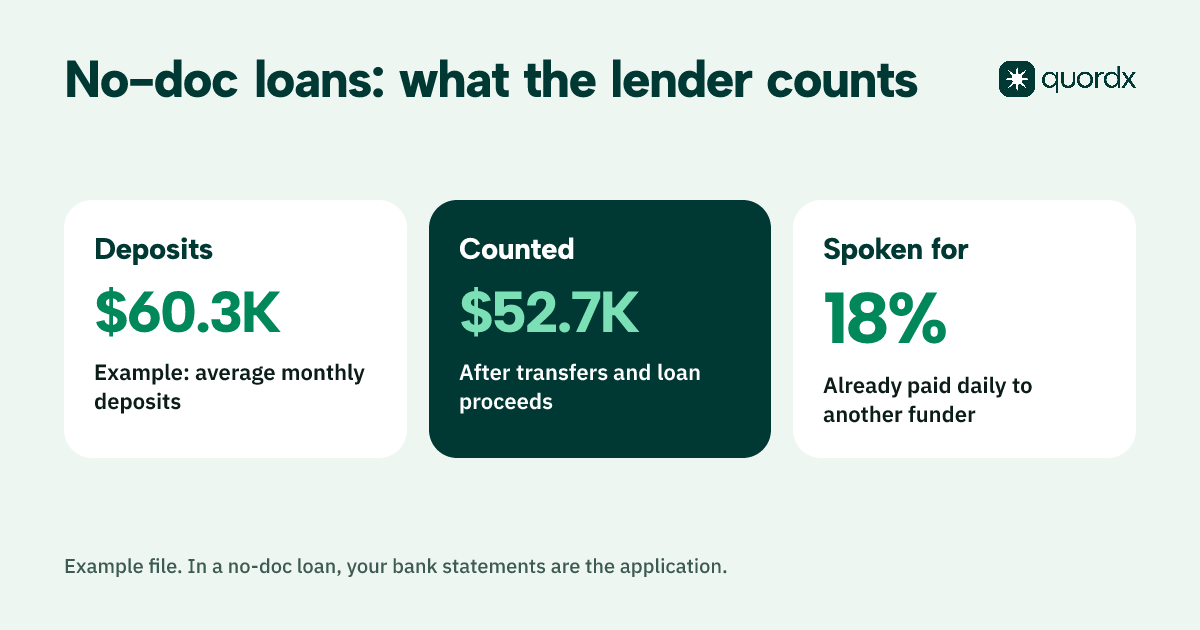
| Average | $60,333 | $52,667 |
The owner thinks of the business as a $60,000-a-month company. The lender sees $52,667. Then it spots a $450 daily debit to the funder from August. Across 21 business days that is $9,450 a month, about 18% of counted revenue already spoken for, and any new offer gets sized around it.
Estimate your funding
Answer a few questions about your business to see a likely range.
The trade-offs of no-doc business loans
You pay for the information the lender doesn't have: Less paperwork means more uncertainty, and lenders price uncertainty. Many low-doc products come from online lenders, and in the Federal Reserve's 2025 Small Business Credit Survey, 60% of firms that borrowed from online lenders said their actual borrowing costs were higher than expected. High interest rates and unfavorable repayment terms were the most common challenges borrowers reported with those lenders.
The price may not be quoted as an APR: Many low-doc products quote a factor rate or a fixed fee. That number looks small next to an annual rate, but it covers a much shorter term. Ask for total dollars repaid, and read what APR means on a business loan before you compare.
Terms are shorter and payments come more often: Daily or weekly debits from your account are common, which strains cash flow in a slow week. The amount you can get also tends to track what your deposits can support, not what you need.
A guarantee and a lien are still on the table: A short file doesn't mean light terms. Read the contract for a personal guarantee and a UCC lien on business assets before you sign.
Worked example: the price of skipping the paperwork
Two hypothetical ways to borrow $30,000. The rates are illustrations we chose to show the math, not market rates or quotes.
| Low-doc advance | Full-doc term loan | |
|---|---|---|
| Amount | $30,000 | $30,000 |
| Pricing (hypothetical) | 1.30 factor rate | 11% APR |
| Term | About 6 months (126 business days) | 36 months |
| Payment | About $309.52 per business day | $982.16 per month |
| Total repaid | $39,000 | $35,357.81 |
| Cost of the money | $9,000 | $5,357.81 |
The full-doc loan costs $3,642.19 less in dollars and gives you six times as long to pay. If pulling together two tax returns and a profit and loss statement takes you a week, that week was worth about $3,600 here.
When a no-doc loan makes sense, and when it doesn't
- If the money pays for itself inside the term, such as inventory you will sell within weeks or a job that pays on delivery, a low-doc product can be worth its price.
- If you need the money for a year or more, or for something that produces cash slowly like hiring or a buildout, gather the documents and go full-doc.
- If your tax returns are filed and show healthy income, you are paying for convenience you don't need. Ask full-doc lenders first.
- If your returns show low income because of write-offs but your deposits are strong, bank-statement underwriting may be the more accurate read of your business.
- If you already have an advance, a second one doubles the daily drain. Read what happens with two merchant cash advances at once first.
How to spot a no-doc business loan scam
Low-doc lending is legitimate. Thin files and urgent borrowers also attract people who are not lenders at all. These are the patterns to walk away from.
- A fee before you see an offer. The FTC tells borrowers to walk away from any upfront fee a lender wants before granting the loan. Legitimate origination or closing fees are written into the contract and usually come out of the proceeds at funding.
- Approval promised before anyone looked. The FTC notes that legitimate lenders won't promise or guarantee a loan before you apply. A real low-doc lender still reads your statements.
- Payment by wire transfer or cryptocurrency. The FTC names both among the ways advance-fee scammers ask to be paid. A real lender takes its fees out of the loan or bills them in the contract.
- Someone asks for your online banking password. Lenders that read your account do it through a secure connection screen where you sign in yourself. Never send a login by email, text or phone.
- No straight answer on total payback. Ask for the total dollars you will repay, in writing. New York, for example, requires standardized disclosures on commercial financing of up to $2,500,000, with set rules for calculating the finance charge and APR.
- A company you can't find. Look up its legal name with the Secretary of State where it says it is based, and make sure that name matches the contract.
For a fuller checklist, see how to tell if a business funding company is legit.
Getting low-doc offers through Quordx
Quordx is a broker, not a lender. The term loans, lines of credit and working capital advances it can place are underwritten mostly from bank statements, which is the honest version of 'no-doc.' Those lenders generally start around $17,000 a month in deposits and about a year in business. If your file is smaller than that, a light-file application through Quordx is unlikely to work, and a local bank, credit union or community lender is a better first call.
If you clear that bar, one application of about 10 minutes reaches the lenders that fit, most options can be explored without a hard credit pull, and lenders typically decide in 24 to 48 hours. You pay Quordx nothing; the lender pays a commission if your deal funds. Quordx does not serve businesses in Virginia, Connecticut, Missouri or North Dakota. If you want to see exactly which papers each product needs, start with small business loans without documents.
Questions Business Owners Ask Before Applying
Do no-doc business loans check your credit?
Expect a credit check. Some lenders prequalify with a soft pull and run a hard pull later, at acceptance or at your first draw, so ask when it happens. A lender that never checks anything has no way to know whether you will repay.
Why did a no-doc lender ask me for more documents?
Something in the file raised a question: a large unexplained deposit, overdrafts, a lien, a request larger than your deposits support, or a name that doesn't match state records. Low-doc is where a file starts, not a promise it stays that way. Answer the question in writing and quickly.
Is a merchant cash advance a no-doc loan?
A merchant cash advance is usually structured as a purchase of your future sales rather than a loan, and it is often underwritten from bank or card statements alone. That makes it one of the most common low-doc products. Its cost is usually quoted as a factor rate, so compare it on total dollars repaid.
Can a new business get a no-doc loan?
It is hard. Bank-statement underwriting needs a history of deposits to read, and a business with only a few weeks of activity hasn't produced one yet. Startups usually do better with options built for them, which ask for more paperwork, not less.
Is there such a thing as a no-doc SBA loan?
No. SBA requires its Borrower Information Form, Form 1919, on every standard 7(a) loan, and lenders add their own document list on top. SBA loans sit at the document-heavy end of business lending.
Apply for Funding
No obligation · Initial inquiry doesn't impact credit · Takes about 10 minutes
Sources
- Federal Reserve Banks: 2026 Report on Employer Firms (2025 Small Business Credit Survey)
- IRS: Income Verification Express Service (IVES)
- FTC: What To Know About Advance-Fee Loans
- New York DFS: Regulation for disclosure requirements for commercial financing (Feb. 1, 2023)
- SBA: 7(a) loan program terms, conditions and eligibility

Written by
Cody Dreis
Founder, Quordx Capital
Read full bio
Related articles
Keep exploring business loans
Quordx Capital is a business funding broker, not a lender. Lenders make every credit decision and set the rate, fees and terms, and not every business qualifies. Quordx may be paid by a lender when a deal funds. Full disclosures