

How to Get a Startup Business Loan With No Revenue
You can get a startup business loan with no revenue, but only from lenders that underwrite you instead of the business: SBA microlenders, CDFIs and other nonprofit loan funds, SBA 7(a) lenders willing to finance a launch, and equipment lenders who lend against the machine. Fast cash-flow lenders, the kind that fund off bank statements, need deposits to read, so they come after your first months of sales. Expect a smaller first loan than you hoped for, your own cash in the deal, and a personal guarantee.
The short version: Under $50,000, go to an SBA microlender or a CDFI first. For a bigger launch, take a full plan and real owner cash to SBA 7(a) lenders through Lender Match. If you're buying equipment, finance it so the equipment carries the deal. Grants for starting a business are rare, and revenue-based financing only becomes an option once money is coming in.
Part of our guide to Business Loans.
Last updated · Reviewed by Cody Dreis
50+ Lenders|Funding in as little as 24 hours
Why most lenders say no before your first sale
Most business loans are repaid out of the business's cash flow. A lender reads your bank deposits, subtracts your costs and asks whether the payment fits. With no deposits, that test has nothing to run on.
So the lender looks at you instead: Four things carry a pre-revenue file: your personal credit, the cash you're putting in, any collateral you can pledge, and your experience in the industry plus the plan itself. A founder with a strong personal file, a fifth of the budget in cash and ten years in the trade is a very different request from a first-time owner asking to borrow the whole thing.
What won't work yet: merchant cash advances, invoice factoring and most online working capital loans. Each one is priced and repaid off sales or receivables you don't have. A lender that offers one anyway, before you have sales, is one to walk away from.
What a pre-revenue startup can realistically use
Here is the honest menu, with what each lender leans on when there's no revenue. For named lenders and nonprofits in each category, see our list of the best startup business loans for 2026; this page is about how each route works and which one fits your situation.
| Option | What the lender leans on | Fits best when | Main catch |
|---|---|---|---|
| Personal loan or home equity | Your personal credit and income | You have a strong personal file and a modest need | You're borrowing as an individual; a home equity loan puts your house on the line |
| SBA microloan | Your plan, credit and the intermediary's judgment | You need under $50,000 | Each nonprofit intermediary sets its own terms |
| CDFI loan fund | Your plan, character and often advising | Banks have passed on you, or you're in an underserved area | Programs vary widely by fund and location |
| SBA 7(a) startup loan | Owner cash, credit, experience, collateral | A larger launch: build-out, franchise, equipment-heavy start | Every 20% owner signs an unlimited personal guarantee |
| Equipment financing or lease | The equipment's value | The money is mostly for machines, vehicles or tools | A down payment is common for a new business |
| Friends and family loan | The relationship | You can write real terms and repay on schedule | Losing their money costs more than money |
| Grants | A program's specific purpose | Research, a narrow local program or a competition | Rare, slow and never a launch budget |
| Revenue-based financing | Your sales | Only after revenue starts | Not available before your first steady deposits |
Estimate your funding
Answer a few questions about your business to see a likely range.
Borrowing on your personal credit
For a small launch, the fastest money is often a personal loan or a home equity line in the owner's name. The bank qualifies you on your own income and credit, which you have, instead of business revenue, which you don't.
The trade is liability: A personal loan is your debt whether or not the business works, and a home equity loan is secured by your house. Borrow only what you could repay from your household income if the business never earns a dollar.
Keep the money traceable: Move the proceeds into a business checking account and pay business costs from there. That account becomes the bank statement history a cash-flow lender will ask for in a year. Business credit cards also lean on the owner's credit; keep them for short gaps you clear each month, not the launch itself.
SBA microloans and CDFIs: the usual first stop
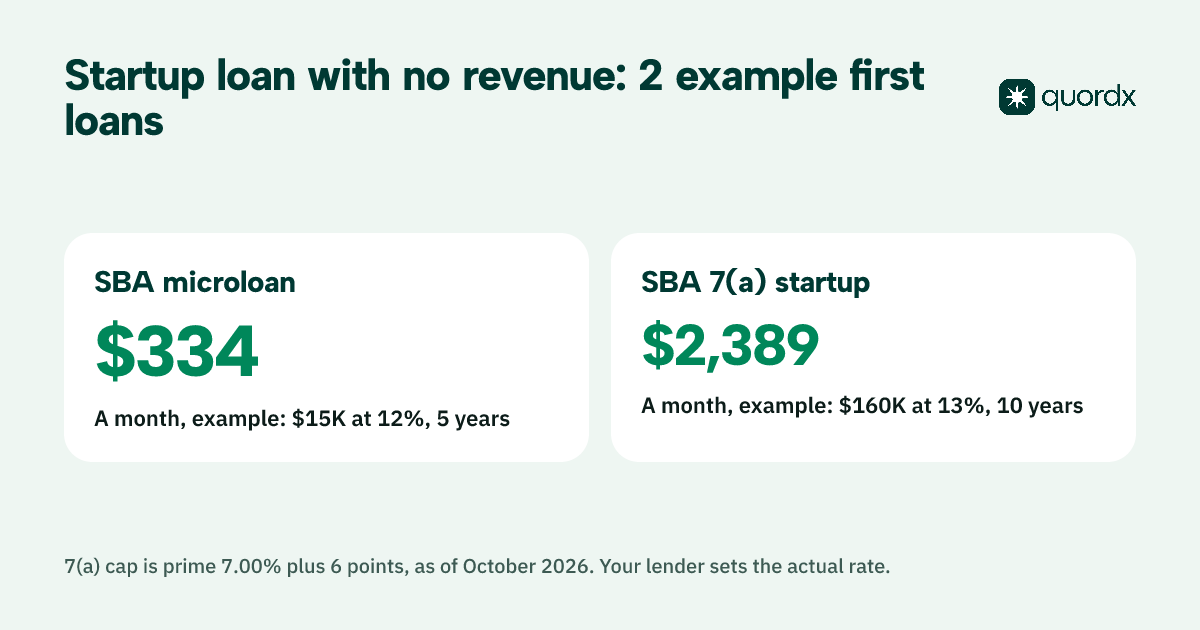
SBA microloans: go up to $50,000 through nonprofit, community-based intermediary lenders, and SBA says the program helps businesses start up and expand. The average loan is about $13,000, the maximum term is seven years, and rates are set by each intermediary, generally between 8% and 13%. You can't use one to pay off existing debt or buy real estate. Our explainer on what an SBA microloan is covers the application.
Example: a $15,000 microloan to open a service business
Say an intermediary approves $15,000 at 12% over five years. The 12% is an assumption inside SBA's stated range, not a quote.
- Monthly payment: about $334.
- Total interest over 60 payments: about $5,020.
- Reserve to hold back: if you expect no real income for six months, keep about $2,000 (six payments) out of the launch budget so the first payments don't depend on sales.
CDFIs: (community development financial institutions) are lenders certified by the Treasury's CDFI Fund to serve people and places that lack access to financing. They include loan funds, credit unions, community development banks and venture funds, and there are certified CDFIs in all 50 states, DC, Guam and Puerto Rico. The CDFI Fund posts a downloadable list of every certified CDFI (dated September 17, 2026 when we checked), so you can find the ones near you.
Why these two come first: they expect to lend to businesses with thin histories, and many pair the loan with business advising. Decision rule: if your need is under $50,000, apply to a microlender or a CDFI loan fund before anyone else.
SBA 7(a) loans for startups: what SBA allows and what lenders add
SBA's lender guide lists starting a business among the eligible uses of a 7(a) loan, while its borrower page describes an operating business. In practice the SBA allows a launch, and the lender decides whether yours is one it will finance.
The SBA rules that apply to every startup borrower
- Personal guarantee: every owner of 20% or more signs an unlimited personal guaranty.
- Ownership: effective March 1, 2026, all direct and indirect owners must be U.S. citizens or U.S. nationals living in the U.S. Green card holders can't hold any share. Confirm the current rule with your lender.
- Rate ceiling: SBA caps the variable rate at the base rate plus 6.5 points up to $50,000 and plus 6 points from $50,001 to $250,000. With prime at 7.00% as of October 2026, that's 13.50% and 13.00%.
- Guaranty fee: a percentage of the part SBA guarantees, set each fiscal year. For loans approved from October 1, 2026, it's 2% up to $150,000 and 3% from $150,001 to $700,000 (SBA Information Notice 5000-881797).
Example: a $200,000 launch with $40,000 of owner cash
Say you're opening a small fitness studio with a $200,000 budget. You put in $40,000 of your own money (an assumption for the example, not an SBA figure) and ask for $160,000 over 10 years.
- Highest rate SBA allows on this loan size: 13.00% (7.00% prime plus 6 points).
- Monthly payment at that ceiling: about $2,389.
- SBA guaranty: 75% on loans over $150,000, so $120,000.
- Upfront guaranty fee: 3% of $120,000, so $3,600, usually financed into the loan.
- Lender's annual service fee: 0.55% of the guaranteed balance, which the lender may not pass on to you.
Decision rule: count the months until your projected break-even and hold that many payments in reserve. If you expect break-even in month nine, that's about $21,500 set aside beyond the build-out, and a lender will want to see where it comes from.
What lenders add on top of SBA's rules: a written plan with projections, your own cash in the deal, industry experience and, where you have it, collateral. Each lender sets its own credit standards. To find SBA lenders, Lender Match sends you a list of interested lenders two business days after you submit a request; it isn't an application and doesn't promise a match.
Equipment financing when the equipment is the collateral
If most of the launch budget is a truck, an oven, a press or a set of chairs, finance those items on their own. The lender's fallback is the equipment, so your lack of revenue matters less than it would on an unsecured loan.
Expect a down payment and a closer look at you: New businesses are often asked to put money down, and the lender still checks your personal credit and experience with that type of equipment. A lease can keep the upfront cash lower; a loan usually costs less over its life. Our guides on equipment financing for a new business and leasing versus buying go through both.
Decision rule: finance the equipment separately and keep the cash you have for rent, payroll and inventory, which no equipment lender will cover.
Friends and family loans: put the terms in writing
SBA's own guide to funding a business lists savings and money from family and friends as part of self-funding, and for many startups it's the first outside money. It's also the money most likely to cost a relationship, so treat it like a real loan.
- Write a promissory note: the amount, the rate, the payment schedule, and what happens if the business closes.
- Decide loan or ownership up front. A loan gets repaid; an equity stake gets a share of the company. Mixing the two later causes most of the fights.
- Pick a rate deliberately. The IRS publishes minimum interest rates each month, called applicable federal rates. Ask a CPA whether your rate needs to meet them; Quordx isn't a tax advisor.
- Example: $30,000 at 6% (a rate the family picks for this example) over five years is about $580 a month.
Are there grants for a startup with no revenue?
Very few. SBA says plainly that it does not provide grants for starting and expanding a business; its grant money goes to research programs, states and organizations that train and counsel owners. The research route, SBIR and STTR, funds federal research and development work, not general launch costs.
What to do instead: treat grants as a bonus, never the plan, and never pay anyone for a list of grants. Our page on government funding for startups covers what's real and how to spot a grant scam.
Once revenue starts: revenue-based financing and cash-flow loans
The day deposits start arriving, a new set of lenders can read your file. Revenue-based financing is the most direct: you receive a lump sum and repay a set total as a percentage of each month's sales, so payments shrink in a slow month and grow in a strong one.
Example: how revenue-based payments move with sales
Take hypothetical terms: $40,000 now, a fixed $48,000 to repay, collected at 6% of monthly revenue. These numbers are for the math only, not a market quote.
- At $15,000 a month in sales: $900 a month, so about 53 months to repay.
- At $30,000 a month: $1,800 a month, about 27 months. The total stays $48,000 either way, which means faster growth raises the effective annual cost.
Standard cash-flow loans come next: Term loans, lines of credit and working capital advances price off your deposit history and time in business, and most want a year of statements before they'll talk. Our guide to the minimum revenue for a business loan shows how lenders size that.
Where Quordx fits for a pre-revenue startup
Usually it doesn't, yet. Quordx is a broker, not a lender, and the lenders it works with for cash-flow products generally look for around $17,000 a month in revenue and, in most cases, 12 months in business. Its SBA route generally starts around $400,000. A business with no deposits will get further going straight to an SBA microlender, a CDFI or Lender Match.
Two exceptions are worth a conversation: Some equipment lenders Quordx works with will review a newer business when the owner has strong credit and real experience with the equipment. And if the business owns real estate with equity in it, bridge and hard money lenders in some states lend against the property instead of revenue. In both cases the lender makes the decision.
When you're past the first year: the about 10-minute application at apply.quordx.com reaches cash-flow lenders together instead of one at a time. Quordx doesn't serve Virginia, Connecticut, Missouri or North Dakota.
Questions Business Owners Ask Before Applying
Can I get an SBA loan with no revenue?
Yes, through two programs. SBA microloans go up to $50,000 through nonprofit intermediaries that lend to startups, and SBA's 7(a) lender guide lists starting a business as an eligible use. In both, the lender decides based on your credit, cash in the deal, experience and plan.
Can I use projected revenue to qualify?
Only with lenders that underwrite a plan, like SBA lenders, microlenders and CDFIs, which expect projections as part of the application. Cash-flow lenders and revenue-based financers lend against deposits that already happened, so projections don't count with them. Build projections from conservative assumptions you can explain line by line.
How much can a startup borrow with no revenue?
Usually far less than the program maximum. A first loan is sized to your personal credit, the cash you're putting in and any collateral, so a microloan in the low tens of thousands is common, while SBA 7(a) launches can be larger with substantial owner cash. Size the request to a payment you could cover from reserves until break-even.
Do I need collateral for a startup loan?
Not always, but it carries more weight when there's no revenue. SBA's terms page says it doesn't require collateral on 7(a) loans of $50,000 or less, and equipment loans are secured by the equipment itself. With little to pledge, expect a smaller loan and a personal guarantee.
When will I qualify for a regular business loan?
Most cash-flow lenders want to see a track record in your business bank account. The lenders Quordx works with generally start around $17,000 a month in revenue and about a year in business, and other lenders publish their own floors. Run every sale through a business account from day one so that history exists.
Apply for Funding
No obligation · Initial inquiry doesn't impact credit · Takes about 10 minutes
Sources

Written by
Cody Dreis
Founder, Quordx Capital
Read full bio
Related articles
Keep exploring business loans
Quordx Capital is a business funding broker, not a lender. Lenders make every credit decision and set the rate, fees and terms, and not every business qualifies. Quordx may be paid by a lender when a deal funds. Full disclosures