

Government Funding for Small Business Startups: What Actually Exists
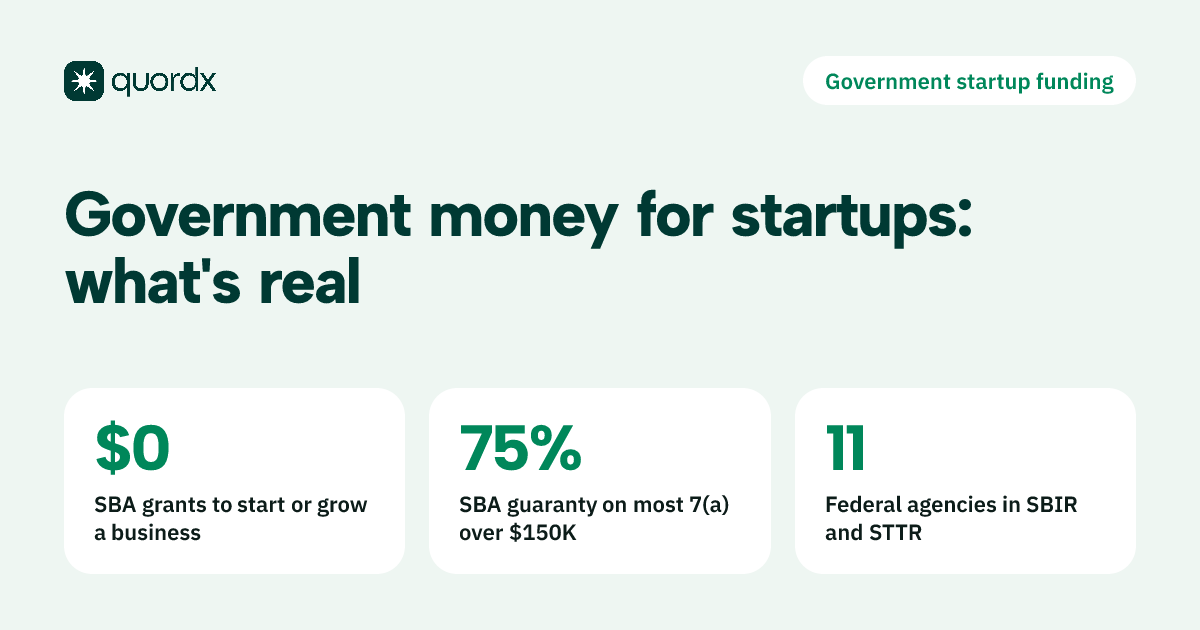
Government funding for a small business startup almost never arrives as a check from the government. It comes mostly as loans from private lenders that the SBA guarantees, small loans through nonprofit microlenders, research awards through the SBIR and STTR programs, and state programs paid for partly by the U.S. Treasury. The SBA says plainly that it does not provide grants for starting or expanding a business (SBA), and anyone who calls offering you free government grant money is running a scam.
The short version: If you need a loan, start with SBA Lender Match for 7(a) and 504 loans, or a microlender for $50,000 or less. If you are building new technology, look at SBIR and STTR. Check your state's small business programs, and treat grants as a narrow bonus, never the plan. Never pay a fee to get a grant or a government loan.
Last updated · Reviewed by Cody Dreis
50+ Lenders|Funding in as little as 24 hours
Does the government fund small businesses?
Yes, but mostly indirectly. Federal money reaches small businesses through guarantees on bank loans, through nonprofit lenders, through research contracts and grants, and through states that run programs with federal funds. Here is what each route really is.
| Program | Who actually provides the money | Size | Startup fit |
|---|---|---|---|
| SBA 7(a) loan | A private lender; SBA guarantees part of the loan | Up to $5 million | Possible; the lender sets its own credit standards |
| SBA Express | A private lender with a 50% SBA guaranty | Up to $500,000 | Possible; the lender makes the credit decision |
| SBA 504 loan | A bank plus a Certified Development Company | CDC portion from $25,000 to $5 million, more for some manufacturing and energy projects | Yes, with a larger down payment for businesses two years old or less |
| SBA microloan | A nonprofit intermediary lender | Up to $50,000; average about $13,000 | Built for small and early businesses |
| SBIR and STTR | One of 11 federal agencies, by contract, grant or cooperative agreement | Set by each agency and phase | Only for research and development |
| State programs (SSBCI and others) | Your state, territory or Tribal government, often through private lenders and investors | Varies by program | Varies; many target young businesses |
| Federal grants | A federal agency, for a specific purpose | Varies | Rare for general startup costs |
The pattern is the same throughout. The government lowers the risk for someone else, and a lender, CDC, nonprofit or state agency decides whether to fund you.
How government-backed SBA loans work
SBA guarantees; the lender lends: SBA calls 7(a) its primary business loan program and describes it as a loan guarantee to lenders (SBA 7(a)). On most 7(a) loans, SBA guarantees up to 85% of loans of $150,000 or less and up to 75% of larger ones. You apply to the lender, the lender underwrites you, and if you default, SBA covers its share of the lender's loss, not your debt.
What the guarantee costs, with real numbers
Take a $400,000 7(a) loan approved in fiscal year 2027, which started October 1, 2026. The guaranteed portion is 75%, or $300,000. The upfront guaranty fee for loans of $150,001 to $700,000 is 3% of the guaranteed portion, so $9,000, and it is 0% for manufacturers, listed food supply chain businesses and rural businesses at this size (SBA Information Notice 5000-881797).
The rate is capped, not set: For a variable-rate 7(a) loan over $350,000, the maximum is prime plus 3.0%. With the prime rate at 7.00% as of October 2026, that cap is 10.00%, and the lender can price below it. The lender also pays SBA an annual service fee of 0.55% on the guaranteed balance, and it may not pass that fee on to you.
| 7(a) loan size | Maximum variable rate | Cap with prime at 7.00% |
|---|---|---|
| $50,000 or less | Prime plus 6.5% | 13.50% |
| $50,001 to $250,000 | Prime plus 6.0% | 13.00% |
| $250,001 to $350,000 | Prime plus 4.5% | 11.50% |
| Over $350,000 | Prime plus 3.0% | 10.00% |
Ownership rules tightened in 2026: Under an SBA policy in effect since March 1, 2026, every direct and indirect owner of a 7(a) or 504 applicant must be a U.S. citizen or U.S. national whose principal residence is in the United States, its territories or possessions. Lawful permanent residents may not own any share, so check this before you spend time on an application.
Can a startup get a government-backed loan?
Sometimes. The SBA pages we used set no minimum time in business for a 7(a) loan; the lender applies its own credit standards, and a business with no history has less to show. The 504 program plans for young businesses directly: the borrower puts in at least 10% of the project, rising to 15% if the business has operated two years or less, and 20% if it is also buying a special-purpose building.
A 504 startup example: A business under two years old buying a $1,000,000 building would put in at least $150,000. A bank would fund at least $500,000, and the CDC loan would cover the remaining $350,000. Our guide to using an SBA loan to start a business covers what lenders ask a new owner for.
Estimate your funding
Answer a few questions about your business to see a likely range.
SBA microloans: the government route built for small amounts
SBA microloans go up to $50,000, and SBA puts the average at about $13,000 (SBA microloans). SBA funds nonprofit, community-based intermediaries that have experience in lending and in management and technical assistance, and those intermediaries make the credit decisions.
What the money can and cannot do: Microloans can pay for working capital, inventory, supplies, furniture, fixtures, machinery and equipment, with terms of up to seven years. They cannot pay off existing debt or buy real estate.
For a startup that needs a few thousand dollars and some guidance, this is often the most realistic government route. See what an SBA microloan is for how to find an intermediary near you.
SBIR and STTR: research funding, not general startup money
SBIR and STTR provide equity-free funding to American small businesses through 11 participating federal agencies, to develop technology and move it toward commercial use (SBIR.gov). The funding agreement can be a contract, a grant or a cooperative agreement.
How the phases work: Phase I establishes technical merit, feasibility and commercial potential, and only Phase I awardees can compete for Phase II (SBIR.gov FAQ). As of April 2026, SBIR.gov says agencies may make Phase I awards of up to $323,090 and Phase II awards of up to $2,153,927 without SBA approval. STTR differs in one way that matters: the small business must formally collaborate with a research institution in both phases.
Who should apply: If your startup is building something that answers a research need an agency has published, SBIR or STTR can fund development without giving up equity. If you are opening a restaurant, a store or a services firm, these programs are not for you.
State and local government funding for small businesses
Much of the government money closest to a startup is run by states. Treasury's State Small Business Credit Initiative is a nearly $10 billion program that sends money to states, the District of Columbia, territories and Tribal governments, which then build their own programs (U.S. Treasury).
Those programs mostly back private lenders and investors: Treasury lists venture capital, loan participations, loan guarantees, collateral support and capital access programs. In practice, a state program might add collateral support so a bank can approve a loan it would otherwise decline, so ask your bank whether it participates.
Where to look: Start with your state's economic development agency and your nearest Small Business Development Center, which provides counseling and training. SCORE mentors give advice at no cost, and Women's Business Centers offer free to low-cost counseling (SBA resource partners).
Small business grants: why they are rare and who gets them
Grants are real, but they pay for a specific purpose a funder cares about, not for starting a business in general. SBA's own grant programs go to research (SBIR and STTR), to state and territory governments for export programs (STEP), and to organizations that support small businesses, not to individual owners covering startup costs (SBA grants).
Every federal grant is listed in one place: The FTC says the only place to find a list of all available federal grants is Grants.gov, which is free. If someone offers you a federal grant you cannot find there, assume it is fake.
Plan as if you will not win one: Grant applications take time and most are competitive. Build your funding plan on revenue, savings and loans you can qualify for, and treat any grant you win as a bonus.
Government grant scams: the warning signs
Owners searching for government money are a favorite target. The FTC's guidance on government grant scams boils down to a few rules.
- No fee, ever. Do not pay for a list of grants or pay any upfront fee to receive one.
- The government does not call out of the blue. A call, text or message saying you qualify for a grant you never applied for is a scam.
- Never hand over financial details to anyone who contacts you, including bank logins or account numbers.
- Check the agency's name. Scammers invent official-sounding agencies; the FTC's example is a Federal Grants Administration, which does not exist.
- Check the sender. SBA tells owners contacted by someone claiming to be from SBA to check where the message really came from, and to report it if it looks suspicious.
Report grant scams to the FTC at ReportFraud.ftc.gov. Apply the same caution to loan offers: be wary of anyone who wants money up front to guarantee an approval.
How to apply for government funding for a small business
- Decide what you are funding and how much. A $15,000 equipment buy points to a microloan; a $1,000,000 building points to a 504 loan; a research project points to SBIR or STTR.
- Check eligibility before you write anything. That means SBA's size standards and ownership rules for SBA loans, and the agency's published topics for SBIR and STTR.
- For a loan, find a lender. Use SBA Lender Match, which is not a loan application; SBA sends a summary of interested lenders two business days after you submit, with no guarantee of a match. For $50,000 or less, contact a microloan intermediary.
- Prepare the file. SBA's checklist before you talk to lenders: a business plan, how much you need and how you will use it, your credit history, financial projections, and any collateral you can offer. SBA notes that most lenders expect a business plan for startup funding.
- For grants and SBIR, register and search on the official sites. Federal grants are on Grants.gov; SBIR and STTR opportunities are on SBIR.gov.
- Get free help. An SBDC, SCORE mentor or Women's Business Center can review your plan before a lender sees it.
Our step-by-step guide to applying for an SBA loan goes deeper on the lender side, and startup business loans with no revenue covers private options for brand-new companies.
Where Quordx fits, and where it does not
Most government funding is outside what Quordx can do, and it is better to say so up front. Quordx is a broker, not a lender, and the only SBA route on its panel is an SBA lender that takes 7(a) requests of roughly $400,000 and up. It has nothing for smaller SBA loans, SBA Express, 504 loans or microloans, and nothing for grants. Quordx does not sell grant lists or grant writing.
So for a startup, the right first stops are usually SBA Lender Match, a microlender, your SBDC and Grants.gov. Once your business has about a year of steady revenue, or if it needs a 7(a) loan of $400,000 or more and meets SBA's ownership rules, a single Quordx application of about 10 minutes reaches its lenders, and the lender, not Quordx, decides. Quordx does not serve businesses in Virginia, Connecticut, Missouri or North Dakota.
Questions Business Owners Ask Before Applying
Can I get a government grant to start a small business?
Rarely. SBA states that it does not provide grants for starting or expanding a business, and federal grants listed on Grants.gov are for specific purposes such as research. A startup's realistic government routes are SBA-guaranteed loans, microloans, state programs and, for technology companies, SBIR or STTR.
Does the SBA give money directly to small businesses?
For its main loan programs, no. SBA guarantees part of 7(a) loans made by private lenders, backs 504 loans made with Certified Development Companies, and funds nonprofit intermediaries that make microloans. You apply to the lender, CDC or intermediary, and they decide.
Is there a government loan for a startup with no revenue?
SBA microloans are the closest fit, because they are small and come from nonprofit lenders that also provide business assistance. A 504 loan can fund a young business's building or equipment with a larger down payment. A 7(a) lender may consider a startup, but it will rely heavily on your plan, your own investment and collateral.
How can I tell if a government grant offer is a scam?
If someone contacted you first, asks for a fee, or wants your bank details, it is a scam. Real federal grants are listed on Grants.gov, you apply for them yourself, and none charge a fee to receive the money.
Are SBIR awards grants or loans?
Neither is a loan. SBIR and STTR funding comes as a contract, grant or cooperative agreement with one of 11 federal agencies, and SBIR.gov describes it as equity-free. It pays for research and development, not general business costs.
Do I have to be a U.S. citizen to get an SBA loan?
Under SBA's policy in effect since March 1, 2026, every owner of a 7(a) or 504 applicant must be a U.S. citizen or U.S. national living in the United States or its territories. Lawful permanent residents cannot own any share of the applicant. Check for updates, because the policy expires March 1, 2027 unless renewed.
Apply for Funding
No obligation · Initial inquiry doesn't impact credit · Takes about 10 minutes
Sources

Written by
Cody Dreis
Founder, Quordx Capital
Read full bio
Related articles
Quordx Capital is a business funding broker, not a lender. Lenders make every credit decision and set the rate, fees and terms, and not every business qualifies. Quordx may be paid by a lender when a deal funds. Full disclosures