

How do I know if a business funding company is legit?
A business funding company is legit when you can confirm it exists under the exact name on its paperwork, it's registered wherever your state requires, it doesn't ask for money before you're funded, and the website and emails you're dealing with really belong to it. You can check all of that yourself in about 15 minutes with free public records: a Secretary of State lookup, a UCC search, your state regulator's registration list, and the BBB, CFPB and FTC complaint channels. Do it before you send bank statements, because those statements carry your account numbers.
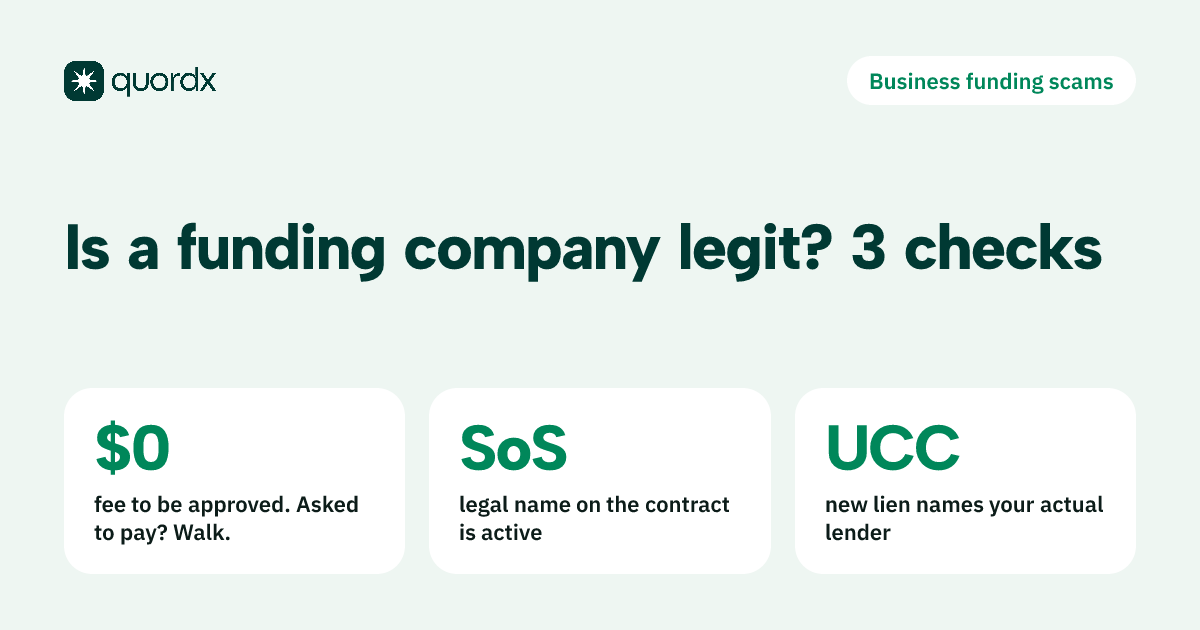
The short version: Never pay a fee to be approved, and walk away from anyone who guarantees approval before reviewing your file. Match the legal name on the contract to a Secretary of State record, and reach the company by typing its web address yourself, not by clicking a link in an email. If your state registers brokers or funders, look the company up on that list.
Part of our guide to Business Loans.
Last updated · Reviewed by Cody Dreis
50+ Lenders|Funding in as little as 24 hours
The 15-minute legitimacy checklist
Run these in order. Each one takes a few minutes, and a company that fails any of the first four isn't worth the rest.
- No money before funding. A fee to process, insure or release an approval, due before you've seen a contract, is a stop sign.
- No approval promised up front. Real lenders review your credit and finances before making a firm offer.
- The company exists. Search the legal name in the Secretary of State's business records and check that it's active.
- It's the real website. Type the address yourself and compare the spelling of the domain and every email address.
- It's registered where required. Check your state's broker or provider registration list, if your state has one.
- Liens tell the truth. Run a UCC search on your own business before you sign, and again after you close.
- Complaints show patterns. Read BBB complaints and the company's responses, and search the CFPB complaint database.
- Terms are in writing before you commit. You should see the cash you receive, the total you repay and every fee.
Advance-fee scams: the clearest red flag
The classic business funding scam is simple: someone says you're approved, then asks you to pay before the money arrives. The FTC's guidance on advance-fee loans says any upfront fee a lender wants before granting the loan is a cue to walk away, especially if it's called insurance, processing or paperwork. It also warns that real lenders won't promise or guarantee credit before you apply.
SBA scams follow the same script: The SBA's Inspector General says to suspect fraud if anyone promises SBA loan approval but requires any payment up front. SBA itself only emails from addresses ending in @sba.gov.
Florida bans broker advance fees by statute: Under section 559.9614, a commercial financing broker may not assess, collect or solicit an advance fee for its services, with a narrow exception for real third-party costs like a credit report, paid directly to that third party.
Know the legitimate fees, so a scam can't hide behind them: The FTC notes a real lender can charge an application or appraisal fee before considering your loan. An origination fee is usually taken out of the loan at closing and shown on the contract. The difference is that none of these is the price of being told you're approved, and none is sent by wire to a stranger after a phone call.
Hypothetical example: an email says you're approved for $150,000 and asks you to wire $2,500 for loan insurance before funding. Every element of that message matches the FTC's warning signs. A real offer would arrive as a written contract from a lender you can look up, with any fee deducted from the proceeds and listed in writing.
Estimate your funding
Answer a few questions about your business to see a likely range.
Look up the company with the Secretary of State
Every corporation and LLC is registered with a state's Secretary of State, or an equivalent office, and the search is free on that office's website. Search the legal name exactly as it appears on the application or contract, which may differ from the brand on the website.
- Status: it should be active or in good standing, not dissolved, revoked or delinquent.
- Formation date: a company claiming two decades in business that was formed last spring has some explaining to do.
- Name match: the entity on your contract should be the entity you researched. If the website brand and the contracting company differ, find out why.
- Out-of-state companies: many funders are formed in one state and registered to do business in others, so search the state of formation too.
A clean Secretary of State record proves a company exists. It doesn't prove the company is honest, which is why the other checks still matter.
Run a UCC search before and after you sign
Business loans and advances often come with a UCC-1 filing, a public notice at the Secretary of State that a lender has a claim on some or all of your business assets. Those filings are searchable by business name, usually through the same Secretary of State website.
Before you sign, search your own business: You'll see every lien already on file, which is exactly what a legitimate lender will look at. If a company claims you have no liens when the record shows several, or tells you a lien doesn't matter, that tells you how carefully it reads your file.
After you close, search again: The secured party on the new filing should match the lender named in your contract. A lien from a company you've never heard of is a reason to call the lender, using a phone number you found yourself.
Check state registration for funders and brokers
Some states now register commercial funders, brokers or both, mostly for merchant cash advances and similar sales-based financing. Where a list exists, it's the fastest legitimacy check there is. The FTC's own advice is to check whether a lender is registered in your state, and to call your state attorney general or banking regulator if you aren't sure.
| State | Who registers | Where to check |
|---|---|---|
| Connecticut | Commercial financing providers and brokers, with the Banking Commissioner | The Department of Banking's published list of registrants, or NMLS Consumer Access |
| Texas | Commercial sales-based financing providers and brokers, through NMLS; brokers already in business must register by December 31, 2026 | The OCCC's licensee search |
| Virginia | Sales-based financing providers and brokers, with the State Corporation Commission | The Virginia State Corporation Commission |
| Missouri | Commercial financing brokers, with the Division of Finance, plus a $10,000 surety bond | The Missouri Division of Finance |
No registration list doesn't mean no rules: Only some states keep a registry, so a missing entry only means something in a state that requires one. Florida, for example, doesn't register brokers but bans their advance fees. For more on what these laws require brokers to disclose, see how business loan brokers get paid.
Read complaints: BBB, CFPB and FTC
Read the BBB complaints, not just the rating: Look for the same problem repeated: debits after payoff, fees that weren't disclosed, approvals that never funded. Then read how the company answered. A business that responds with specifics is a better sign than one that never responds.
Search the CFPB complaint database: The CFPB's Consumer Complaint Database covers consumer financial products, so a company that only funds businesses may not appear at all. Complaints are published after the company responds or after 15 days, and the CFPB says the database isn't a statistical sample. A hit is worth reading, and a blank result proves very little.
Search the name and the phone number: The FTC suggests searching a company's name with words like review, complaint or scam, and searching the phone number that called you to see if others reported it. If you've already lost money or have information about a scammer, report it at ReportFraud.ftc.gov.
Spoofed lender sites and impostor emails
Some scammers don't invent a company. They copy a real one, with a lookalike website, a logo lifted from the real site, and email addresses one letter off. The FTC's impersonation rule targets exactly this: spoofed business email and web addresses, lookalike URLs that rely on misspelling a company's name, and deceptive use of business logos.
- Type the address yourself. Reach the company by entering the domain you already know, not through an email link or an ad.
- Read the domain letter by letter. A swapped letter, an extra word or a different ending (.co instead of .com) is enough.
- Check the sender's email domain against the website. A real lender's staff write from the company's domain, not a free email account.
- A logo proves nothing. The SBA warns that its logo on an email or web page doesn't mean the SBA sent or endorsed it, and the same goes for any lender's logo.
- Verify by phone using a number you found yourself. If an email says the lender changed its wiring instructions or needs your bank login, call the number on the real website before you do anything.
Legit company, bad deal: warning signs that aren't fraud
A funder can pass every check above and still offer you something you shouldn't sign. These signs don't mean a scam, but they mean slow down.
- Pressure to sign today. An offer that expires in an hour isn't giving you time to read it.
- No total cost in writing. You should see the cash you receive, the total you repay, the payment amount and every fee. In several states, covered offers must come with a standard disclosure; our merchant cash advance guide lists five of them.
- Blank fields or missing pages. Never sign a contract with numbers left to fill in later.
- Statements that contradict the paperwork. If the rep says there's no personal guarantee and the contract has one, the contract wins.
If you're comparing two legitimate offers, how to compare business loan offers shows how to put them on the same footing.
Running this checklist on Quordx
You should run every check on this page on Quordx too. Quordx is a broker, not a lender: it doesn't fund deals, so your contract will be with the lender named on your offer, and that's the company to look up with the Secretary of State and in the UCC records after you close.
Quordx asks nothing of the business owner, because lenders pay it when a deal funds, so any request for money in Quordx's name before funding isn't from Quordx. It doesn't serve businesses based in Virginia, Connecticut, Missouri or North Dakota, and California applicants see a state notice first.
Questions Business Owners Ask Before Applying
Is it normal to pay a fee before getting a business loan?
Not to be approved. The FTC says an upfront fee a lender wants before granting the loan, especially for insurance, processing or paperwork, is a cue to walk away. A real lender may charge an application or appraisal fee, and origination fees are usually deducted at closing and shown on the contract.
How can I verify a business lender's license or registration?
Start with your state's financial regulator or attorney general, which is what the FTC recommends. Connecticut publishes a list of registered commercial financing providers and brokers, and Texas lets you search registrants through the OCCC. Many states don't register business funders at all, so check what your state requires before reading anything into a missing entry.
Are online business lenders legit?
Many are, and the same checks apply to them as to anyone else. Confirm the legal entity, read the written terms, and make sure you're on the real website. Our page on whether online business lenders are legit covers that question in more detail.
What should I do if I already paid a funding scam?
Contact your bank right away about the payment, and report it at ReportFraud.ftc.gov. If the scam used the SBA's name, report it to the SBA Inspector General's hotline. Keep every email, text and payment record.
Does a BBB rating mean a funding company is legitimate?
A rating alone doesn't settle it. Read the actual complaints and the company's responses, and look for the same problem repeating. Then run the Secretary of State, UCC and registration checks, which rely on public records rather than reviews.
Apply for Funding
No obligation · Initial inquiry doesn't impact credit · Takes about 10 minutes
Sources
- FTC: What To Know About Advance-Fee Loans
- FTC Business Blog: New Impersonator Rule (spoofed email and web addresses, lookalike URLs)
- CFPB Consumer Complaint Database
- SBA Office of Inspector General: Protect yourself from scams and fraud
- Connecticut Department of Banking: commercial financing providers and brokers registered in CT

Written by
Cody Dreis
Founder, Quordx Capital
Read full bio
Related articles
Keep exploring business loans
Quordx Capital is a business funding broker, not a lender. Lenders make every credit decision and set the rate, fees and terms, and not every business qualifies. Quordx may be paid by a lender when a deal funds. Full disclosures