

How much collateral is needed for a business loan?
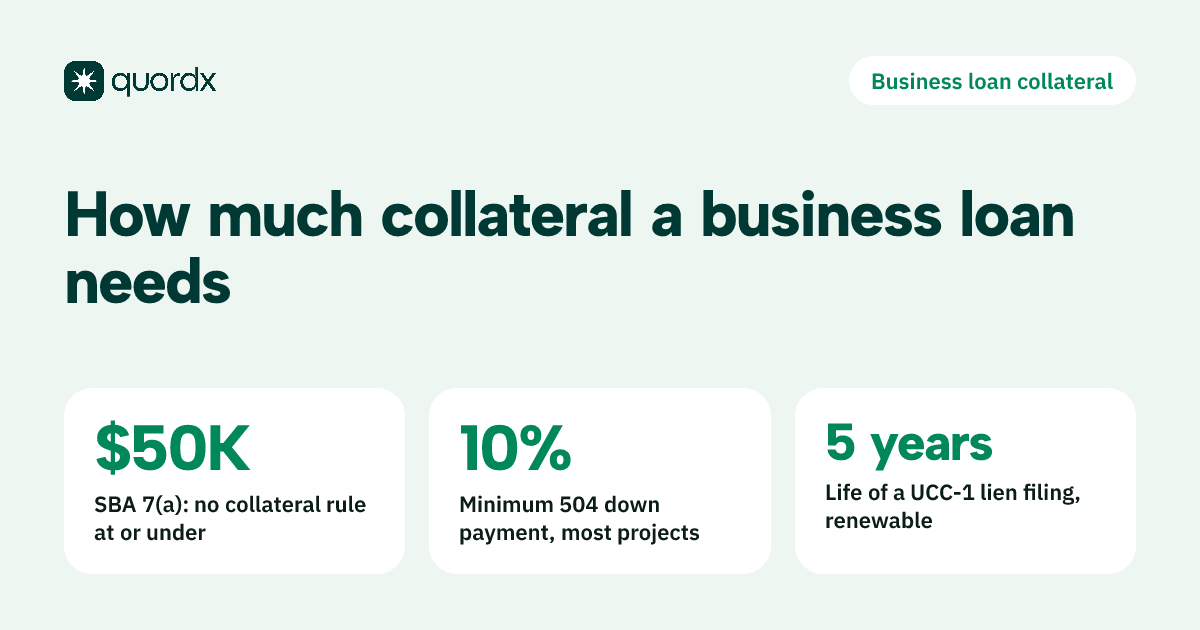
Many business loans need no specific collateral, and SBA requires none on 7(a) loans of $50,000 or less; when a loan is secured, lenders want the discounted value of what you pledge to cover the balance. The discount is the part most owners miss: a lender counts what an asset would bring in a forced sale, not what you paid, so $540,000 of equipment, trucks, receivables and inventory supports only about $244,000 of borrowing in the worked example below. What you pledge, how the lender values it and whether a blanket lien comes with it decide how much collateral is enough.
The short version: Multiply each asset you could pledge by a conservative recovery percentage, add them up and compare the total with the loan you want. If you fall short, expect the lender to ask for a down payment, a blanket lien on all business assets, a personal guarantee or a smaller loan. For smaller SBA 7(a) and SBA Express loans, SBA says a loan should not be declined solely because collateral is inadequate, so a shortfall there is not an automatic no.
Part of our guide to Business Loans.
Last updated · Reviewed by Cody Dreis
50+ Lenders|Funding in as little as 24 hours
Do business loans require collateral?
Not always: Whether a loan needs collateral depends more on the product than on the lender. In the Federal Reserve's 2025 Small Business Credit Survey, 51% of firms with debt said they used business assets to secure it, which leaves 49% that did not.
Unsecured rarely means no strings: Loans sold as no-collateral commonly come with a UCC-1 filing against your business assets and a personal guarantee, so the lender still has something to pursue if payments stop. The table shows what typically backs each product.
| Product | What secures it | What the lender relies on most |
|---|---|---|
| Online term loan or working capital loan | Often no specific asset; a blanket lien on business assets is common | Cash flow, bank statements and a personal guarantee |
| Business line of credit | Unsecured, or secured by receivables, inventory or a cash deposit | Cash flow, or the assets in a borrowing base |
| Equipment financing | The equipment being bought | Resale value of the equipment, plus cash flow |
| Commercial real estate loan | A mortgage on the property | Appraised value and the income that pays the loan |
| Invoice factoring | Nothing pledged in the usual sense; the factor buys the invoices | Your customers' ability to pay |
| SBA 7(a) | None required by SBA at $50,000 or less; more above that (see below) | Repayment ability, with collateral taken where available |
| SBA 504 | The project property, with the bank in first lien position and the CDC second | The project and the business's cash flow |
How lenders value collateral: loan-to-value and haircuts
Lenders lend against recovery value, not price: The underwriter's question is what the asset would bring if the lender had to repossess and sell it quickly, after removal, storage and auction costs. The gap between market value and that number is the haircut, and what's left is the advance rate the lender applies.
Two ratios describe the same thing from opposite ends: Loan-to-value (LTV) is the loan divided by the asset's value: a $300,000 loan on a $400,000 building is 75% LTV. Collateral coverage is the counted collateral divided by the loan: $244,000 of counted collateral behind a $300,000 loan is 0.81x coverage, which means the collateral alone wouldn't repay it.
The table below uses round, hypothetical advance rates to show why different assets count so differently. They are not market rates. Every lender sets its own, and appraisals, age and condition move them.
| Asset | Why a lender discounts it | Example advance rate used on this page |
|---|---|---|
| Cash or a CD held at the lender | The lender can collect it directly | 95% |
| Owner-occupied commercial real estate | Holds value, but takes months to sell and needs an appraisal | 75% |
| Receivables under 90 days old from creditworthy customers | Turns into cash, but some invoices get disputed or go unpaid | 70% |
| New general-purpose equipment | Active resale market, but value drops once it's used | 60% |
| Titled vehicles | Easy to repossess, but they lose value every year | 50% |
| Inventory | Can spoil, go out of style or sell only at a discount | 40% |
| Used or specialized equipment | Few buyers, plus removal and auction costs | 30% |
| Leasehold improvements, software, furniture | Little or nothing to resell | 0% |
Run the numbers on your loan
Pick a product, set the amount and term, and see a typical payment.
Worked examples: how much collateral you need
Example 1: a $300,000 loan against business assets
A machine shop wants to borrow $300,000 and offers everything it owns. On paper that's $540,000 of assets, 1.8 times the loan. Here is how it looks after the example haircuts.
| Asset | Market value | Example advance rate | What the lender counts |
|---|---|---|---|
| Used CNC machine | $250,000 | 30% | $75,000 |
| Two work trucks | $80,000 | 50% | $40,000 |
| Receivables under 90 days | $150,000 | 70% | $105,000 |
| Inventory | $60,000 | 40% | $24,000 |
| Total | $540,000 | $244,000 |
Result: $244,000 of counted collateral against a $300,000 loan is 0.81x coverage, a $56,000 shortfall. The shop's realistic options are to borrow about $244,000, put $56,000 of its own cash toward the purchase, add another asset such as real estate, or use a loan that leans on cash flow and a guarantee more than on collateral.
Example 2: buying a $400,000 building
Conventional loan: if the lender advances 75% of value, as in this example, the most it lends is $300,000, so the buyer brings $100,000, or 25%, plus closing costs. SBA 504: the bank funds at least 50% of the project, the CDC up to 40%, and the borrower at least 10%, which is $40,000 on a $400,000 project under 13 CFR 120.910.
That 504 contribution rises to at least 15% ($60,000) if the business has operated two years or less, or if the building is a limited or single-purpose property, and to at least 20% ($80,000) when both apply. Real projects carry costs beyond the price, so treat these as a planning floor, not a quote.
Example 3: a $75,000 unsecured working capital loan
Here collateral coverage barely enters the decision. A lender offering an unsecured loan this size mostly reads your bank statements and asks whether the payment fits your cash flow, then files a UCC-1 against business assets and asks for a personal guarantee as backup. The number to know is your debt service coverage ratio, not the value of your assets.
SBA collateral requirements by loan size
SBA sets collateral rules by loan size and delivery method, and its 7(a) terms page spells them out. In plain terms:
| SBA loan | What SBA requires for collateral |
|---|---|
| 7(a) loans of $50,000 or less | SBA does not require collateral (International Trade loans have different rules) |
| 7(a) Small over $50,000 (7(a) Small tops out at $350,000) | The lender follows its own written collateral policy for similar non-SBA loans; the loan is not to be declined solely for inadequate collateral |
| SBA Express over $50,000, up to $500,000 | The lender may use its existing collateral policy, with the same rule against declining solely for inadequate collateral |
| Standard 7(a), $350,001 to $5 million | Fully secured means liens on all assets the loan buys, refinances or improves, plus available fixed assets with a combined adjusted net book value up to the loan amount |
| 504 | The project property: the bank takes a senior lien and the CDC a junior one |
Fully secured is measured in adjusted book value, not price: SOP 50 10, SBA's lending rulebook, sets the other conditions for Standard 7(a) loans. For 7(a) Small and SBA Express loans, SBA says thin collateral alone shouldn't sink a sound loan, and its terms say every loan must show a reasonable assurance of repayment ability, so cash flow carries the weight.
Two other SBA rules travel with collateral: Owners of 20% or more generally must personally guarantee the loan, and SBA requires hazard insurance on all collateral for 7(a) loans over $500,000, both under 13 CFR 120.160. If you're still deciding whether SBA fits, our SBA loans guide compares the programs.
Blanket liens and UCC-1 filings: what you're signing
A UCC-1 is the public notice of a lender's claim: When a lender takes a security interest in business assets, it files a financing statement, the UCC-1, in the state's public records. Under UCC 9-504, that filing can describe the collateral simply as all assets or all personal property, which is what people mean by a blanket lien.
It lasts five years unless renewed: A filed financing statement is effective for five years, and the lender can extend it with a continuation statement filed in the six months before it lapses, per UCC 9-515. When you pay the loan off, ask the lender to file a termination so the lien stops showing up in searches.
First to file usually wins: Competing security interests generally rank by when they were first filed or perfected, under UCC 9-322. That is why a blanket lien from a small working capital loan can make your next lender hesitate: anything you pledge sits behind the first filing unless the first lender agrees to subordinate. Our page on getting a second business loan shows how that plays out.
What to negotiate before you sign: ask whether the lien can cover specific assets instead of all assets, and ask for a carve-out for equipment you plan to finance separately. Search your state's UCC records before you apply anywhere, so you know what's already on file under your business name.
What to do if you don't have enough collateral
- The shortfall is small: borrow less or put more cash in. In Example 1, $56,000 of the owner's money closes the gap.
- Strong cash flow, few hard assets: look at loans underwritten mostly on bank statements, and expect a blanket lien and a guarantee. Compare the two structures in secured vs unsecured business loans.
- You're buying equipment: let the equipment secure itself. Equipment financing is built around the asset being bought.
- You invoice other businesses: factoring relies on the invoices instead of a pledge of everything you own. See invoice factoring and AR financing.
- You need $50,000 or less through SBA: SBA doesn't require collateral at that size, though the lender still checks repayment ability.
- The lender wants your house: treat that as a last step, not a first offer. A mortgage on your home for working capital puts the home at risk on top of any personal guarantee.
Mistakes to avoid: counting purchase price instead of resale value, signing an all-assets lien without asking how it affects future borrowing, and offering personal real estate before you know what the business's own assets support.
Where Quordx fits on secured and unsecured loans
Quordx is a broker, not a lender, so what it can place depends on the collateral you bring. The lenders it works with cover equipment financing (including large and harder-to-place deals), factoring for companies that invoice other businesses, term loans and lines of credit underwritten mostly on cash flow, and hard money or bridge real estate loans in some states.
It does not place asset-based lines secured by inventory and receivables, conventional bank real estate loans, or SBA loans under roughly $400,000. For a smaller SBA loan, start with SBA Lender Match. Cash-flow loans through Quordx generally start around $17,000 a month in revenue and 12 months in business, the application takes about 10 minutes, and the lender makes the credit decision.
Questions Business Owners Ask Before Applying
Do I need a down payment for a business loan?
Often, when the loan buys a specific asset. If the lender advances less than the asset's full value, you cover the gap: a 75% advance on a $400,000 building leaves $100,000 for you to bring. SBA 504 projects need at least 10%, 15% or 20% from the borrower depending on business age and property type, and our SBA down payment guide covers 7(a) as well.
Can I use my house as collateral for a business loan?
Yes. Lenders can take a mortgage on a personal residence, and some ask for one when business assets fall short. A business default can then cost you the home, separate from any personal guarantee, so if you agree, try to limit the lien to that one loan and negotiate a release once the balance falls to an agreed level.
Will an SBA lender turn me down for not having enough collateral?
For 7(a) Small and SBA Express loans, SBA says a loan shouldn't be declined solely because collateral is inadequate. SBA still requires a sound loan with a reasonable assurance of repayment, so weak cash flow will sink an application that thin collateral would not. Standard 7(a) loans over $350,000 carry the fuller fully-secured test.
How long does a UCC lien stay on my business?
A UCC-1 filing is effective for five years from the filing date. The lender can continue it by filing in the six months before it lapses. Once the loan is paid off, ask the lender to file a termination.
What is the best collateral for a business loan?
Cash and real estate count for the most because they hold value and are straightforward to value. Specialized equipment, inventory and leasehold improvements count for the least, because a lender may recover little from them. Using this page's example rates, $100,000 of real estate supports $75,000 of borrowing, while $100,000 of used machinery supports $30,000.
Apply for Funding
No obligation · Initial inquiry doesn't impact credit · Takes about 10 minutes
Sources
- SBA: 7(a) loan program terms, conditions and eligibility (collateral by loan type)
- 13 CFR 120.910: 504 borrower contribution
- UCC 9-504: Indication of collateral (all-assets filings)
- UCC 9-515: Duration and effectiveness of a financing statement
- Federal Reserve Banks, 2026 Report on Employer Firms (2025 Small Business Credit Survey)

Written by
Cody Dreis
Founder, Quordx Capital
Read full bio
Related articles
Keep exploring business loans
Quordx Capital is a business funding broker, not a lender. Lenders make every credit decision and set the rate, fees and terms, and not every business qualifies. Quordx may be paid by a lender when a deal funds. Full disclosures