

What Is Accounts Receivable Financing and Invoice Factoring?
Quordx is a marketplace, not a single lender. Apply once and get matched across 50+ vetted lenders and every major funding type, including accounts receivable financing and invoice factoring. Free, transparent, no sales calls, no obligation.
Accounts receivable financing and invoice factoring both turn unpaid customer invoices into cash before your customer pays. With AR financing you borrow against your invoices and keep collecting them yourself; with factoring you sell the invoices to a factor, which usually collects from your customer directly. In both cases the money you get is sized to your receivables, and the lender or factor cares as much about your customers' ability to pay as about your own credit. That is why a young business with thin credit and large, reliable customers can often use these products when a bank loan is out of reach.
The short version: If you invoice other businesses and wait 30 to 90 days to get paid, you can get most of that money now. Factoring is easier to qualify for; an AR line asks for stronger financials and more reporting, and you pay interest only on what you draw. Compare offers on total dollars paid for the time your customers actually take to pay, not on the advance percentage, and read the recourse and contract-length terms before you sign.
One option in our guide to Alternative Financing.
Last updated · Reviewed by Cody Dreis
50+ Lenders|Funding in as little as 24 hours
See Accounts Receivable Financing and Invoice Factoring offers you qualify for, free.
One 10-minute application. Matched to 3-7 best-fit lenders from a 50+ network. Decisions in 24-48 hours.
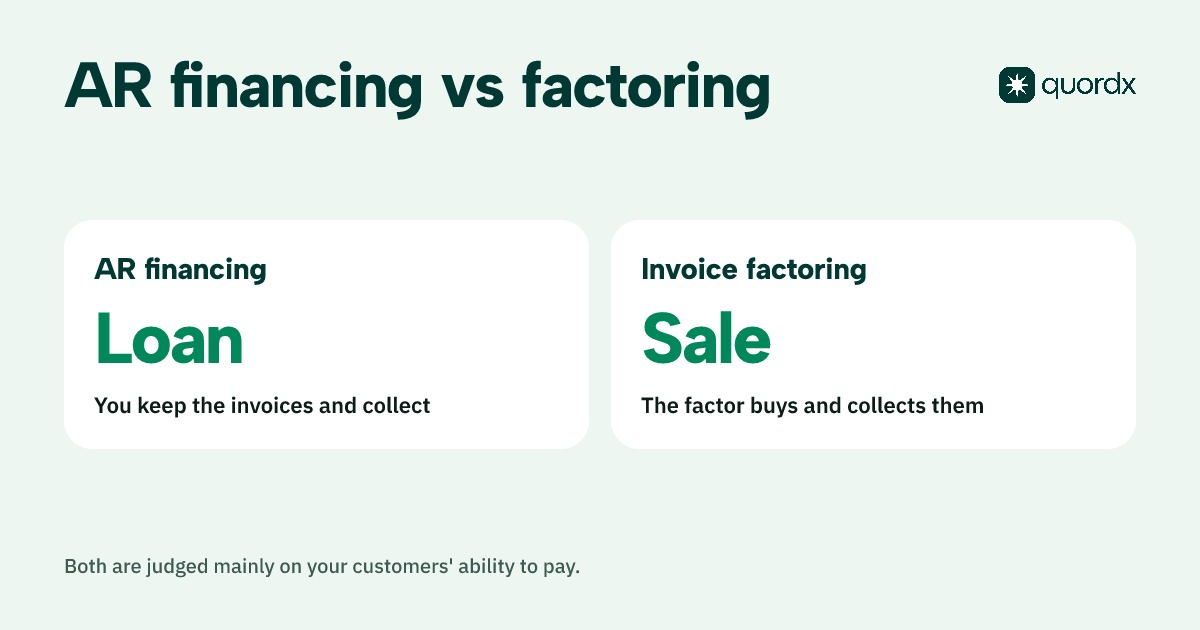
AR financing vs factoring: the four choices that shape every deal
People use the two names loosely, and plenty of providers offer both. What matters is the structure in the contract you are handed. Four choices decide how the money flows, who talks to your customer, and who eats a bad debt.
| Choice | Option A | Option B | What it changes for you |
|---|---|---|---|
| Loan or sale | AR financing: a loan or line secured by your invoices. You still own them. | Factoring: you sell the invoices. The factor owns them and collects. | Who collects, how it is priced, and how it may show up on your books |
| Who takes the loss if a customer never pays | Recourse: you buy back or replace the unpaid invoice. | Non-recourse: the factor absorbs the loss, usually only if the customer becomes insolvent. | Your risk, the price, and how strict the factor is about which customers it accepts |
| Does your customer know | Notification: your customer is told to pay the factor or lender. | Non-notification: your customer keeps paying you, often into an account the lender controls. | Customer relationships, and how much financial strength you need to qualify |
| How much of your ledger | Spot factoring: you pick single invoices, one at a time. | Whole-ledger: all invoices (or all from named customers) go through the facility. | Price per invoice, minimum volume commitments, and how hard it is to leave |
Loan or sale
AR financing is a borrowing base: The lender looks at your eligible receivables, lends a percentage of them, and you draw against that availability like a line of credit. You pay interest on what you draw and send the lender regular reports, usually an AR aging and a borrowing base certificate.
Factoring is a purchase: The factor buys specific invoices, advances part of the face value now, and holds the rest as a reserve until your customer pays. Under the Uniform Commercial Code, a sale of accounts falls under the same Article 9 rules as a loan secured by them (UCC 9-109), which is why a factor files a UCC-1 just as a lender would. Whether a factoring sale comes off your balance sheet is an accounting question that recourse terms can change, so ask your CPA.
Recourse vs non-recourse
Recourse keeps the credit risk with you: If your customer does not pay within the period set in your contract, you buy the invoice back or swap in a new one. Non-recourse shifts that loss to the factor, but read the definition: it often covers a customer's insolvency, not a customer who simply disputes the work. Our page on recourse vs non-recourse factoring walks through the clauses.
Notification vs non-notification
With notification, your customer gets a letter: It tells them the invoice was assigned and where to pay. Once a customer receives that notice, paying you no longer discharges what it owes; it has to pay the assignee (UCC 9-406). Non-notification keeps the arrangement quiet, but the lender keeps the right to contact your customers if you default (UCC 9-607), and because the lender relies on you to pass along collections, expect it to ask for stronger financials and regular reporting.
Spot vs whole-ledger
Spot factoring is pay-as-you-go: You sell one invoice when you need cash and nothing more. It suits a one-off gap but can price higher per invoice. Whole-ledger facilities can price lower because the factor sees all your volume, but they may carry a minimum volume, a fixed term and an auto-renewal clause.
How accounts receivable financing works, step by step
Setup is the slow part. After the first approval, each new invoice moves through a shorter version of the same loop.
- You apply and send your receivables file: an AR aging report, a customer list with contacts, sample invoices with proof of delivery, recent bank statements, and your entity documents.
- The provider underwrites your customers. Each customer (the account debtor) is checked for credit and given a limit. Strong customers get high limits; customers with no credit file may get small limits or none.
- It checks your lien position. The provider searches UCC filings in your state. If an existing lender holds a blanket lien that covers receivables, that lender usually has priority because it filed first (UCC 9-322), so it must agree to subordinate or be paid off.
- You sign the agreement and it files a UCC-1. With factoring or a notified AR line, your customers receive a notice of assignment with new payment instructions.
- You submit invoices. The provider verifies each one, often by confirming with your customer that the work was delivered and the amount is undisputed.
- You get the advance. Factoring advances a set share of each verified invoice. An AR line makes the money available to draw, up to your borrowing base.
- Your customer pays. Payment goes to the factor or to a lockbox or controlled account.
- The reserve comes back. In factoring, the factor releases the held-back portion minus its fees. In an AR line, the payment reduces your balance and frees up availability.
An AR line example, with stated assumptions: Say your aging shows $220,000 of receivables, and the lender excludes $20,000 that is more than 90 days old, leaving $200,000 eligible. If the lender advances 80% of eligible receivables, you can draw up to $160,000. These numbers are an illustration, not market terms. Every lender sets its own advance rate and eligibility rules.
Run the numbers on your loan
Pick a product, set the amount and term, and see a typical payment.
What invoice factoring costs: a worked example
Factoring is priced as a fee on the invoice for each period it stays unpaid, not as an annual interest rate. The example below uses round numbers chosen to show the mechanics. It is an illustration, not a quote and not a market rate.
The setup: a $50,000 invoice to a customer that pays in 60 days. Say the factor advances 85% and charges 2% of the invoice face for each 30 days the invoice is open.
| Step | Customer pays in 60 days | Customer pays in 90 days |
|---|---|---|
| Advance on day one (85% of $50,000) | $42,500 | $42,500 |
| Reserve held back (15%) | $7,500 | $7,500 |
| Fee (2% per 30 days on $50,000) | $2,000 (2 periods) | $3,000 (3 periods) |
| Reserve returned after the fee | $5,500 | $4,500 |
| Total you receive | $48,000 | $47,000 |
| Fee as a share of the cash advanced | 4.7% | 7.1% |
Slow customers cost you dollars: The same invoice costs $1,000 more when the customer takes 90 days instead of 60. Annualized, both cases work out to about 28.6% simple interest on the $42,500 advanced ($2,000 divided by $42,500, times 365 divided by 60). That figure is only an illustration of how to compare a factoring fee with a loan rate, but the method works on any real quote.
Watch how periods are counted: Under block pricing, day 31 starts a full second period. Ask whether the fee is charged on the invoice face or on the cash advanced, and whether it prorates daily after the first period.
Ask for every other fee in writing: Contracts can add application or setup fees, wire or ACH fees, lockbox fees, credit check fees, a minimum monthly volume with a charge if you fall short, and an early termination fee. Our guide to invoice factoring cost breaks these down.
Can you get same-day accounts receivable financing?
Sometimes, but rarely on the first invoice. The first funding waits on setup: customer credit checks, a UCC search, any payoff or subordination with an existing lender, and notice letters. None of that is fast if your paperwork is not ready, and the lender sets the timeline.
Once an account is open, speed comes down to verification: A factor will advance quickly on an invoice it can confirm: a known customer with an approved credit limit, a clear proof of delivery, and an amount the customer agrees it owes. An invoice to a new customer, or one the customer will not confirm, waits.
- Have the file ready on day one: AR aging, invoices, proof of delivery or signed timesheets, and a contact in each customer's payables department.
- Clear your liens early. If a lender or a merchant cash advance provider has a UCC filing on your receivables, ask for a payoff or subordination letter now. An unreleased lien stops funding until it is sorted out.
- Lead with your strongest customers. Invoices to customers the factor already knows, or that have public credit files, verify fastest.
- Send clean invoices. Purchase order numbers, matching amounts and no open disputes or credits.
No broker or factor can honestly promise same-day money before it has seen your customers and your lien search. If someone does, ask what they need from you to make that true.
What factors and AR lenders look at before they say yes
Underwriting starts with your customers and your invoices, then checks you for fraud and liens. Your personal credit and time in business matter less than with a loan.
Customer credit: each customer is judged on its own payment record and size. A business with large, slow but reliable customers is often a better fit than one with many tiny customers.
Verifiability: the invoice must be for work already done, owed by a business, and confirmable. A request not to contact your customers at all is a red flag to factors, because invented invoices are the main fraud they guard against.
Dilution: credits, returns, disputes and short pays that reduce what customers actually pay. High dilution means a lower advance or a decline.
Concentration: how much of your receivables one customer owes. If one customer is most of your ledger, expect a cap on what the provider will fund on that account.
Clean ownership: no prior lien on receivables, no tax lien, and no invoices already pledged or sold elsewhere. Progress billings and retainage need special handling; see AR financing for construction.
If you want to check fit before applying, what businesses qualify for invoice factoring goes industry by industry.
When factoring fits, and when another product is better
If your customers are stronger than your balance sheet, start with factoring: It is built for young or fast-growing businesses whose cash is stuck in receivables, which is why staffing firms use it to make payroll between billing cycles (factoring for staffing agencies).
If you have a year or more of clean books and can produce agings on time, ask about an AR line: You pay interest only on the balance you draw and keep control of collections. SBA's 7(a) Working Capital Pilot offers monitored lines of credit up to $5 million for businesses with at least one year of operating history that can produce timely financial statements and AR and AP agings, including those that want to borrow against receivables (SBA).
If the gap is before you can invoice, look at [purchase order financing](/purchase-order-financing/): You cannot factor an invoice that does not exist yet.
If you sell to consumers, these products are not for you: Factoring and AR lending depend on business customers who pay on terms. A line of credit compared with invoice financing is the better starting point.
Invoice factoring mistakes that cost owners money
- Comparing advance rates instead of total cost. A higher advance with a slower fee schedule can cost more. Run your real payment days through each offer, as in the example above.
- Signing whole-ledger when you needed spot. A facility with a minimum volume and a 12-month term is expensive if you only had one slow customer.
- Missing the renewal window. Some agreements renew automatically unless you give written notice by a set date. Put that date on your calendar the day you sign.
- Forgetting your existing lender. Selling receivables that a bank already has a lien on can put you in default on that loan. Get the subordination in writing first.
- Factoring disputed invoices. Under a recourse agreement the factor will hand them back, and you will owe the advance plus fees.
- Not telling your customers yourself. A short call before the notice letter arrives keeps the relationship intact.
Getting AR financing and factoring offers through Quordx
Quordx is a broker, not a lender or a factor. One application, which takes about 10 minutes, reaches the factors and AR lenders in a network of 50+ lenders whose rules fit your customers and industry. Lenders typically decide in 24 to 48 hours, and funding typically follows in 3 to 7 business days once a lender approves, though each lender sets its own timeline.
It is free to the business owner; lenders pay Quordx when a deal funds. Most options can be explored without a hard credit pull. You see the actual terms from each provider, including recourse, notification and contract length, and choose for yourself.
Questions Business Owners Ask Before Applying
Is invoice factoring a loan?
No. Factoring is a sale of your invoices, so there is no loan balance to repay; the factor collects from your customer. AR financing, by contrast, is a loan or line secured by your invoices, and you repay it as customers pay you.
Will my customers know I am factoring their invoices?
With standard notification factoring, yes: they receive a notice telling them to pay the factor. Non-notification arrangements exist, mostly as AR lines for businesses with stronger financials, but the lender can still contact customers if you default.
Can I factor invoices with bad personal credit?
Often, because the factor relies mainly on your customers paying. It will still check you for tax liens, existing liens on receivables and signs of fraud, so those matter more than your score.
What happens if my customer never pays a factored invoice?
Under recourse factoring you buy the invoice back or replace it with another one, usually after a period set in your contract. Under non-recourse the factor takes the loss, but typically only when the customer cannot pay because of insolvency, not when it disputes your work.
How is AR financing different from a regular line of credit?
An AR line is sized to your eligible receivables and moves up and down with them, and you report your aging regularly. A general line of credit is sized to your overall credit profile and usually has a fixed limit.
Does factoring show up on my credit report?
The factor files a UCC-1 financing statement, which is public and shows up when other lenders search your business. Selling invoices is not a loan, so there is no loan payment history to report; ask the factor whether it reports to business credit bureaus.
Apply for Funding
No obligation · Initial inquiry doesn't impact credit · Takes about 10 minutes
Sources
- Uniform Commercial Code 9-109: Scope of Article 9 (covers sales of accounts)
- Uniform Commercial Code 9-406: Discharge of account debtor and notification of assignment
- Uniform Commercial Code 9-607: Collection by secured party
- Uniform Commercial Code 9-322: Priorities among conflicting security interests
- U.S. Small Business Administration: 7(a) loans, including the Working Capital Pilot

Written by
Cody Dreis
Founder, Quordx Capital
Read full bio
Related articles
Keep exploring alternative financing
Quordx Capital is a business funding broker, not a lender. Lenders make every credit decision and set the rate, fees and terms, and not every business qualifies. Quordx may be paid by a lender when a deal funds. Full disclosures