

Accounts Receivable Financing for Construction Companies
Construction companies can get accounts receivable financing, but usually only against approved progress billings owed by a creditworthy general contractor or owner, and almost never against retainage. A factor or AR lender advances part of each approved pay application now and collects from the GC or owner when it pays, while the retainage stays out of the deal until the project closes out. That is why a construction factoring offer often releases far less cash than the gross billing suggests. It is also why many general factors decline construction entirely, and why the ones that accept it ask for lien waivers, signed contracts and proof that each pay app was approved.
The short version: Plan on financing the current payment due on each approved pay app, less retainage and any backcharges, not the full value of the work. Use a construction-specialist factor that understands progress billing, have your G702/G703, schedule of values and lien waivers ready, and fund retainage and mobilization some other way.
Part of our industry guide: Industry Financing.
Last updated · Reviewed by Cody Dreis
50+ Lenders|Funding in as little as 24 hours
Common Reasons Operators Apply
Construction firms commonly use Quordx-matched funding for situations like these:
- Payroll between draw schedules on long-cycle projects
- Working capital to support mobilization on new projects
- Heavy equipment purchase, lease, or repair
- Subcontractor and vendor deposits for new jobs
Why many factors avoid construction receivables
A factor's business depends on one thing: the invoice gets paid in full by someone creditworthy. Construction receivables put that in doubt in several ways at once.
A pay app is a claim, not a finished sale: A progress billing says the job is a certain percentage complete. The architect, owner or GC can review it and approve less, and work billed this month can be disputed next month.
Backcharges and offsets reduce what gets paid: A GC can deduct cleanup, damage, schedule delays or work it had to redo from your next payment. To a factor, that is dilution: the invoice shrinks after the money has gone out.
Payment runs through a chain: The owner pays the GC, the GC pays you, and your subcontract may say you get paid only when the GC does. Each link adds days and risk the factor cannot control.
Retainage and lien rights complicate ownership of the money: Part of every billing is held back, and suppliers and lower-tier subs can file liens against the project if they go unpaid. A factor that buys your receivable can end up behind those claims.
None of this makes construction unfinanceable. It means you need a provider that underwrites the project paperwork, not one that treats a pay app like a shipping invoice.
How AIA G702 and G703 pay applications work
Commercial jobs often bill monthly on a pay application, and many use the AIA forms. The G702, Application and Certificate for Payment, is the contractor's payment request and the architect's certification. It summarizes the contract sum, approved change orders, completed and stored work, retainage, previous payments and the current payment requested (AIA).
The G703 Continuation Sheet is the detail behind it: the schedule of values, line by line, with each item's scheduled value, work completed in prior and current periods, stored materials, balance to finish and retainage. The totals carry over to the G702.
What a factor actually finances is the current payment due: on an approved G702, after retainage and after any deductions the GC has taken. Before advancing, a construction factor will typically want to see the certified or GC-approved pay app, not just your draft, and may confirm the amount directly with the GC's payables team.
Run the numbers on your loan
Pick a product, set the amount and term, and see a typical payment.
Retainage: why it is usually left out of the advance
Retainage is the share of each progress payment the owner or GC holds back until the work is complete, as security that you finish the job and fix the punch list. It is shown as a separate line on the G702 and tracked per item on the G703. Retainage terms come from the contract documents and may also be shaped by state law (AIA).
On federal construction contracts, retainage is allowed when progress is not satisfactory, may not exceed 10 percent of the approved estimated amount, and must be paid promptly once all contract requirements are met (FAR 32.103). Private contracts set their own terms, often holding retainage on each billing until the project is complete.
Factors generally exclude it because it is conditional: Retainage depends on substantial completion, the punch list, closeout documents and sometimes the whole project, including other trades, being accepted. It can sit for months after your crew leaves. Once retainage is released and billed as a final payment with closeout complete, it becomes an ordinary receivable a factor can consider.
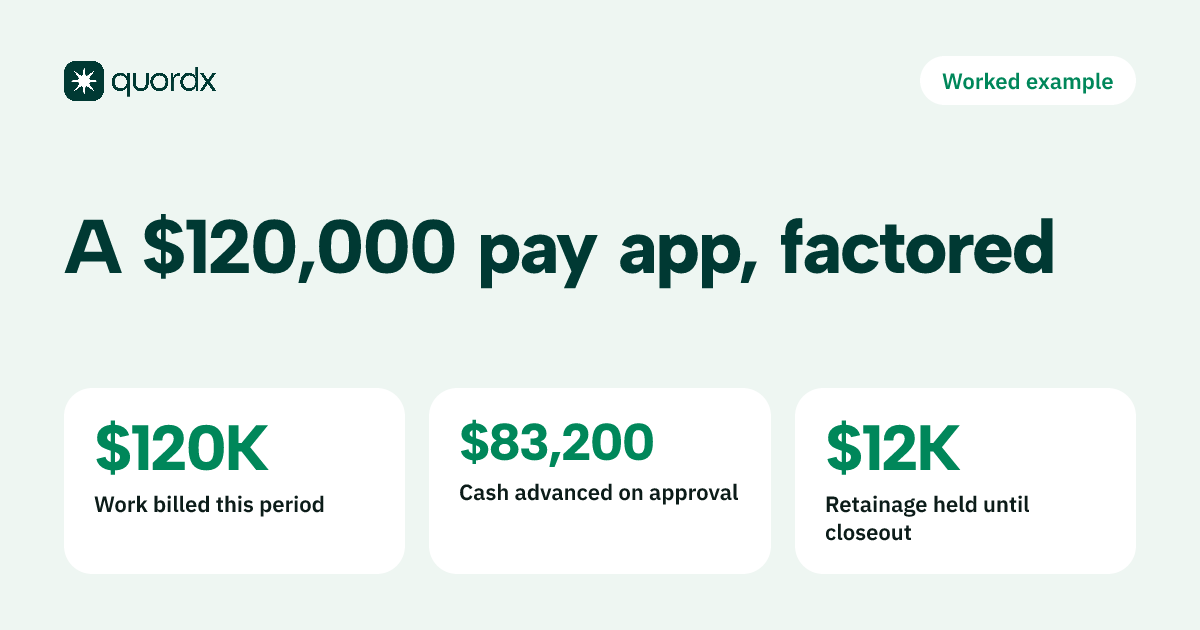
Worked example: factoring a retainage-heavy pay app
This is an illustration with stated assumptions. The advance rate and fee are hypothetical round numbers chosen to show the mechanics, not market rates or a quote.
The job: an electrical subcontractor has a $600,000 subcontract with 10% retainage on every billing. Its third pay app shows $270,000 of work completed to date, against $150,000 billed through the prior period, so this period's work is $120,000. The GC deducts a $4,000 backcharge for cleanup. Say the factor advances 80% of the approved payment due and charges 2% of it for each 30 days it stays unpaid, and the GC pays on day 50.
| Line | Amount | How it is worked out |
|---|---|---|
| Work completed this period | $120,000 | $270,000 to date minus $150,000 previously billed |
| Retainage held (10%) | $12,000 | Not financed; waits for closeout |
| Backcharge from the GC | $4,000 | Deducted from the payment |
| Approved payment due | $104,000 | $120,000 minus $12,000 minus $4,000 |
| Advance on approval (80%) | $83,200 | 80% of $104,000 |
| Reserve held by the factor | $20,800 | $104,000 minus $83,200 |
| Fee for 50 days (2 periods of 2%) | $4,160 | 4% of $104,000; day 31 starts a second period |
| Reserve returned when the GC pays | $16,640 | $20,800 minus $4,160 |
| Total cash from this pay app | $99,840 | $83,200 plus $16,640 |
The gap between work done and cash in hand is the point: The sub did $120,000 of work this month and got $83,200 up front, about 69% of the gross billing, even with a generous advance rate. The rest went to retainage, the backcharge and the reserve.
Retainage piles up across the job: If the 10% holds on every billing, $60,000 of this $600,000 subcontract sits with the GC at the end, none of it financeable until release. Plan that cash need separately, and read your contract for any step-down in retainage after the job reaches a set percentage complete.
Lien waivers, notices and who the GC pays
Lien waivers follow the money: When you get paid, you give the GC a waiver of your lien rights for that payment, and the GC wants matching waivers from your suppliers and lower-tier subs. A conditional waiver takes effect only when the payment actually arrives; an unconditional waiver gives up the rights when you sign. The forms and rules vary by state, so use the version your state and contract require.
A factor cares about both directions: It wants your suppliers' waivers, because an unpaid supplier with lien rights is a competing claim on the project. It also needs your waivers to the GC sequenced correctly, so you never sign an unconditional waiver for money that went to the factor and has not been confirmed.
The GC must be told where to pay: With a notice of assignment, the GC can no longer settle its debt by paying you and must pay the factor instead (UCC 9-406). Some GCs push back on this, so talk to your project manager and the GC's accounting team before the letter arrives.
Federal and public jobs
On federal construction contracts over $100,000, the prime contractor must post a payment bond that protects everyone supplying labor and material (40 U.S.C. 3131). Subs and suppliers on those jobs look to that bond for payment, and a factor will ask to see it.
Federal receivables have their own assignment rules: Under the Assignment of Claims Act, a prime contractor can assign money due under a federal contract of $1,000 or more to a financing institution only if the contract does not prohibit it, generally to a single assignee, and only after written notice and a copy of the assignment go to the contracting officer, the surety and the disbursing officer (31 U.S.C. 3727). Ask any factor whether it has handled these filings before.
What a construction-friendly factor looks for
Specialist factors still underwrite the paying party first. After that, they want proof the billing is real, approved and free of competing claims.
- Strong payers: a GC or owner with a solid payment record. A large GC on a bonded job is easier to fund than a small developer.
- A signed contract and schedule of values, plus signed change orders for any extra work you are billing.
- An approved pay app: a certified G702 or written GC approval of the amount, ideally with the GC acknowledging the payment due.
- Lien waivers: conditional waivers to the GC and waivers from your suppliers and lower-tier subs for prior payments.
- A clean AR aging with retainage shown separately, so the factor can see what is current, what is held back and what is late.
- A low history of backcharges and disputes with the GCs you are asking it to fund.
- Current license, general liability and workers' comp coverage, and no tax liens or prior liens on your receivables.
Decision rule: if you cannot get the GC to approve a pay app in writing, or your subcontract has a pay-if-paid clause on a job where the owner is shaky, expect a lower advance or a decline on that job. Fund those jobs with a different tool.
Other ways to cover construction cash gaps
Before the first pay app, there is nothing to factor: Mobilization, materials and the first weeks of payroll come before any billing. A line of credit or a short-term loan sized to the gap fits better; see our overview of loans for construction companies.
For a revolving need across many jobs: an established contractor with clean books may qualify for a business line of credit or an AR line secured by receivables, where you pay interest only on what you draw.
For trucks and equipment: finance the asset itself rather than tying it to receivables.
If you invoice finished work outside construction too, the general guide to accounts receivable financing and invoice factoring covers recourse, notification and spot versus whole-ledger terms, and our page on recourse vs non-recourse factoring explains who carries the loss if a GC never pays.
Comparing construction factoring offers through Quordx
Quordx is a broker, not a lender or a factor. One application, about 10 minutes, goes to lenders in a network of 50+ whose rules fit construction receivables, so you do not have to find out one general factor at a time that it does not take pay apps. Lenders typically decide in 24 to 48 hours, and funding typically follows in 3 to 7 business days, but each lender sets its own timeline and the first funding depends on how fast your pay apps and waivers can be verified.
It is free to the business owner; lenders pay Quordx when a deal funds. Most options can be explored without a hard credit pull.
Questions Business Owners Ask Before Applying
Can I factor my retainage?
Usually not while it is still held, because payment depends on project completion and closeout. Once retainage is released and billed as a final payment with closeout documents done, a factor can treat it like any other receivable.
Will the general contractor know I am using factoring?
Yes, with standard notification factoring. The GC receives a notice of assignment and must pay the factor directly, so tell your project manager and the GC's accounting team before the notice arrives.
Can a subcontractor factor invoices under a pay-when-paid contract?
Often, if the GC and owner are strong and the pay app is approved, because the factor is underwriting their ability to pay. A pay-if-paid clause on a job with a shaky owner is harder, since your right to be paid depends on the owner paying the GC.
Can I factor federal or government construction contracts?
Yes, but federal receivables follow the Assignment of Claims Act, which requires written notice to the contracting officer, the surety and the disbursing officer. Choose a factor that has handled those filings before.
Do residential contractors qualify for AR financing?
Factoring is built around business customers who pay on terms, so homeowner invoices are a harder fit. Residential builders working for developers or GCs on commercial terms are closer to the standard model.
Apply for Funding
No obligation · Initial inquiry doesn't impact credit · Takes about 10 minutes
Sources
- AIA Contract Documents: How to complete the G702 payment application
- Federal Acquisition Regulation 32.103: Progress payments under construction contracts
- 40 U.S.C. 3131: Bonds of contractors of public buildings or works (Miller Act)
- 31 U.S.C. 3727: Assignments of claims
- Uniform Commercial Code 9-406: Discharge of account debtor and notification of assignment

Written by
Cody Dreis
Founder, Quordx Capital
Read full bio
Related articles
Keep exploring industry financing
Quordx Capital is a business funding broker, not a lender. Lenders make every credit decision and set the rate, fees and terms, and not every business qualifies. Quordx may be paid by a lender when a deal funds. Full disclosures