

Can Amazon sellers get business loans?
Yes, Amazon sellers can get business loans, and plenty of lenders will fund marketplace revenue as long as they can trace it from Seller Central to your bank account. What shapes the offer is how steady your payouts are, how healthy your seller account is, how fast your inventory turns and how much of your year rides on Q4. Amazon itself no longer lends directly: its Amazon Lending program now connects invited sellers with third-party providers. Outside Amazon, sellers use inventory financing, revenue-based lines of credit, SBA loans and equipment financing.
The short version: Check Seller Central for an Amazon Lending invitation, then get at least one outside quote before you sign anything. Size a Q4 loan to the cash gap in your inventory order, not to the whole order, and make sure payments start after the new stock is selling. If every owner is a US citizen living in the United States and you can wait weeks rather than days, price an SBA 7(a) loan too.
Part of our industry guide: Industry Financing.
Last updated · Reviewed by Cody Dreis
50+ Lenders|Funding in as little as 24 hours
What lenders look at when an Amazon seller applies
Underwriting an Amazon business is mostly a question of cash timing. A lender wants to know how much money reaches your bank, how predictably it arrives and what could stop it. Four things answer that.
Payout history and Amazon's disbursement cycle
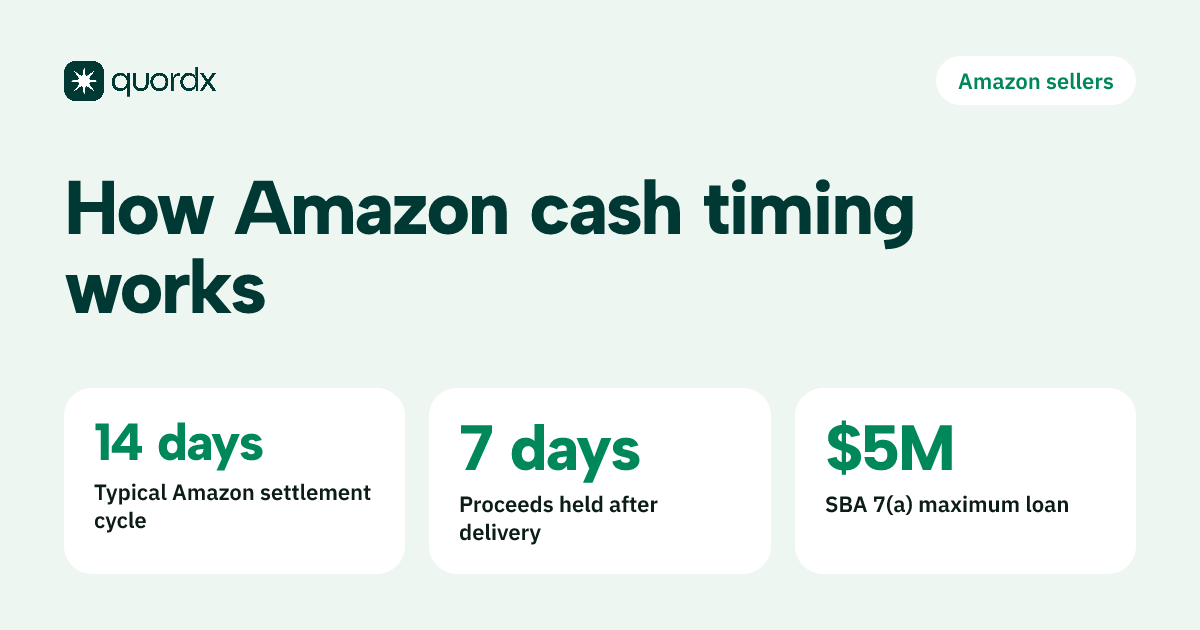
Amazon does not pay you when a customer buys. In its seller forums, Amazon says it disburses funds on a settlement cycle that is typically every 14 days for most sellers, and that it typically reserves sales proceeds until seven days after an order is delivered. Held amounts show as deferred transactions on your Payments dashboard.
What a lender sees: Amazon deposits landing about every two weeks, in amounts that rise and fall with sales. Many lenders match those deposits against your Seller Central reports. Send every payout to a business checking account, because Amazon money mixed into a personal account is harder to verify and easier to discount.
Why the cycle matters for borrowing: a sale made today can take weeks to become cash in your bank. A loan that starts collecting before your new stock has sold and paid out is being repaid with old money. That is how sellers end up short in December with a warehouse full of product.
Seller account health
Your Amazon account is the business's main asset, and every lender knows Amazon can restrict it. Amazon's own lending guide says eligibility can rest on your credit profile, sales history, or other business performance factors, and it recommends keeping the selling account in good health, earning strong customer feedback and growing sales steadily. Outside lenders ask for the same picture, usually through a read-only connection to Seller Central.
Clean these up before you apply: open warnings on the Account Health page, a rising order defect rate, suppressed or stranded listings on your best sellers, and any recent change to your reserve. A longer hold on payouts means less cash reaching the bank, and the lender will ask why.
Inventory turns
Inventory turns measure how many times a year you sell through your average stock: annual cost of goods sold divided by the average value of inventory on hand. A seller with $144,000 of annual product cost and $36,000 of average inventory turns 4 times a year, which is roughly 91 days of stock.
Faster turns make you easier to lend to: because inventory bought with borrowed money converts back to cash sooner. Slow turns and aged stock tell a lender that part of last year's money is still sitting on a shelf. Know your number before a lender works it out for you.
Seasonality and the Q4 spike
Many Amazon categories do a large share of the year between October and December. A lender reading 12 months of deposits will see that spike and the January drop after it, and will ask which months are normal.
Apply on your trailing numbers, not your best month: If November ran at double your average, a loan sized on November alone sets payments that January cannot cover. Bring month-by-month sales for your last two holiday seasons if you have them, so the lender can see the pattern repeats.
Amazon Lending in 2026: who actually provides the money
Amazon's lending program still exists, but Amazon is no longer the lender. Its own guide says Amazon Lending has discontinued offering Amazon loans directly to sellers and now connects them with third-party providers. Offers arrive as invitations in Seller Central, and accepting one means agreeing to share your Amazon selling data with that provider.
| Product type | Providers named on Amazon's program page |
|---|---|
| Term loan | Lendistry (through the Amazon Community Lending program), Parafin, QuickBooks Capital (loans issued by WebBank), Uncapped |
| SBA 7(a) loan | iBusiness Funding |
| Merchant cash advance | Parafin |
| Line of credit | Slope, Uncapped |
The convenience is real, and so is the limit: You cannot shop Amazon Lending without an invitation, and the offer you see is the one a provider chose to make from your data. Treat it as one quote. Compare the total dollars repaid and the payment schedule against an outside offer before you accept.
Read the repayment mechanics: Amazon's program page describes term loans repaid in equal weekly, biweekly or monthly payments, and a merchant cash advance repaid from a portion of future sales for a fixed capital fee. A fixed payment does not shrink in a slow January. A sales-based payment does, but a fixed fee stays the same whether you repay in four months or ten, so a fast payoff raises the effective cost.
Estimate your funding
Answer a few questions about your business to see a likely range.
Business loan options for Amazon sellers outside Amazon
Inventory financing
Inventory financing is any loan or advance used to buy stock and repaid as that stock sells. Some providers build products around marketplace sellers: 8fig offers a Growth Plan for Amazon and Shopify sellers, and SellersFi lists a line of credit, term loans and inventory financing for Amazon sellers. Wholesale sellers whose supplier wants cash against a confirmed order can use purchase order financing, which pays the supplier directly.
Our guide on how to get inventory financing covers the documents and the application.
Revenue-based line of credit
A revenue-based line sets your limit from your sales data and lets you draw, repay and draw again. It fits the reorder loop of an Amazon business: draw to pay the supplier, repay as payouts land, draw for the next order. Read how each draw is repaid, since some lines set a fixed term per draw. Our ecommerce line of credit guide goes deeper on limits and draws.
A close cousin is payout acceleration. Payability advances part of your Amazon sales ahead of Amazon's normal payout schedule. That closes the gap between a sale and a deposit, but it does not pay for a large inventory order. See revenue-based financing for how sales-linked repayment changes the real cost.
SBA loans
An SBA 7(a) loan is often the lowest-cost long-term money an established seller can get, and the slowest. SBA lists short- and long-term working capital among eligible uses, with a maximum 7(a) loan of $5 million. Rates are capped by loan size: with prime at 7.00% as of October 2026, the variable-rate cap is 10.00% on loans over $350,000 and 13.00% on loans from $50,001 to $250,000.
Two catches for sellers: SBA's terms table lists 5 to 10 business days for a standard 7(a), and the lender's own underwriting comes before that, so an October application is not Q4 money. And under an SBA policy that took effect March 1, 2026, every direct and indirect owner must be a US citizen or US national living in the United States, so a green card holder or foreign co-owner makes the business ineligible. That policy has been challenged, so confirm the current rule with the lender.
Equipment financing
Sellers who prep, pack or store their own goods buy equipment: pallet racking, a forklift, label printers, a shrink-wrap station, a product photo setup. Equipment financing uses the equipment as collateral, so it leans less on your payout history than an unsecured loan does. For tax year 2026, Section 179 lets a business expense up to $2,560,000 of qualifying equipment, limited to taxable business income. Quordx is not a tax advisor, so ask your CPA how it applies to you.
Worked example: sizing a Q4 inventory buy with a loan
Here is how to size a loan for a holiday order. Every number below is a hypothetical example, not a market rate or a typical seller, so swap in your own.
- Unit economics: price $30. Landed cost (product, freight, duty) $8. Amazon referral and FBA fees $10. Ad spend $4 a unit. That leaves $8 of contribution per unit before overhead.
- Normal sales: 1,500 units a month.
- Q4 forecast: 1,800 units in October, 3,000 in November and 3,600 in December, for 8,400 units.
- January cover: 4 more weeks of stock (1,200 units), because the next shipment will not land until February.
- What you have: 2,400 units on hand and inbound, plus $20,000 of cash you can put toward inventory after payroll and overhead.
Step 1: units and dollars to order
Units needed are 8,400 plus 1,200, or 9,600. Subtract the 2,400 you have and you order 7,200 units. At $8 landed, the order costs $57,600.
Step 2: find the cash gap
$57,600 minus your $20,000 leaves a $37,600 gap. Round up to $40,000 to absorb a freight surprise. That is the loan. Borrowing the full $57,600 means paying a fee on cash you already had.
Step 3: test repayment against a bad quarter
Say the offer you are weighing carries a fixed fee of $4,000, so you repay $44,000. Now run the quarter at forecast and at 25% below forecast.
| Scenario | Units sold in Q4 | Contribution at $8 a unit | Left after repaying $44,000 | Extra stock carried into January |
|---|---|---|---|---|
| At forecast | 8,400 | $67,200 | $23,200 | None beyond the planned 1,200 units |
| 25% below forecast | 6,300 | $50,400 | $6,400 | 2,100 units ($16,800 at cost) |
The downside case still repays the loan, but only just, and it leaves $16,800 of cash sitting in stock until spring. If your weak case cannot cover repayment, order less.
Step 4: match the payment schedule to your payouts
Most of this quarter's cash arrives from late November on, and Amazon's delivery reserve and settlement cycle push late-December sales into January deposits. A loan with weekly payments starting in October collects from money the new stock has not produced yet. Decision rule: if the first payment lands before your stock is selling, ask for a later start or use a product whose payments follow sales.
Mistakes Amazon sellers make with business loans
- Taking the first invitation without a second quote. An Amazon Lending offer is convenient. Convenient and cheapest are different things.
- Stacking sales-based advances. Two advances pulling from the same payouts can take more than your margin. Pay one off or refinance before adding another.
- Sizing to the forecast instead of the floor. Borrow what your weak-case sales can repay.
- Spending inventory money on ads. Once the order cash goes to PPC, the reorder has no funding and the loan is still due.
- Starting the funding search when the order ships. If your supplier needs 60 days plus ocean freight, the holiday order is paid for in summer. Line up the money when you place the order.
Where Quordx fits for Amazon sellers
Quordx is a broker, not a lender. One application, about 10 minutes, reaches lenders in a network of 50+ that work with marketplace revenue, and those lenders make every credit decision. Most options can be explored without a hard credit pull, and lenders typically return decisions in 24 to 48 hours.
It is free to the business owner; lenders pay Quordx when a deal funds. Quordx does not serve businesses in Virginia, Connecticut, Missouri or North Dakota, and California applicants see a state notice first. If your Amazon Lending invitation turns out to be the best offer you get, take it. For the slow months after the holidays, see seasonal working capital.
Questions Business Owners Ask Before Applying
Does Amazon still lend money to sellers directly?
No. Amazon's own guide says Amazon Lending has discontinued offering Amazon loans directly to sellers. The program now connects invited sellers with third-party providers, which on October 12, 2026 included Lendistry, Parafin, QuickBooks Capital, Uncapped, iBusiness Funding and Slope.
Can I get a loan while Amazon is holding my funds in reserve?
You can apply, but a lender will count only the money that reaches your bank. Held amounts show as deferred transactions in Seller Central, and a lender reading your payment reports will see them. Ask Seller Support why a hold was extended and when it releases, and have that answer ready for the lender.
Do Amazon seller loans check my personal credit?
Sometimes. Amazon's guide says eligibility may use your credit profile, sales history or other business performance factors, and that in many cases no credit check is required for its providers' offers. Outside lenders vary: some price mostly from sales data, while SBA lenders review the credit history of the applicant and its guarantors.
How long do I need to sell on Amazon before a lender will fund me?
There is no single rule. Each lender sets its own minimum, and many publish it on their site. History through at least one holiday season helps with any lender, because it shows how the business handles the spike and the drop.
Should I use a term loan or a merchant cash advance for Q4 inventory?
Compare the total dollars repaid and when the payments fall. A term loan with fixed payments costs less if you repay early but does not flex in a slow January. An advance repaid from sales flexes, but its fixed fee does not shrink when you repay fast, so run both through the repayment test above.
What if I sell on Shopify or my own site as well as Amazon?
Lenders that fund e-commerce sellers can usually read more than one sales channel, and some products, such as 8fig's Growth Plan, name both Amazon and Shopify. Shopify Capital works much like Amazon Lending: Shopify evaluates your store data, and an offer still needs an application before it funds. Combined channel revenue in one business bank account makes any application easier to read.
Apply for Funding
No obligation · Initial inquiry doesn't impact credit · Takes about 10 minutes
Sources

Written by
Cody Dreis
Founder, Quordx Capital
Read full bio
Related articles
Keep exploring industry financing
Quordx Capital is a business funding broker, not a lender. Lenders make every credit decision and set the rate, fees and terms, and not every business qualifies. Quordx may be paid by a lender when a deal funds. Full disclosures