

Ecommerce business line of credit: how it works for online sellers
An ecommerce business line of credit lets an online seller draw to pay a supplier, repay as platform payouts land, and draw again for the next order without reapplying. Lenders size it from what they can verify in your connected bank and store accounts: steady payouts, margins after ad spend and platform fees, and how fast inventory turns back into cash. It fits the reorder loop well, but only if each batch of stock sells through fast enough to clear the line before the next supplier payment is due.
The short version: Map one full inventory cycle in days, from supplier deposit to the last payout, and size the line to the peak balance in that cycle with room for a second order. Send every platform payout to one business account, because lenders count deposits, not your store dashboard. Use a line for repeating inventory buys, and use a term loan or equipment financing for one-time projects like a warehouse move.
Part of our industry guide: Industry Financing.
Last updated · Reviewed by Cody Dreis
50+ Lenders|Funding in as little as 24 hours
How a line of credit fits the ecommerce cash cycle
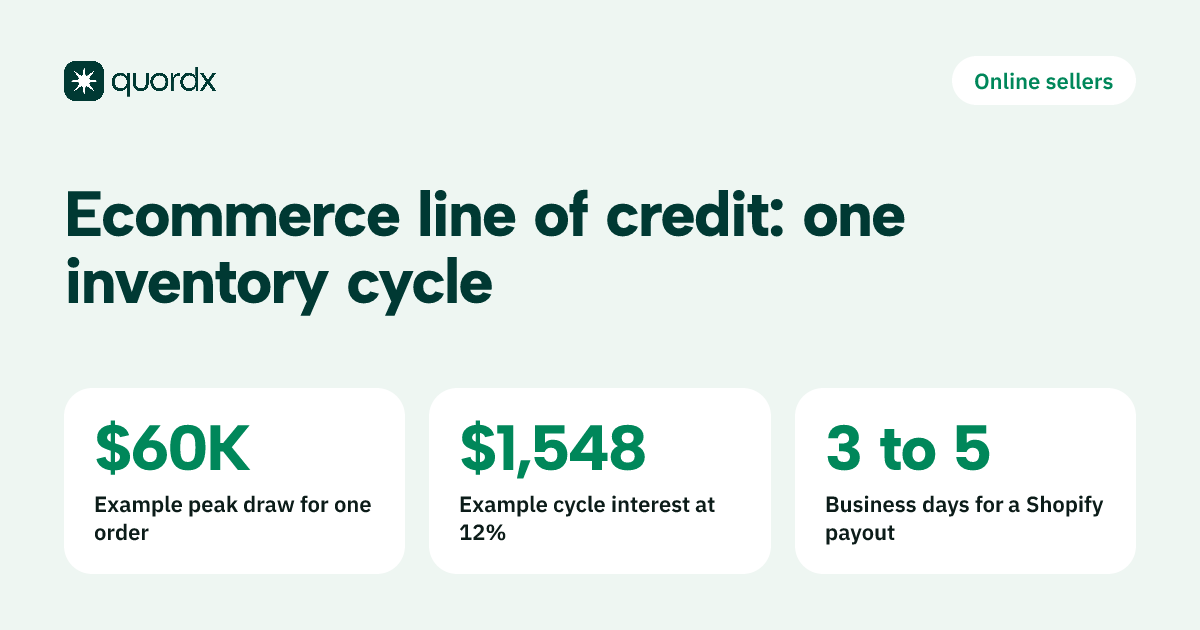
An online store pays for stock weeks or months before it gets paid for it. A line covers that stretch, and its cost depends on how many days the money is out. Here is one purchase order traced through the line. All numbers are hypothetical.
- Day 0: you place a $60,000 order (product plus freight) and pay the supplier a 30% deposit, $18,000, from the line.
- Day 45: the goods ship and you pay the other 70%, $42,000. The line balance is now $60,000.
- Day 75: stock arrives and goes live. It sells evenly over the next 60 days.
- Days 80 to 140: you repay the line from payouts as they land, evenly, until the balance is zero.
At a hypothetical 12% rate with daily interest, the cycle costs about $1,548: $18,000 for 45 days, $60,000 for 35 days, then an average of $30,000 for 60 days. Borrow the same $60,000 as a 12-month term loan at the same 12% and you pay about $3,971 in interest over the year, starting on money you would not need for 45 days.
The real risk: slow sell-through
Now say the same stock takes 120 days to sell instead of 60. Interest rises to about $2,140, which is manageable. The bigger problem is the next order.
If you have a $75,000 line and place the next order on day 120, the balance from the first batch is still $40,000 instead of $20,000. When that second order's $42,000 balance comes due on day 165, you would need $77,500 of a $75,000 line.
Decision rule: size the line to your peak balance across two overlapping orders, not one, and test it at half your normal sell-through speed. If the slow case breaks the line, order smaller or space the orders out.
What lenders look at when an online seller applies
Most lenders that fund online sellers underwrite from connected accounts. You link your business bank account, and often your store or marketplace account, through a read-only connection, and the lender reads months of activity directly instead of relying on uploaded PDFs.
Payouts, not sales
A lender counts the money that reaches your bank. Platform payouts arrive net of refunds and processing fees, so they are always smaller than the sales figure on your dashboard.
| Hypothetical month | Amount |
|---|---|
| Gross sales on the store dashboard | $100,000 |
| Refunds | minus $6,000 |
| Payment processing fees (a hypothetical 3% of $94,000) | minus $2,820 |
| Payouts that reach the bank | $91,180 |
If you apply quoting $100,000 a month and the lender sees $91,180, the gap costs you credibility. Quote the deposit figure.
Payout timing and patterns
Each platform pays on its own schedule, and the pattern shows up in your statements. For US Shopify Payments stores, Shopify says the minimum settlement time is 3 business days, new merchants start on a longer settlement time, and payouts typically arrive 3 to 5 business days after a payment is captured. Payments captured Friday through Sunday are combined into a single payout, so a weekend-heavy store shows one large deposit and several smaller ones each week. Amazon pays on a different cycle with its own reserves; our Amazon seller guide covers that in detail.
What else they read
- Trend: whether payouts are growing, flat or falling over the last several months.
- Refunds, chargebacks and disputes: a rising rate signals product or fulfillment trouble.
- Reserves and holds: a platform holding back part of your payouts means less cash reaching the bank, and the lender will ask why.
- Channel concentration: one marketplace providing nearly all revenue means one account suspension can stop the business.
- Ad spend: if advertising eats most of the margin, there is little left to repay a draw.
- Other debits: existing loan, advance or platform financing payments reduce what you can carry.
Run the numbers on your loan
Pick a product, set the amount and term, and see a typical payment.
Platform financing vs an outside line of credit
Some platforms offer their own financing. Shopify Capital is an example: offers are invitation-only, set by Shopify's underwriting model from your store data, and repaid automatically with a fixed percentage of your daily sales, only on days you make sales. Shopify says its US loans are issued by WebBank. Amazon Lending offers financing through third-party providers, and you check for offers as invitations in Seller Central.
| Platform financing | Outside line of credit | |
|---|---|---|
| How you get it | By invitation, from that platform's data | You apply; the lender reads your bank and store accounts |
| What it sees | One sales channel | All channels that pay into your bank account |
| Repayment | Usually taken from sales before the payout reaches you | Payments from your bank account, on the line's terms |
| Reuse | Usually a new offer each time | Draw, repay and draw again up to the limit |
Watch the interaction: Repayment taken out of sales before the payout shrinks the deposits an outside lender sees, so platform financing can lower the line you qualify for. If you plan to use both, apply for the line first or tell the line lender about the platform financing up front.
Ecommerce business loans: when a line isn't the right tool
Online sellers borrow for inventory, advertising and fulfillment, and those needs don't all fit one product. Match the money to how the thing you are paying for turns back into cash.
| What you are paying for | Better fit | Why |
|---|---|---|
| Repeating inventory orders | Line of credit | Draw for each order, repay as it sells |
| One large seasonal buy | Short-term loan or inventory financing | A fixed amount once, repaid after the season |
| A confirmed wholesale order you can't fund | Purchase order financing | The financier pays your supplier directly |
| Ad spend to scale a proven product | Line of credit or revenue-based financing | Repaid from the sales the ads produce |
| Warehouse racking, packing equipment, a forklift | Equipment financing | The equipment secures the loan |
| Moving to a 3PL or a new warehouse | Term loan | One-time cost that pays back over years |
For stock purchases specifically, see how to get inventory financing and purchase order financing. For ad-driven growth repaid from sales, revenue-based financing explains how sales-linked repayment changes the real cost. Racking and packing lines belong on equipment financing.
On advertising: a draw for ads works when you know a campaign's return from past data and the sales arrive within a few weeks. Funding untested campaigns with a line turns a marketing experiment into debt.
Seasonality and the year-end review
Many online stores do a large share of the year in the fourth quarter, then drop in January. That pattern affects a line twice. Before the season, you draw heavily for stock, so make sure the limit covers the peak with room for a reorder. After the season, many lenders review lines on recent statements, and January deposits are your weakest.
Pay the line down from holiday payouts before any review if you can, and send the lender month-by-month sales for your last two seasons so a January drop reads as a normal pattern. Seasonal working capital covers the slow months.
Mistakes online sellers make with a line of credit
- Letting payouts land in a personal account. Deposits the lender can't see don't count toward your limit.
- Applying on your dashboard's gross sales. Quote payouts, and expect the lender to check.
- Drawing the full order cost at the deposit stage. Draw the 30% when it is due and the 70% when it is due, and you pay interest on less.
- Leaving last season's stock on the line. Aged inventory that hasn't sold keeps the balance up and blocks the next order.
- Adding platform financing without telling the line lender. It can reduce your deposits and break a covenant on new debt.
Where Quordx fits for online sellers
Quordx works as a broker, so it arranges financing rather than providing it. For an online store with steady payouts, it can send one application to lenders that offer lines of credit and term loans and that read connected accounts, and those lenders decide the limit and terms. The lenders it works with want roughly $17,000 a month in revenue and usually a full year of selling, so a store still in its first season is better served by platform financing first.
Quordx does not place inventory financing or purchase order financing. For those, go to a specialist directly or start with your platform's own program. Lenders, not the business owner, pay Quordx when a deal funds.
Sellers based in Virginia, Connecticut, Missouri or North Dakota can't apply through Quordx, and California sellers see a notice first. When your payouts are ready for an outside line, apply here.
Questions Business Owners Ask Before Applying
Can a new Shopify store get a business line of credit?
It is hard in the first few months, because lenders need payout history to size a line, and Shopify starts new merchants on a longer settlement time. Platform financing offered by invitation, a business credit card or a cash-secured bank line are the usual first steps. Once you have several months of steady payouts in a business account, outside lines become realistic.
Do lenders count Amazon, Shopify and other channels together?
Lenders that read your bank account see every payout that lands there, from every channel. That is why routing all channels into one business account matters. Some lenders also connect directly to store and marketplace accounts to match deposits to sales.
What is the difference between an ecommerce business loan and a line of credit?
A loan pays a lump sum once and you repay it on a fixed schedule, which suits a one-time cost like a warehouse move or equipment. A line lets you draw repeatedly up to a limit and pay interest only on what is drawn, which suits recurring inventory orders. Many sellers use both.
Do I need collateral for an ecommerce line of credit?
Usually not a specific asset, but most lines carry a personal guarantee or a general lien on business assets. Many lenders treat inventory alone as weaker collateral than receivables or equipment, because it can be slow to sell if the business fails.
Can I use a business line of credit for Facebook or Google ads?
Yes, draws can usually fund any business purpose. It makes sense when the campaign's return is proven and the sales land within weeks, so the draw repays itself. For untested campaigns, use cash you can afford to lose.
Apply for Funding
No obligation · Initial inquiry doesn't impact credit · Takes about 10 minutes
Sources

Written by
Cody Dreis
Founder, Quordx Capital
Read full bio
Related articles
Keep exploring industry financing
Quordx Capital is a business funding broker, not a lender. Lenders make every credit decision and set the rate, fees and terms, and not every business qualifies. Quordx may be paid by a lender when a deal funds. Full disclosures