

What is the average business line of credit limit?
There is no reliable average business line of credit limit, because no public data source reports one: the Federal Reserve's Small Business Credit Survey groups lines of credit with loans and cash advances, and the averages quoted online come from lenders' own marketing. What lenders actually do is size each line against the business in front of them, mainly its verified deposits, the cash flow left after existing debt payments, and any receivables or inventory that can back it. The number that matters is the limit your own numbers support, and you can estimate it before you apply.
The short version: Work out your true monthly deposits (revenue only, no transfers or loan proceeds) and your existing debt payments, because those two numbers drive most offers. Expect a first line to start below what you asked for, then grow it by using it, repaying cleanly and asking for an increase at review with updated financials. If a lender cuts your request, ask why: the reason tells you exactly what to fix.
Part of our guide to Business Loans.
Last updated · Reviewed by Cody Dreis
50+ Lenders|Funding in as little as 24 hours
Why a business line of credit average doesn't help you
Even if a clean average existed, it would mix a lawn care company's starter line with a distributor's asset-based facility. Your limit comes from your file, not the market's.
What the public data does show is that limits often come in under the request: In the Fed's 2026 Report on Employer Firms, only 42% of applicants for financing received the full amount they sought. Another 36% received some or most of it, and 22% received none. If a lender offers less than you asked for, you are in the majority, and the rest of this page explains why and what moves the number.
How lenders size a business line of credit limit
Most lenders use one or more of three methods. Every multiple and percentage below is a hypothetical example, chosen to show how the math works. Each lender sets its own figures and rarely publishes them.
Step one: your true monthly deposits
Lenders start from the money that reaches your business account from customers. Say your statements show $58,000 a month in average deposits. Of that, $5,000 is transfers from the owner's savings and $3,000 is proceeds from an old equipment loan. Neither is revenue, so the lender counts $50,000 a month, or $600,000 a year.
Mixed accounts shrink this number: Revenue split across several accounts, or run through a personal one, is revenue the lender may not count.
Method 1: a share of revenue or deposits
Many online lenders cap a line at a share of revenue. If one lender's rule were 10% of annual revenue, your $600,000 business would see a $60,000 line. If another capped a first line at one month of true deposits, the same business would see $50,000. Same business, same month, two different limits.
Method 2: payment capacity
Banks usually size from cash flow and existing debt, and test the line as if it were fully drawn. Suppose your cash flow available for debt service is $120,000 a year and the bank wants coverage of 1.25x. Total annual debt payments can be up to $120,000 / 1.25 = $96,000. You already pay $48,000 a year on other debt, so the room left is $48,000.
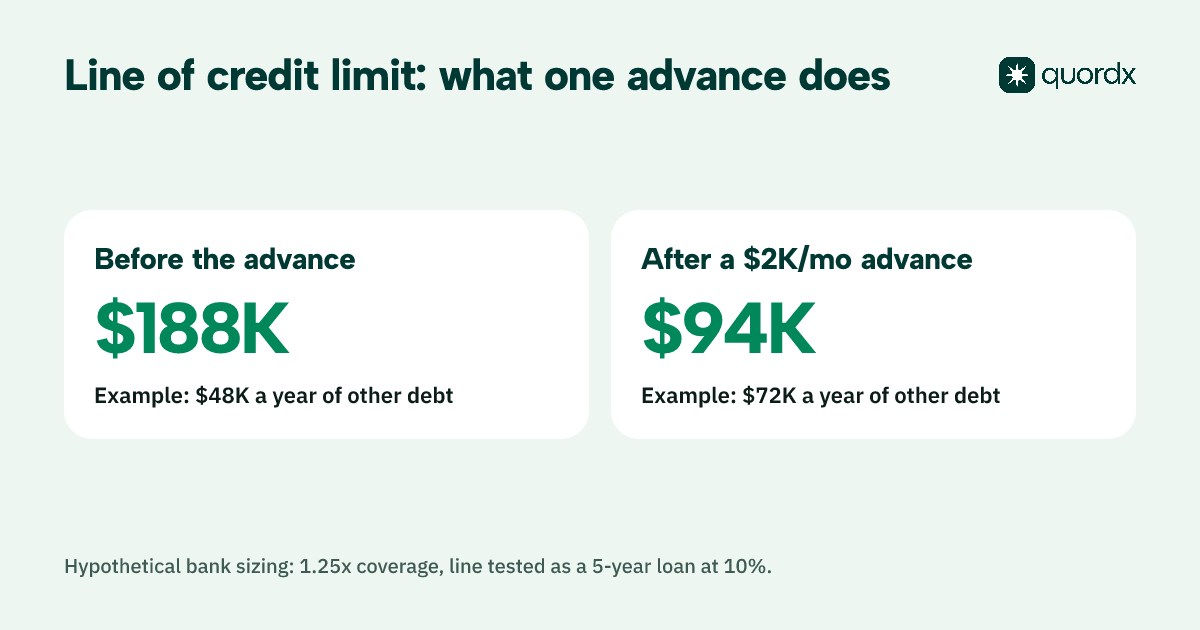
Now the bank asks what limit, if fully drawn and paid off over 5 years at a hypothetical 10%, would cost $48,000 a year. Each $100,000 of limit would cost $2,124.70 a month, or about $25,496 a year. So the room supports a line of about $188,000 ($48,000 / $25,496 x $100,000). How DSCR is calculated explains the coverage ratio itself.
Existing debt hits this method hard: If you had also taken a cash advance costing $2,000 a month, your existing payments would be $72,000, the room would fall to $24,000, and the same business would qualify for about $94,000. One advance cut the line in half.
Method 3: a borrowing base
Asset-based lines recalculate the limit from collateral. Say the agreement lends against 80% of eligible receivables and 50% of eligible inventory, and treats invoices over 90 days old as ineligible. You have $200,000 of receivables, of which $30,000 is past 90 days, plus $100,000 of inventory at cost.
| Borrowing base item | Eligible amount | Hypothetical advance rate | Counts toward the base |
|---|---|---|---|
| Receivables under 90 days | $170,000 | 80% | $136,000 |
| Inventory at cost | $100,000 | 50% | $50,000 |
| Borrowing base | $186,000 | ||
| Committed line | $150,000 | ||
| What you can draw | $150,000 (the lower of the two) |
If a slow month drops eligible receivables to $120,000, the base falls to $146,000 and you can draw $4,000 less than the committed line. A borrowing-base line moves with your business every month, in both directions.
| Method | Who tends to use it | What raises your limit |
|---|---|---|
| Share of revenue or deposits | Online lenders | Higher, steadier true deposits in one business account |
| Payment capacity | Banks and SBA lenders | More cash flow, fewer existing debt payments |
| Borrowing base | Asset-based lenders | More eligible receivables and inventory, faster-paying customers |
Run the numbers on your loan
Pick a product, set the amount and term, and see a typical payment.
Why your first business line of credit starts small
The lender commits the whole limit on day one: It can't see what you will draw it for, and it has no repayment history with you yet. A smaller first line limits what it can lose while it learns how you use credit.
Your file may support less than your plan: Credit, time in business, industry, and existing liens and advances all pull the number down from what the revenue method alone would suggest. A personal guarantee is common, so a weak personal score can cap a strong business.
Some banks start with your own cash: A cash-secured line sets the limit equal to a deposit you place with the bank. It is small by design, and the bank may later review you for an unsecured line. If you are new, getting a line of credit as a new business covers the starting options.
Decision rule: if the first offer is below your largest expected gap, take it only if it still covers a real need, and plan the increase from day one. A line too small to use builds no history.
How to get a business line of credit increase
- Use the line and pay it down. A line that is drawn and repaid on time, with the balance falling to zero between needs, is the strongest case you can make. A line that sits unused proves nothing.
- Grow deposits where the lender can see them. Under the revenue method, the increase follows the deposits. If your business grows from $600,000 to $840,000 a year, a hypothetical 10% rule moves the line from $60,000 to $84,000.
- Pay off other debt before you ask. Under the payment-capacity method, every dollar of payments you retire frees room. Retiring the $2,000-a-month advance in the example above roughly doubles the supportable line.
- Ask at review time, with fresh numbers. Bring your latest tax return, a year-to-date profit and loss statement and a short note on what the larger line is for.
- Avoid new advances and liens first. A new lien or a daily debit from a cash advance can stop an increase, and on some lines it can trigger a cut.
- Ask whether an increase means a new credit pull. Some lenders treat an increase like a new application.
If the lender says no, ask for the reasons
Under Regulation B, a refusal to increase a line you applied to increase counts as adverse action (12 CFR 1002.2(c)). So does a refusal to grant credit in substantially the amount you asked for, unless the lender makes a counteroffer and you accept or use it.
For a business with gross revenues of $1 million or less, the lender must notify you of the decision and of your right to ask for the specific reasons, and it may give that second notice when you apply. If you ask within 60 days, the lender has 30 days to give them (12 CFR 1002.9). Ask before you accept a smaller counteroffer, because accepting or using it takes the decision out of the adverse action rules.
If the line you qualify for is too small
Pair it with a term loan: Put the one-time part of the need on fixed payments and keep the line for the swings. Size them together, because each counts against the other. Line of credit vs business loan shows which part belongs where.
Ask your bank about an SBA Express line: SBA's terms page allows Express lines up to $500,000 that can revolve for up to 10 years, and the bank makes the credit decision.
Finance the asset instead of the gap: If receivables are what tie up your cash, invoice financing vs a line of credit compares the two.
Don't stack a cash advance on top: It adds daily or weekly debits that shrink every future line you apply for, as the payment-capacity example shows.
Mistakes that keep a line of credit limit low
- Running revenue through several accounts, or a personal one. The lender sizes from the account it reads.
- Asking for a limit you can't explain. "As much as possible" gets a cautious number. A specific gap with a payback plan gets a real one.
- Drawing the full limit on day one and leaving it there. It tells the lender the line is funding a permanent need.
- Applying right after a weak quarter. Wait for statements that show your normal level if you can.
- Shopping the increase to five lenders at once. Each hard pull and each new account opened can weigh on your personal credit.
How Quordx can help size a line
Quordx is a broker and doesn't lend its own money. It sends one application to lenders that offer lines of credit, and each lender runs its own sizing, so the limits that come back show you how your file reads to more than one underwriter. That is useful when your bank's number feels low and you want to know whether the issue is your file or that bank's method.
The lenders Quordx works with for lines start at roughly $17,000 in monthly revenue, usually with a year of history, and they decide the limit and price. Borrowing-base facilities and SBA Express lines are outside what Quordx places, so take those to an asset-based lender or your bank. There is no cost to the business: the lender pays Quordx if a deal funds.
It does not work with businesses in Virginia, Connecticut, Missouri or North Dakota, and it shows California applicants a notice up front. The full business line of credit guide covers fees and covenants before you apply.
Questions Business Owners Ask Before Applying
Should I ask for a higher line of credit than I need?
Ask for what you can justify with a specific gap and a payback plan. An inflated request with no reason behind it tends to get a cautious counteroffer, and some lines charge annual or unused fees on the full limit. If you expect to grow, say so and ask how the lender handles increases.
How often can I ask for a line of credit increase?
There is no set rule; it depends on the lender. Many review lines on a schedule, often yearly, and that is the natural time to ask. Asking after a strong season, with statements that show it, beats asking every few months.
Can a lender lower my limit without me asking?
Yes, if the agreement allows it, which most do. Falling deposits, a new lien or cash advance, a covenant breach or a credit drop can lead to a lower limit or frozen draws. Under Regulation B, an unfavorable change to your account that doesn't affect all or substantially all of a class of the lender's accounts is adverse action, so you can ask why.
Does a higher business line of credit limit help my credit?
It can, if the lender reports the line and you keep the balance well below the limit, since lower use of available credit generally reads better. Whether it shows on your personal or business report depends on the lender. Ask which bureaus it reports to.
Is a business credit card limit the same as a line of credit limit?
No. Card limits are usually set from personal credit and income, and the card is built for purchases. A line of credit is sized from the business's deposits, cash flow or collateral, and draws go to your bank account for any business use.
Apply for Funding
No obligation · Initial inquiry doesn't impact credit · Takes about 10 minutes
Sources

Written by
Cody Dreis
Founder, Quordx Capital
Read full bio
Related articles
Keep exploring business loans
Quordx Capital is a business funding broker, not a lender. Lenders make every credit decision and set the rate, fees and terms, and not every business qualifies. Quordx may be paid by a lender when a deal funds. Full disclosures