

Average business loan interest rates: what sets your rate in 2026
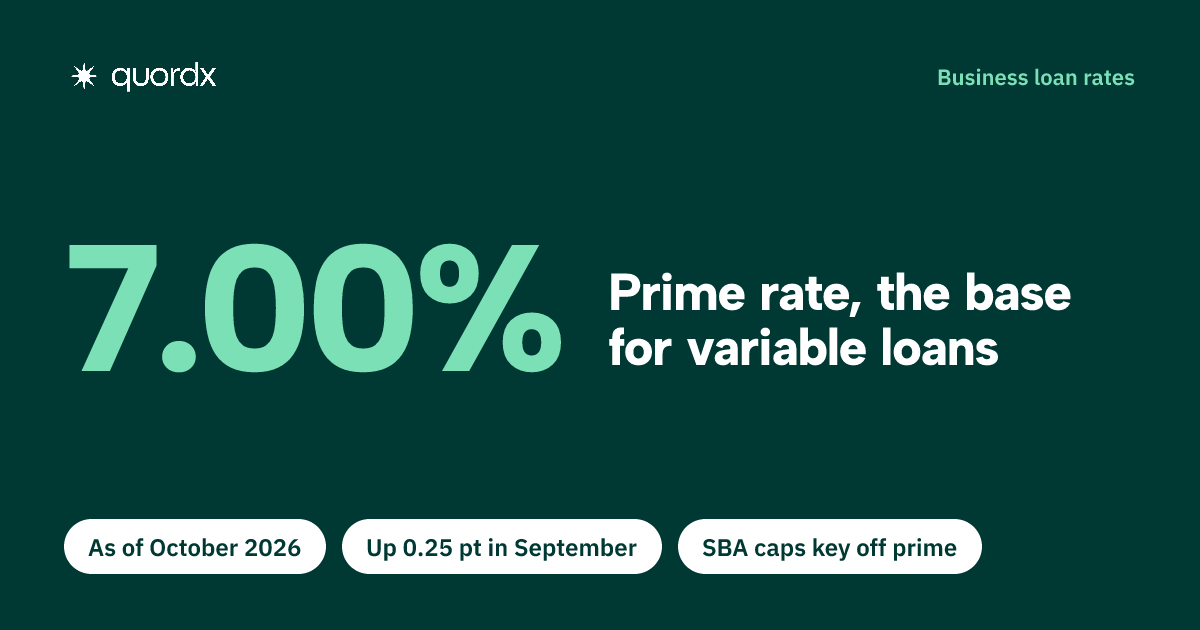
There is no single average business loan interest rate worth quoting, because the rate you pay depends on the kind of loan, the kind of lender, and how risky your business looks to that lender. What you can pin down is the base most variable loans are priced from: the prime rate, 7.00% as of October 2026, plus the SBA's published caps on how far above prime a 7(a) lender may go. Everything else (online loans, lines of credit, equipment finance, cash advances) is priced deal by deal, and no neutral source publishes a reliable average for those products. So the useful question is not what the average is, but what your offers actually cost once fees and term are counted.
The short version: Prime is 7.00% as of October 2026, and SBA 7(a) variable rates are capped at prime plus 3.0 to 6.5 points depending on loan size. Your own rate depends on credit, time in business, cash flow, collateral and term. Compare offers by APR when the terms match and by total dollars repaid when they don't, and run every offer through the business loan payment calculator before you sign.
Part of our guide to Business Loans.
Last updated · Reviewed by Cody Dreis
50+ Lenders|Funding in as little as 24 hours
Why there is no reliable average business loan rate
Business loans are not one product: A 10-year SBA loan, a 12-month online term loan and a merchant cash advance are priced in different units, by different lenders, for different risks. Averaging them together produces a number that describes nobody.
The best public data covers banks only: The Federal Reserve Bank of Kansas City runs a quarterly Small Business Lending Survey that collects interest rates on new small business term loans and lines of credit at commercial banks. It is the most credible place to look for bank pricing, and it says nothing about online lenders, cash advances, factoring or non-bank equipment finance.
Most published ranges for non-bank products are marketing: When we traced the rate ranges printed for lines of credit, equipment finance and cash advances, they led back to lenders' and brokers' own sales pages, not to a neutral source. We don't repeat them here. What we can give you is the sourced anchor (prime), the sourced ceilings (SBA caps and fees), and the math to compare real quotes.
The prime rate in October 2026, and why your rate starts there
Prime is 7.00%, effective September 17, 2026: The Federal Reserve raised its federal funds target range by a quarter point to 3.75% to 4.00% at its September 15 to 16 meeting, and prime moved up with it, as it runs 3 points above the top of that range. The Fed's H.15 release shows the bank prime loan rate at 7.00% into October 2026. It had been 6.75% since December 2025.
Variable business loans reset when prime moves: Most bank and SBA variable loans are quoted as prime plus a spread, so your spread stays fixed and your rate follows prime. On a $250,000 variable balance, the September quarter-point increase adds roughly $625 a year in interest ($250,000 x 0.25%) for as long as the balance stays near that level.
The next Fed meeting is October 27 to 28, 2026: If you are choosing between a fixed and a variable offer, that is the date that can change the comparison. A fixed rate removes the risk of further increases. A variable rate lets you benefit if rates fall.
Run the numbers on your loan
Pick a product, set the amount and term, and see a typical payment.
SBA 7(a) loan rate caps and fees as of October 2026
SBA doesn't set your rate, it caps it: For variable-rate 7(a) loans, the SBA's terms page limits the rate to a base rate plus a maximum spread that depends only on loan size. Lenders can price below the cap. Since March 1, 2026, lenders may also use Treasury or SOFR base rates, but the ceiling still may not exceed prime plus the allowed spread.
| 7(a) loan amount | Maximum variable rate | Ceiling with prime at 7.00% |
|---|---|---|
| $50,000 or less | Prime + 6.5% | 13.50% |
| $50,001 to $250,000 | Prime + 6.0% | 13.00% |
| $250,001 to $350,000 | Prime + 4.5% | 11.50% |
| More than $350,000 | Prime + 3.0% | 10.00% |
Fixed-rate SBA caps change monthly: SBA publishes its maximum fixed 7(a) rates each month rather than as a standing table, so we don't print a figure that may be stale by the time you read it. Ask the lender for the current maximum alongside its quote.
FY2027 guaranty fees apply to 7(a) loans approved from October 1, 2026: Per SBA Information Notice 5000-881797, the upfront fee is a percentage of the SBA-guaranteed portion of the loan, not the full amount:
- $150,000 or less: 2% of the guaranteed portion
- $150,001 to $700,000: 3% of the guaranteed portion
- $700,001 to $5,000,000: 3.5% of the guaranteed portion up to $1 million, plus 3.75% on the guaranteed portion above $1 million
- Maturity of 12 months or less: 0.25% of the guaranteed portion
- Loans of $700,000 or less to manufacturers, listed food supply chain businesses and rural businesses: 0%
- SBA Express loans to veteran-owned businesses: $0
Worked example: a $500,000 7(a) loan with a 75% SBA guaranty has a guaranteed portion of $375,000. At 3%, the upfront fee is $11,250. SBA describes these as fees payable by lenders and borrowers, so ask the lender in writing how that fee will be charged, because it belongs in your total cost. The separate 0.55% annual service fee is the lender's cost, and lenders may not pass it on to you.
What pushes a business loan interest rate up or down
Lenders price risk. These are the inputs they weigh, and which way each one tends to move your rate. None of this tells you a market range; it tells you where you will land within whatever range a given lender uses.
| Factor | Tends to lower your rate | Tends to raise your rate |
|---|---|---|
| Credit profile | Clean personal and business credit, on-time history | Recent late payments, judgments, thin file |
| Time in business | Several years under the same ownership | Startup or recent change of ownership |
| Revenue and deposits | Steady monthly deposits that comfortably cover the payment | Uneven deposits, frequent low balances |
| Collateral | Real estate, equipment or receivables pledged | Unsecured, nothing for the lender to recover |
| Existing debt | Little other debt, especially no daily-pay advances | Several loans or advances already drawing on cash flow |
| Industry | Stable, low-default sectors | Sectors lenders see as volatile or seasonal |
| Term length | Term matched to what you are financing | Very short payback that compresses fees into a high APR |
| Loan size (SBA 7(a)) | Larger loans carry a lower SBA cap | Smaller loans carry a higher SBA cap |
Decision rule: if your file is weak on one row, strengthen a different row. A business with a short history can often get better pricing by pledging collateral, and a business with uneven deposits can help itself by waiting until it has three or four steady months of statements before applying.
Interest rate vs APR vs factor rate
Three different numbers show up on business funding offers, and they are not interchangeable. Mixing them up is an easy way to pay more than you planned.
Interest rate
The interest rate is the yearly cost of the money you borrowed, charged on the balance you still owe. It leaves out fees. Two loans with the same interest rate can cost very different amounts if one carries an origination fee.
APR (annual percentage rate)
APR folds the interest and the upfront fees into one yearly rate, based on the cash you actually receive. That makes it the right tool for comparing offers.
Federal Truth in Lending rules exempt credit extended primarily for a business purpose, so a business lender may not be required by federal law to show you an APR. If an offer doesn't state one, ask for it or calculate it. Our guide to APR on a business loan walks through the inputs.
Factor rate
A factor rate is a multiplier on the amount advanced, used mostly on merchant cash advances. Hypothetical example: a $50,000 advance at a 1.3 factor means $65,000 repaid, or $15,000 in cost, no matter how fast you pay.
Paid back in 26 weekly payments of $2,500, that works out to an APR of roughly 107%. Stretch the same $65,000 over 52 weekly payments and the APR falls to roughly 54%, even though the dollar cost is identical. More on the mechanics in what is a factor rate.
How to compare business loan offers: a worked example
Say you need $100,000 and two lenders send three-year offers with monthly payments. These numbers are hypothetical round figures, chosen to show the math, not market rates. Offer A quotes 10% with no fee. Offer B quotes 9% with a 4% origination fee, which is $4,000 taken out of the proceeds.
| Detail | Offer A | Offer B |
|---|---|---|
| Quoted interest rate | 10% | 9% |
| Origination fee | $0 | $4,000 |
| Cash you receive | $100,000 | $96,000 |
| Monthly payment (36 months) | $3,226.72 | $3,179.97 |
| Total repaid | $116,161.87 | $114,479.04 |
| Total cost (repaid minus cash received) | $16,161.87 | $18,479.04 |
| APR | 10.00% | 11.81% |
The lower rate costs $2,317 more: Offer B's 9% looks cheaper, but the fee raises its APR to about 11.8%, and you also start with $4,000 less cash. If you need the full $100,000 in hand, you would have to borrow more under Offer B, which raises the cost again.
- Same term and amount: compare APR. The lower APR is the cheaper loan.
- Different terms: compare total dollars repaid minus cash received, then decide whether the lower monthly payment of a longer term is worth the extra cost.
- Factor-rate offer: convert it to an APR using your expected payback period, and compare total dollar cost.
- Before signing: ask about prepayment penalties, because an early payoff only saves money if the contract lets the remaining interest fall away.
You can run your own offers through the business loan payment calculator to get the monthly payment and total cost for any rate, amount and term.
Why so many business borrowers pay more than they expected
In the Federal Reserve's 2025 Small Business Credit Survey, published March 2026, 60% of firms that borrowed from online lenders said their actual borrowing costs were higher than expected. At small and large banks, 37% and 32% said the same. High interest rates and unfavorable repayment terms were the most common challenges reported at online lenders.
The fix is in the paperwork, not the lender type: Online lenders can be the right call when speed matters or a bank has said no. What separates a good outcome from a bad one is knowing the APR, the total dollars repaid and the payment frequency before you sign, which is exactly what the worked example above is built to show.
Getting real rate quotes instead of averages
An average can't tell you your price. A quote can. Quordx is a broker, not a lender: one application of about 10 minutes goes to lenders in a network of 50+, and most options can be explored without a hard credit pull. Lenders set the rates and make every credit decision.
Quordx is free to the business owner; lenders pay Quordx when a deal funds. Lenders typically return decisions in 24 to 48 hours. Quordx does not serve businesses in Virginia, Connecticut, Missouri or North Dakota. If you are weighing SBA against other options, our SBA loans guide and business term loans guide cover how each is structured.
Questions Business Owners Ask Before Applying
Is the 7.00% prime rate what my business will pay?
Usually not. Prime is the base most variable business loans are priced from, and lenders add a spread on top based on your risk. For SBA 7(a) loans, that spread is capped at 3.0 to 6.5 points depending on loan size.
Why is the APR on my business loan offer higher than the interest rate?
Because APR counts upfront fees and the interest rate does not. An origination fee shrinks the cash you receive while your payments stay the same, which raises the true yearly cost. In the example above, a 4% fee turns a 9% rate into an APR of about 11.8%.
Does the SBA set the interest rate on an SBA loan?
No. The lender sets the rate, and the SBA sets the maximum it can charge. Variable 7(a) rates are capped at a base rate plus a spread tied to loan size, and fixed-rate maximums are published by SBA monthly.
Should I choose a fixed or variable rate business loan?
A fixed rate protects you if prime keeps rising, as it did by a quarter point in September 2026. A variable rate can start lower and falls if the Fed cuts. If a payment increase would strain your cash flow, the predictability of a fixed rate is usually worth paying for.
Is business loan interest tax-deductible?
Generally yes, when the loan proceeds are used for business expenses, according to IRS Publication 334. Interest on a loan used partly for personal purposes has to be split, and only the business share is deductible. Quordx is not a tax advisor, so confirm your situation with a CPA.
Apply for Funding
No obligation · Initial inquiry doesn't impact credit · Takes about 10 minutes
Sources
- Federal Reserve H.15 Selected Interest Rates (bank prime loan rate)
- SBA 7(a) loan program terms, conditions and eligibility (maximum interest rates)
- SBA Information Notice 5000-881797: 7(a) fees for fiscal year 2027
- Federal Reserve Banks, 2026 Report on Employer Firms (2025 Small Business Credit Survey)
- CFPB Regulation Z, 12 CFR 1026.3: business purpose credit exemption

Written by
Cody Dreis
Founder, Quordx Capital
Read full bio
Related articles
Keep exploring business loans
Quordx Capital is a business funding broker, not a lender. Lenders make every credit decision and set the rate, fees and terms, and not every business qualifies. Quordx may be paid by a lender when a deal funds. Full disclosures