

Can I get a second business loan if I already have one?
Yes, you can get a second business loan while the first is still open, as long as your cash flow covers both payments and nothing in your first loan agreement blocks new debt. The second lender will check whether your income covers the combined payments, what the first lender already holds a lien on, and how you've paid so far. A clean record on loan one helps you; a blanket lien and a thin debt service coverage ratio are the usual obstacles.
The short version: Work out your debt service coverage ratio with both payments before you apply, and read your current loan agreement for limits on new debt and new liens. Pull your state's UCC filings so you know what's already pledged. If both loans are SBA 7(a) loans approved within 90 days of each other, SBA charges the upfront fee as if they were one loan.
Part of our guide to Business Loans.
Last updated · Reviewed by Cody Dreis
50+ Lenders|Funding in as little as 24 hours
When you can take a second business loan
No general rule limits a business to one loan. What limits you is your cash flow and the contract you already signed, and both show up in underwriting whether you mention them or not, because your bank statements show every existing payment.
Good reasons to borrow again: are tied to something that pays its own way: a second location, equipment that adds capacity, inventory for orders you already have. A poor reason is covering the first loan's payments, which only grows the problem you're trying to solve.
- If you've had late payments on loan one, fix that record before applying. The new lender will see it on your statements and credit file.
- If your coverage ratio with both payments is thin, borrow less, or refinance both needs into one loan with a longer term.
- If the first lender holds a blanket lien, expect the new lender to take second position, ask for a subordination agreement, or pay off the first loan as part of the deal.
- If you're buying equipment, equipment financing is often the simplest second loan, because the new asset secures it.
- If you already have a daily-payment advance, be wary of adding another. Our guide to consolidating merchant cash advances covers the way out.
What lenders check before a second loan
Debt service coverage with both payments
Your debt service coverage ratio (DSCR) is the cash your business has available to pay debt each year, divided by the total annual loan payments. A ratio of 1.0x means every available dollar goes to lenders; lenders want a cushion above that, and each sets its own minimum.
Worked example: a business has $150,000 a year available for debt payments. Its existing $200,000 loan at a hypothetical 10% over five years costs $4,249 a month, or $50,993 a year, so its DSCR today is 2.94x. It wants a second loan of $250,000 on the same terms.
| Scenario | Total annual payments | DSCR | Against an example 1.25x minimum |
|---|---|---|---|
| Existing $200,000 loan only | $50,993 | 2.94x | Passes |
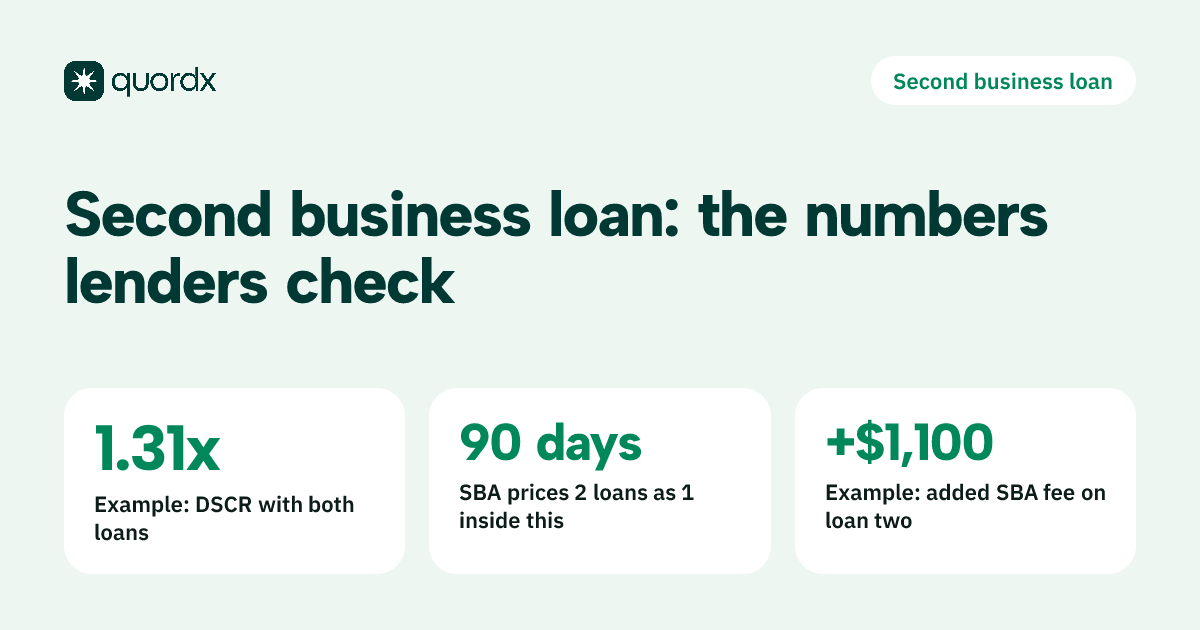
| Plus a $250,000 second loan | $114,734 | 1.31x | Passes, narrowly |
| Plus a $300,000 second loan instead | $127,482 | 1.18x | Fails |
At an example 1.25x minimum, this business can carry about $120,000 a year of total payments, which caps the second loan near $270,000 on these terms. Run the same math with your own numbers before a lender does it for you.
Existing positions and payment history
Lenders call each open loan or advance a position, and short-term lenders in particular count them. Some won't fund behind an existing daily or weekly advance at all, some will only if part of the new money pays it off, and others will lend in second position at a price. On-time payments on loan one are the best evidence you can offer that loan two will be paid.
UCC filings and lien position
Search your state's UCC records under your business name before you apply. If the first lender filed against all assets, any lien the second lender takes generally ranks behind it, because competing security interests rank by when they were first filed or perfected under UCC 9-322. Our page on how much collateral a business loan needs explains blanket liens in more detail.
What your first loan agreement allows
Read the covenants before the new lender asks about them. Look for a negative pledge (no new liens), a cap on additional debt, financial covenants such as a minimum coverage ratio, and a cross-default clause that treats a default on any other debt as a default on this one. If any of these apply, get the first lender's consent in writing before you sign anything new.
Estimate your funding
Answer a few questions about your business to see a likely range.
How subordination works on a second loan
Subordination is an agreement to change the order of repayment: The lender with first claim on an asset agrees to let another creditor rank ahead of it, or a new lender agrees in writing to stay behind. The UCC allows this: under UCC 9-339, a creditor entitled to priority can subordinate by agreement.
Why order matters, in dollars: Say a business defaults and its pledged assets sell for $300,000. The first-position lender is owed $250,000 and the second-position lender $150,000. The first lender collects its full $250,000, and the second gets $50,000 of its $150,000, which is why a second-position lender may ask for a higher rate, a shorter term or a personal guarantee.
The most common ask is narrow: You rarely need the first lender to subordinate everything. A realistic request is a carve-out: the first lender releases or subordinates its lien on one specific asset, such as the equipment the second loan is buying, and keeps its claim on everything else.
A second SBA loan and the 90-day fee rule
You can hold more than one SBA 7(a) loan, from the same lender or a different one; our page on having two SBA loans at the same time covers eligibility. The timing affects your fees.
The rule: under SBA Information Notice 5000-881797, when two or more 7(a) loans with maturities over 12 months are approved for the same applicant, including affiliates, within 90 days of each other, SBA treats them as one loan for the guaranty percentage and the upfront fee. It applies whether the loans come from the same lender or different ones, and lenders may not split a loan to avoid fees.
How the fee is figured: the second loan's upfront fee equals the fee the combined loan would have carried, minus the fee on the first loan. For FY 2027, the upfront fee is 2% of the guaranteed portion on loans of $150,000 or less and 3% on loans of $150,001 to $700,000.
Worked example: two $100,000 7(a) loans, approved 60 days apart. Alone, each would have an 85% guaranty and a 2% fee: $85,000 guaranteed, $1,700 fee. Treated as one $200,000 loan with an assumed 75% guaranty, the combined fee is 3% of $150,000, or $4,500, so the second loan's fee is $4,500 minus $1,700, which is $2,800, or $1,100 more than if it stood alone. The lender's annual service fee is still set on each loan separately.
Alternatives to a second business loan
Refinance both into one loan: If the first loan is expensive or short, one larger loan with a longer term can lower your combined payment and clear the first lien. See whether you can refinance business debt.
Add a line of credit instead: If the second need comes and goes, a business line of credit charges interest only on what you draw, so it doesn't add a fixed payment in months you don't use it.
Mistakes to avoid: leaving existing debt off an application (it shows on your bank statements and reads as misrepresentation), stacking a second short-term advance on top of a first, and signing a new loan without checking the first one's cross-default and negative pledge terms.
Getting a second loan through Quordx
Quordx is a broker, not a lender. List your existing loan on the application, with its balance and payment, because lenders see it anyway and it decides who is worth asking. Some lenders Quordx works with will consider a business that already carries a loan, and some will pay off an existing position as part of a new one; others won't lend behind an open advance.
The cash-flow lenders it works with generally look for around $17,000 a month in revenue and usually 12 months in business. For a second SBA loan, Quordx generally only places 7(a) loans of roughly $400,000 and up, so for a smaller one, SBA Lender Match is the better place to start. Either way, the lender decides.
Questions Business Owners Ask Before Applying
Can I get a second loan from the same lender?
Often, yes, and it can be simpler, since that lender already has your history and its own lien. Some lenders offer more money to good payers by refinancing the first loan into a larger one rather than writing a separate loan. Compare that offer with outside offers, because a refinance can reset the term and the fees.
How long should I wait between business loans?
There's no fixed rule. Lenders want to see on-time payments on the first loan and enough cash flow to cover both, so the right time is when your coverage ratio with both payments clears the lender's minimum. For SBA 7(a), loans approved within 90 days of each other are priced as one for the upfront fee.
What is loan stacking?
Stacking means taking a new short-term loan or advance while an earlier one is still being repaid, usually from a different lender. The term usually refers to daily or weekly payment advances, where each new position takes another cut of your deposits. Some advance contracts restrict it, so read yours first.
Will a second business loan hurt my credit?
Applying can bring a hard inquiry, and a new loan adds to the debt lenders see when they review you. Ask each lender whether its first look is a soft or hard pull, and whether it reports the loan to the owner's personal credit. Paying both loans on time is what matters most over the long run.
Can I use a second loan to pay off the first?
Yes. That's a refinance, and it's often cleaner than holding two loans, because it leaves one payment and one lien. Check the first loan for a prepayment penalty before you do it, and compare the total cost of the new loan, not just the payment.
Apply for Funding
No obligation · Initial inquiry doesn't impact credit · Takes about 10 minutes
Sources

Written by
Cody Dreis
Founder, Quordx Capital
Read full bio
Related articles
Keep exploring business loans
Quordx Capital is a business funding broker, not a lender. Lenders make every credit decision and set the rate, fees and terms, and not every business qualifies. Quordx may be paid by a lender when a deal funds. Full disclosures