

Do lenders look at gross or net revenue?
Lenders look at both, and the product decides which one sets your offer. Cash advances and most short-term loans qualify and size you on gross revenue, read from the deposits in your business bank account. Banks and SBA lenders size the loan on net income with some expenses added back, which is the cash left to pay debt. Neither number is taken at face value: lenders strip non-sales money out of your deposits, and they add non-cash expenses back to your profit.
The short version: For an advance or short-term loan, clean up your deposits, because transfers, loan proceeds and one-off asset sales don't count as revenue. For a bank or SBA loan, start with net profit, add back depreciation, amortization and interest, and divide by every loan payment you'll owe, the new one included. SBA requires that ratio to be at least 1.10 on its 7(a) Small loans.
Last updated · Reviewed by Cody Dreis
50+ Lenders|Funding in as little as 24 hours
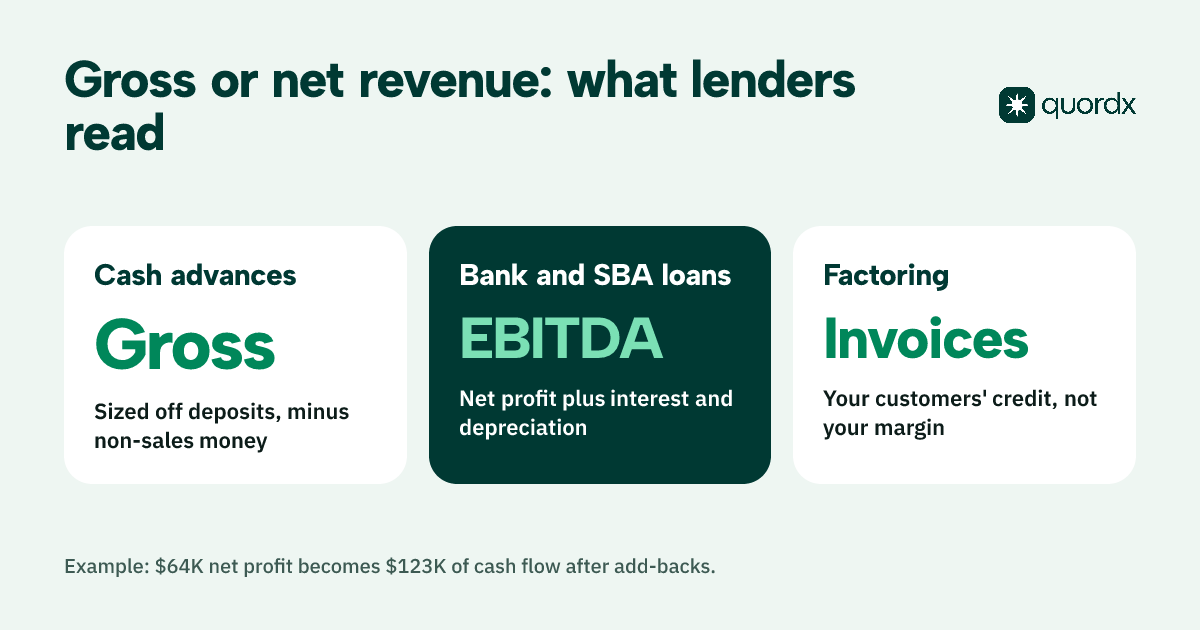
Gross revenue vs net income: what each means to a lender
Gross revenue: is everything the business takes in from sales before expenses. On a sole proprietor's or single-member LLC's tax return, it's line 1 of Schedule C, which the IRS instructions describe as gross receipts from your trade or business. A lender reading bank statements estimates the same thing from your deposits.
Net income: is what's left after expenses. On Schedule C it's line 31, net profit. It's a smaller number, and often a misleading one for lending, because it subtracts things that don't cost you cash this year.
Cash flow for debt: sits between the two. SBA's underwriting rules for 7(a) Small loans define operating cash flow as EBITDA: earnings before interest, taxes, depreciation and amortization. Lenders may adjust it further under SBA's rules. That's the number a bank or SBA lender compares with your loan payments.
Gross deposits tell a lender how much money moves through the business. Cash flow tells it how much of that money can go to a lender.
How each type of loan reads your revenue
| Product | Number that qualifies you | Number that sets the amount | What they ask for |
|---|---|---|---|
| Merchant cash advance | Gross card sales or deposits | Gross receipts, since repayment is a share of them | Bank or card processor statements |
| Short-term working capital loan | Gross deposits after the lender removes non-sales items | Average monthly deposits and the payments already leaving the account | Recent bank statements |
| Online term loan or line of credit | Gross deposits, plus the owner's credit | Deposits on smaller amounts; tax returns as amounts grow | Bank statements, then tax returns |
| Bank term loan or SBA 7(a) | Net income with add-backs | Debt service coverage: cash flow divided by all loan payments | Tax returns, financial statements, bank statements |
| Invoice factoring | Your invoices to other businesses | Invoice value and your customers' credit | Invoices and an accounts receivable aging report |
| Equipment financing | Varies with deal size | Smaller deals lean on credit and deposits; larger ones on financial statements | Varies by lender |
Factoring is the outlier: The factor is buying invoices and collecting from your customers, so their ability to pay matters more than your margin. Our guide to invoice factoring and receivables financing covers how it's priced.
Compare your options side by side
Enter your revenue and see how each type of funding sizes up.
How lenders calculate gross revenue from bank deposits
Your statement's deposit total is not your revenue. Lenders who size offers off deposits remove anything that isn't money from customers.
- Transfers between your own accounts, including money moved from savings or a personal account.
- Loan and advance proceeds, which are borrowed money, not sales.
- Owner contributions, when you put your own cash into the business.
- One-time asset sales, such as selling a used vehicle.
- Returned or reversed deposits, which show up twice if nobody nets them out.
Worked example: six months of business statements show $412,000 of deposits, or $68,667 a month on the headline. Inside that are $45,000 of transfers from the owner's savings, $40,000 from an earlier advance and $15,000 from selling a used truck. Take out those $100,000 and qualifying revenue is $312,000, or $52,000 a month, about 24% less than the headline number.
If a lender sizes offers as a share of monthly revenue, that gap carries straight into the offer. Our pages on how lenders verify business revenue and what lenders look for in bank statements cover the rest of what an underwriter reads, including balances and overdrafts.
Add-backs: how lenders turn net income into cash flow
Net profit on a tax return understates the cash available for a loan, because it subtracts some expenses that don't use cash this year, and interest the lender is about to count separately. Add-backs put those back.
- Depreciation and amortization. These spread the cost of past purchases over time. No cash leaves the business when you book them.
- Interest. Your current loans' interest is already in your debt payments, which the lender counts in full on the other side of the ratio. Adding it back avoids counting it twice.
- Taxes on the business's income, where the business pays them. A single-member LLC filing Schedule C doesn't pay income tax at the business level, so there's nothing to add here.
- Genuinely one-time expenses, such as a lawsuit settlement or a move, if you can document them. Lenders decide case by case whether to accept these.
What doesn't get added back: money you take out for yourself. The IRS instructions tell sole proprietors not to deduct amounts paid to themselves as wages, so owner draws were never subtracted on Schedule C in the first place. Personal costs run through the business are a different problem; they shouldn't be there, and a lender may not accept an explanation after the fact.
Why a big equipment year can make your net income look tiny
For tax years beginning in 2026, Section 179 lets a business expense up to $2,560,000 of qualifying equipment in the year it's placed in service, according to IRS Revenue Procedure 2025-32, and 100% bonus depreciation is permanent for property acquired after January 19, 2025. A business that writes off a large equipment purchase can show little or no profit for that year. Because depreciation is an add-back, a cash flow lender sees through much of it, but a lender that only reads net income won't. Quordx isn't a tax advisor; talk with your CPA before choosing deductions in a year you plan to borrow.
Worked example: add-backs on a $150,000 SBA 7(a) Small loan
A print shop run as a single-member LLC files a Schedule C with $900,000 of gross receipts, $64,000 of net profit, $48,000 of depreciation and $11,000 of interest on equipment notes. Those notes cost $2,900 a month, or $34,800 a year. The shop wants $150,000 over 10 years; say the lender quotes 12%, under SBA's 13.00% cap for a loan this size as of October 2026 (prime of 7.00% plus 6.0%, per SBA's 7(a) terms). That payment is $2,152.06 a month, or $25,825 a year, so total debt service is $60,625.
| Cash flow measure | Amount | Debt service coverage | Against SBA's 1.10 minimum |
|---|---|---|---|
| Net profit only | $64,000 | 1.06 | Fails |
| EBITDA ($64,000 + $48,000 + $11,000) | $123,000 | 2.03 | Passes |
| EBITDA plus a documented $9,000 one-time cost, if accepted | $132,000 | 2.18 | Passes |
Read on net profit alone, the shop looks unable to carry the loan. Read the way SBA defines cash flow, it covers the payments about twice over. The lender will still look at the owner's personal obligations, since a Schedule C profit is also the owner's income, so don't treat the cushion as spare money.
Same revenue, different loan amount: a worked example
Two businesses each deposit $100,000 a month in qualifying revenue, $1.2 million a year. Business X keeps a 6% cash flow margin, $72,000 a year. Business Y keeps 18%, $216,000 a year. Neither has other debt.
| Sizing method | Business X (6% margin) | Business Y (18% margin) |
|---|---|---|
| Advance sized at 75% of a month's deposits (hypothetical) | $75,000 | $75,000 |
| Most it can pay at an example 1.25x coverage | $4,800 a month | $14,400 a month |
| Five-year term loan at a hypothetical 11% | About $220,800 | About $662,300 |
On a deposit-based product, the two businesses look identical. On a cash-flow product, Y can borrow three times what X can. The decision rule: if your margin is thin, a deposit-based product may offer more, but at a cost that has to be paid from that same thin margin, so check the payment before you take the bigger number. If your margin is healthy, a cash-flow lender will usually value the business more.
Merchant cash advances: why gross receipts are the whole story
A merchant cash advance isn't a loan on your profit. The provider buys a share of future sales and collects a fixed percentage of them, so the size of your receipts drives both the offer and the speed of repayment.
Worked example: a $40,000 advance at a hypothetical 1.35 factor rate means $54,000 is paid back, a cost of $14,000. If the provider collects 10% of card sales and the business averages $2,500 a day, it remits $250 a day and finishes after 216 days of sales. If sales slip to $2,000 a day, remittance drops to $200 and repayment stretches to 270 days, while the total owed stays $54,000.
Net income barely enters that math, which is exactly the risk: the advance gets paid from gross, but your rent and payroll get paid from what's left. Before signing, see what a merchant cash advance really costs.
Which number to improve before you apply
- If you're applying for an advance or short-term loan, run every sale through one business account and keep transfers and personal money out of it for a few months first.
- If you're applying to a bank or SBA lender, have the depreciation and interest figures ready and label any one-time expense with a receipt. SBA's 7(a) Small rules let the lender use your last year-end statement if it's dated within 120 days of year end, or add an interim statement dated within 120 days of submission.
- If last year's return shows a loss from a big equipment write-off, lead with the add-back math rather than the bottom line.
- If you already carry debt, list every payment, because SBA's debt service figure includes all business debt plus the new loan. Our page on a second business loan works through coverage with two loans.
- If you need the full method, our guide to the debt service coverage ratio explains the ratio itself.
How the lenders Quordx works with read your numbers
Quordx is a broker, not a lender, and the lenders it submits to use both methods. The working capital and short-term lenders read deposits and generally start around $17,000 a month in revenue with about 12 months in business. The SBA lender it works with handles 7(a) loans of roughly $400,000 and up, and those are sized on cash flow from your returns. Larger equipment lenders tend to want full financial statements.
So the useful thing to know before you apply is which of your two numbers is stronger. Strong deposits with a thin or negative tax return point toward a deposit-based product; a healthy return with add-backs points toward a cash-flow loan. The application takes about 10 minutes, and the lender makes the call. For SBA loans under roughly $400,000, start with SBA Lender Match instead.
Questions Business Owners Ask Before Applying
Do lenders use revenue before or after taxes?
Deposit-based lenders use gross deposits, so taxes don't enter it. Cash-flow lenders start from earnings before interest, taxes, depreciation and amortization, then compare that with your loan payments. For a single-member LLC on Schedule C, the business itself pays no income tax, so net profit is already a pre-tax figure.
Does an owner's salary count as an expense to lenders?
It depends on how the business is taxed. In an S corporation, the owner's W-2 salary is a business expense, and lenders look at salary and profit together. On Schedule C, payments to yourself aren't deductible, so the net profit already includes what you'd pay yourself.
What if my tax return shows a loss but my bank deposits are strong?
A deposit-based lender may still make an offer, because it sizes off deposits. A bank or SBA lender will add back depreciation, amortization and interest first, so a loss created by a large equipment write-off can turn into positive cash flow. If the loss is real, expect cash-flow lenders to say no until a profitable year is on file.
Do lenders count cash sales?
Only if the cash is deposited into the business account. Cash that never reaches the bank is invisible to a lender reading statements, and if it isn't on your tax return either, no lender can count it. Deposit cash sales regularly in the months before you apply.
Is gross revenue the same as total deposits?
No. Deposits include transfers, loan proceeds, owner contributions and other money that isn't sales. Lenders take those out to find the revenue they'll use, which is usually lower than the deposit total on your statement.
Apply for Funding
No obligation · Initial inquiry doesn't impact credit · Takes about 10 minutes
Sources

Written by
Cody Dreis
Founder, Quordx Capital
Read full bio
Related articles
Quordx Capital is a business funding broker, not a lender. Lenders make every credit decision and set the rate, fees and terms, and not every business qualifies. Quordx may be paid by a lender when a deal funds. Full disclosures