

Alternative lenders for small business: the types, what they cost, and how to choose
Alternative lenders for small business are funders other than traditional banks: online lenders, merchant cash advance funders, factoring companies, revenue-based financing providers, community development lenders (CDFIs), and the marketplaces and brokers that connect you to them. Most of them lean less on credit score and collateral and more on your bank deposits, invoices or revenue, and they usually decide faster than a bank. The trade is usually price, and the Federal Reserve's survey data shows owners feel it.
The short version: Match the lender type to the problem first: slow-paying customers point to factoring, a one-time investment to a term loan, a seasonal swing to a line of credit, and a small or underserved business to a CDFI. Compare offers in total dollars and APR, never in factor rates or "low monthly payments". If a bank or credit union will lend to you on terms you can live with, price that first.
Last updated · Reviewed by Cody Dreis
50+ Lenders|Funding in as little as 24 hours
What makes a lender "alternative"?
It's about who is lending and how they decide, not just the product: A bank lends deposits and underwrites heavily on credit history, collateral and years of tax returns. An alternative lender raises money elsewhere and often underwrites on what your business does every month: deposits, card sales, receivables or the equipment being bought.
That changes who gets approved: A newer business, an owner rebuilding credit, or a company that needs money in days rather than weeks may find an alternative lender willing to look when a bank won't. The same features (faster decisions, lighter paperwork, more risk taken on) are why the price is often higher.
Some alternative lenders are cheaper than they sound: CDFIs and SBA microloan intermediaries are mission lenders whose job is to serve businesses banks overlook, and they pair the money with help running the business.
The six types of alternative lenders
| Type | What it provides | What it underwrites on | How you repay | How the price is quoted |
|---|---|---|---|---|
| Online lenders | Term loans, lines of credit | Bank data, revenue, credit, time in business | Fixed weekly or monthly payments | Interest rate or APR, often plus an origination fee |
| Merchant cash advance funders | A lump sum for a share of future sales | Daily deposits and card sales | Daily or weekly debit, or a percentage of sales | Factor rate (total payback multiple) |
| Factoring companies | Cash now for unpaid B2B invoices | Your customers' credit | Your customer pays the factor | Discount fee per period the invoice is open |
| Revenue-based financing | Capital repaid from a share of revenue | Recurring revenue and margins | A percentage of monthly revenue until a cap is reached | Repayment cap (a multiple of the amount advanced) |
| CDFIs and microlenders | Small loans plus business support | The business and its owner, with flexibility on credit and collateral | Monthly loan payments | Interest rate |
| Marketplaces and brokers | Access to several lenders through one application | They don't lend; each lender underwrites | Whatever the chosen lender requires | Each lender's own quote |
Online lenders
Online lenders offer the closest thing to a bank loan: a term loan or line of credit with a set payment. Many connect directly to your bank account to read deposits, which is why they can decide quickly. Check whether the quote is an APR or a simple rate, and whether an origination fee comes out of the funded amount. If speed is the reason you're looking, see fast business loans online.
Merchant cash advance funders
An MCA funder buys a fixed amount of your future sales for a smaller sum today, collected through daily or weekly debits. It is not a loan, it's priced with a factor rate, and it is one of the most expensive ways to fund a business. It fits a short, urgent need with a fast payback; our merchant cash advance guide works through the true cost.
Factoring companies
A factor buys your unpaid invoices from business customers, advances part of the value now, and pays you the rest, minus its fee, when your customer pays. Because the factor is really betting on your customer, a young company with strong customers can qualify. See how invoice factoring works for the mechanics.
Revenue-based financing
A revenue-based financing provider advances capital and takes a fixed share of your monthly revenue until you've repaid an agreed cap. Payments rise and fall with sales, which suits subscription and software businesses with steady recurring revenue. The difference from an MCA is mostly in who uses it and how it's structured; revenue-based financing vs a merchant cash advance compares them.
CDFIs and nonprofit microlenders
A CDFI is a lender certified by the Treasury's CDFI Fund, with a primary mission of community development and a defined target market. They include community development banks and credit unions as well as loan funds and venture capital funds, and certification requires them to offer development services alongside the money. Separately, SBA's microloan program lends up to $50,000 through nonprofit, community-based intermediaries, with an average loan of about $13,000 and terms up to seven years. More in what is an SBA microloan.
Marketplaces and brokers
A marketplace or broker doesn't lend. It takes one application and routes it to lenders that might approve it, which saves you from applying everywhere and collecting a pile of credit inquiries. Many are paid by the lender when a deal funds; how business loan brokers get paid explains the models and what to ask.
Estimate your funding
Answer a few questions about your business to see a likely range.
Alternative lenders vs banks: what the Federal Reserve survey shows
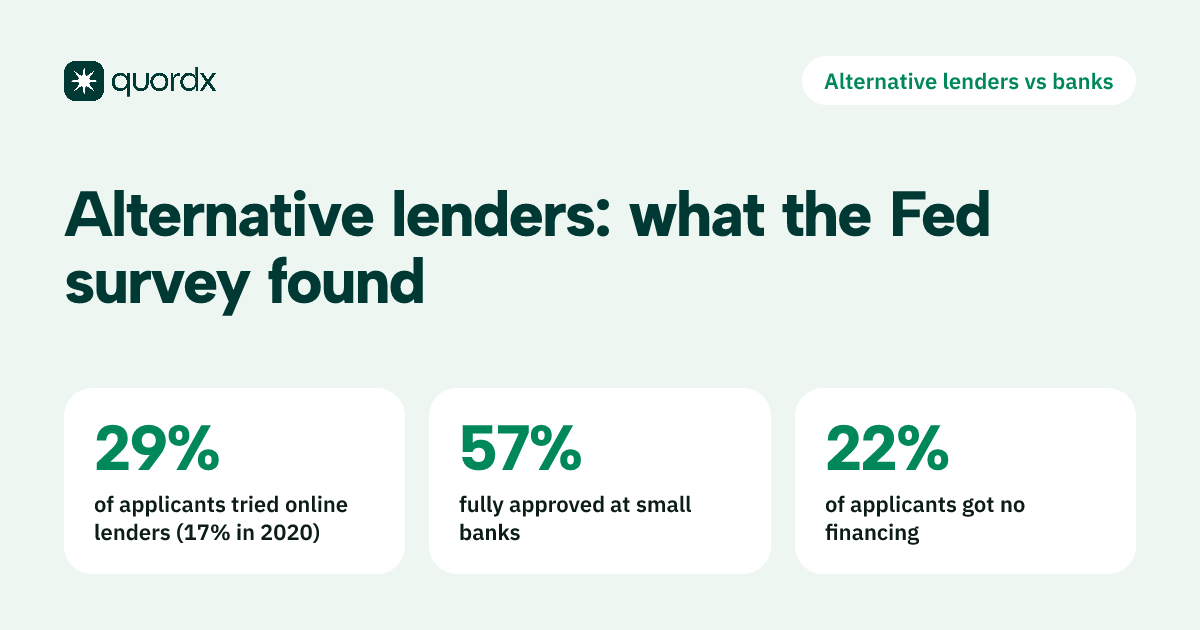
The best public data on where small businesses borrow is the Federal Reserve Banks' Small Business Credit Survey. The 2026 report covers the 2025 survey, fielded September 3 to November 14, 2025, with 6,525 responses from employer firms with 1 to 499 employees. The Fed notes it's a convenience sample, not a random one.
| Finding (2025 survey) | Result |
|---|---|
| Firms that applied for financing in the prior 12 months | 60% |
| Applicants that got the full amount they sought | 42% (36% got some, 22% got none) |
| Applicants that sought financing at online fintech lenders | 29%, up from 17% in the 2020 survey |
| Applicants at small banks that were fully approved | 57%, more likely than at other lender types |
| Online lender borrowers whose costs ran higher than expected | 60% (4% said lower) |
| Small bank and large bank borrowers whose costs ran higher than expected | 37% and 32% |
What the numbers say: Online lenders are now a mainstream stop: applicants most often sought financing at large banks, then online lenders, then small banks. But the Fed also found bank and credit union applicants were more satisfied than online lender and finance company applicants, and that high interest rates and unfavorable repayment terms were the most common problems at online lenders.
The practical reading: if a small bank or credit union is a realistic option, it's worth the slower process to get a quote, because that's where full approvals and fewer cost surprises showed up. Use alternative lenders when the bank can't help or can't help in time, and go in knowing the total cost. Our guide to small business loans from banks covers what banks look for.
How much do alternative lenders cost?
No neutral source publishes reliable rate ranges for these products: and the ranges you'll see online come from lenders' and brokers' own marketing, so we don't repeat them. What you can control is how you compare. Every offer can be reduced to four numbers: cash you receive, total you repay, how long you have, and every fee.
Here is the same hypothetical $80,000 need priced two ways. The rate and factor are made up for the math, not quotes or market rates.
| Term loan | Merchant cash advance | |
|---|---|---|
| Price as quoted | 20% APR, 18 months | 1.25 factor rate |
| Total repaid | about $93,259 | $100,000 |
| Dollar cost | about $13,259 | $20,000 |
| Payment | about $5,181 a month | about $529 every business day for about 9 months (189 debits) |
| APR | 20% | about 62% |
The advance costs about $6,700 more and is repaid in half the time: A factor rate of 1.25 sounds smaller than 20%, but it's a total-cost multiple, not a yearly rate. That's an easy misreading to make, and it's why the factor rate needs converting before you compare.
What moves your price: time in business, monthly deposits, credit, your industry, how many other debts or advances you carry, whether the deal is secured, and how long you take to repay. Lenders quote deal by deal, so the only way to know your price is to get offers.
Why look beyond your bank at all?
One bank means one set of rules: If your file misses one of its tests (time in business, collateral, a credit score floor), the answer is no, whatever else your business has going for it. Alternative lenders judge different things, so a business a bank declines can still qualify somewhere.
Different problems need different tools: A bank term loan is a poor fit for invoices that pay in 60 days, and a factoring line is a poor fit for a building. Owners who know the alternatives can match the tool to the need instead of forcing everything through one product.
Keep the bank in the picture: The Fed's data shows small banks gave full approvals most often, so the strongest approach is usually to ask your bank or credit union and an alternative source at the same time, then compare written offers.
How to pick the right alternative lender
Start from the need, then the numbers. These rules of thumb cover most situations.
- If customers owe you money on invoices, look at factoring or receivables financing before anything priced on your bank balance.
- If you're buying equipment, use equipment financing, where the equipment secures the deal.
- If the need is a defined project with a clear payback, a term loan from an online lender or bank keeps the cost fixed.
- If cash swings with the season, a line of credit lets you pay interest only on what you draw. See business line of credit.
- If you're small, new or in an underserved community, call a CDFI or SBA microlender first; they exist for exactly that file.
- If you run a SaaS business with strong recurring revenue, revenue-based financing or venture debt can fund growth without selling equity.
- If the only offer is a daily-debit advance, run the APR, and ask whether the need can wait for a cheaper product.
Whatever you pick, check the company before you send documents. Our checklist on how to know if a business funding company is legit takes about 15 minutes.
Which alternative lenders Quordx can reach
Quordx is a broker, not a lender, so it sits in the marketplace row of the table above. Through one application, its lender panel covers term loans, lines of credit and working capital advances; B2B invoice factoring, including trucking and construction subcontractors; equipment financing; bridge and commercial real estate loans in some states; and venture debt for software companies with about $2.5 million or more in annual recurring revenue. Lenders make every credit decision and set every price.
The panel's cash-flow products start at roughly $17,000 a month in revenue and usually 12 months in business. Quordx doesn't place CDFI loans, SBA microloans, purchase order financing or inventory financing, so if your business is below that floor or needs a small community loan, a CDFI or SBA microlender is the better first call. Quordx doesn't serve businesses in Virginia, Connecticut, Missouri or North Dakota; lenders on its panel pay it when a deal funds, and you pay Quordx nothing.
Questions Business Owners Ask Before Applying
Are alternative lenders more expensive than banks?
Often, though not always. In the Fed's 2025 survey, 60% of online lender borrowers said costs came in higher than expected, compared with 37% at small banks and 32% at large banks. Mission lenders like CDFIs and SBA microlenders are a different case, so compare the APR and total cost of every offer.
What credit score do alternative lenders require?
There's no single number. Many alternative lenders put more weight on deposits, invoices or revenue than on credit, and each publishes or sets its own minimum. Factoring companies care most about your customers' credit rather than yours.
Do alternative lenders report to credit bureaus or file liens?
Practices differ by lender, so ask before you sign. Many business financing deals include a UCC-1 filing at the Secretary of State, a public lien on business assets that other lenders will see. Read the security section of the contract.
What is the safest alternative to a bank loan?
The safest choice is the one whose payment your cash flow can carry with room to spare. For many small businesses that means a CDFI or SBA microloan, a line of credit, or factoring if you have business customers, before a daily-debit advance. Run the APR on every offer.
Is a merchant cash advance an alternative loan?
It's an alternative financing product, but legally it's a purchase of future sales, not a loan. That's why it carries a factor rate instead of an interest rate. Convert it to an APR before comparing it with anything else.
Apply for Funding
No obligation · Initial inquiry doesn't impact credit · Takes about 10 minutes
Sources

Written by
Cody Dreis
Founder, Quordx Capital
Read full bio
Related articles
Quordx Capital is a business funding broker, not a lender. Lenders make every credit decision and set the rate, fees and terms, and not every business qualifies. Quordx may be paid by a lender when a deal funds. Full disclosures