

$500,000 business loan: what it takes and what it costs
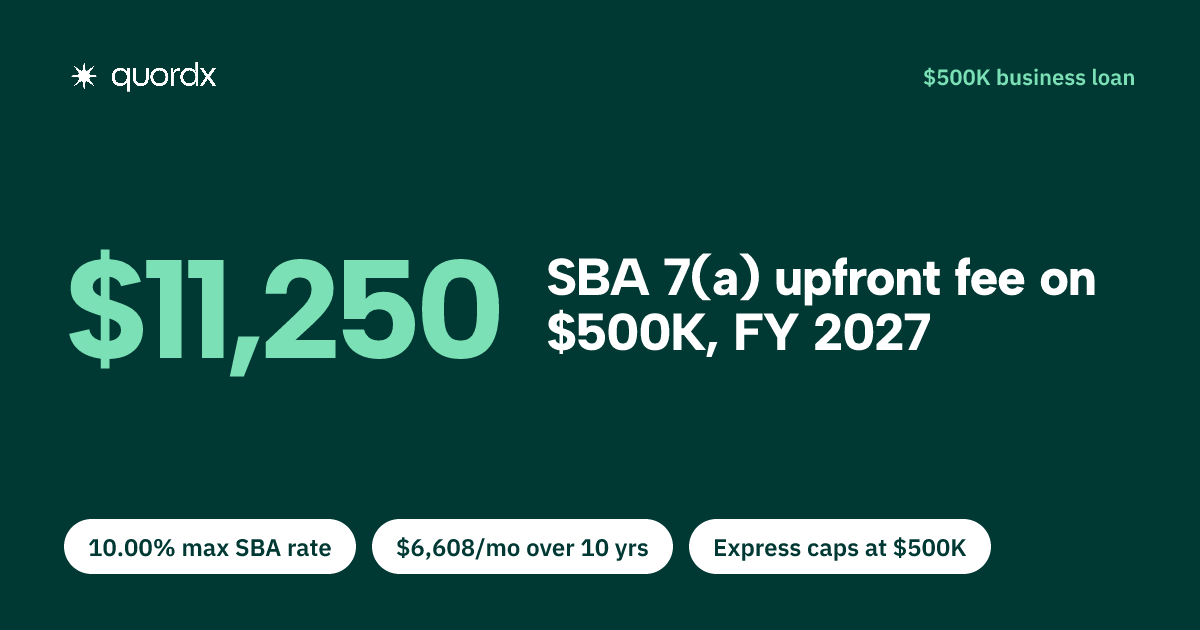
A $500,000 business loan takes cash flow that covers the payment with room to spare, full financial records, and a clear use for the money. On a 10-year SBA 7(a) loan at today's 10.00% maximum rate the payment is $6,607.54 a month, so a lender aiming for a hypothetical 1.25x cushion would want to see about $99,000 a year of cash flow left after your other debt payments. SBA 7(a), conventional term loans, equipment financing and commercial real estate loans all reach this amount, and an SBA loan approved this fiscal year carries an upfront guaranty fee of $11,250.
The short version: Check your cash flow against the payment before you pick a product; the longer the term, the lower the bar. If the money buys a building or a machine, finance it against that asset over its useful life. If speed tempts you toward a fixed-payback offer, convert it to an annual rate first: the made-up example below works out to about 24.8%, more than double the SBA cap.
Part of our guide to Business Loans.
Last updated · Reviewed by Cody Dreis
50+ Lenders|Funding in as little as 24 hours
Common Reasons Operators Apply
Operators looking at $500,000 in capital commonly use Quordx-matched funding for situations like these:
- Refinancing higher-cost debt into longer-term capital
- Real estate improvements and facility expansion
- Bridging cash flow across long-cycle contracts
- Business acquisitions and partner buyouts
Which loans reach $500,000
Plenty of products stop below half a million, so the first job is to rule out the ones that can't get there. These can:
| Route | What the lender leans on | How it repays | Best fit |
|---|---|---|---|
| SBA 7(a) | Cash flow, credit history, available collateral | Monthly, usually variable off prime; up to 10 years, 25 for real estate | Working capital, equipment, buying a business, real estate |
| SBA Express | Same 7(a) rules, with the lender's own credit process | Monthly; lines can revolve | Requests at or under exactly $500,000 |
| SBA 504 | The property or long-life equipment, plus cash flow | Terms of 10, 20 or 25 years | Owner-occupied buildings, major equipment |
| Bank term loan | Cash flow, collateral, the banking relationship | Monthly, set by the bank | Established, profitable businesses |
| Equipment financing | The equipment itself | Monthly over the asset's useful life | Machinery, vehicles, medical and tech equipment |
| Nonbank term loan or line | Bank deposits, credit, time in business | Shorter terms; often weekly or daily | Speed, thinner files |
| Fixed-payback working capital | Bank deposits | Daily or weekly debits, a fixed total | Short, high-return needs |
The top half of the table is cheaper and slower; the bottom half is faster and costs more. Most businesses asking for $500,000 should start at the top and move down only if the file can't support it.
SBA 7(a) rules that apply to a $500,000 loan
Half a million sits where several SBA lines cross, and each one changes your cost.
- It is a Standard 7(a) loan. 7(a) Small loans stop at $350,000, so $500,000 gets full Standard underwriting. SBA's own published processing time is 5 to 10 business days for Standard loans, versus 2 to 10 for Small ones.
- The rate ceiling is prime plus 3.0%. With prime at 7.00% as of October 2026, after the Fed's September 15-16 rate increase, the maximum variable rate is 10.00%. Lenders can price below it.
- SBA guarantees up to 75%, or $375,000 of a $500,000 loan (SBA 7(a) terms).
- SBA Express ends here. Express loans are capped at $500,000 with a 50% guaranty. Ask for $500,001 and Express is off the table.
- The fee band runs to $700,000, so anything from $150,001 up to that line pays the same percentage.
SBA fees on a $500,000 loan for FY 2027
SBA's Information Notice 5000-881797 covers 7(a) loans approved from October 1, 2026 through September 30, 2027. For a loan of $150,001 to $700,000 with a maturity over 12 months, the upfront fee is 3% of the guaranteed portion. On a standard 7(a) loan that is $375,000 × 3% = $11,250; on an Express loan, with half guaranteed, it is $250,000 × 3% = $7,500.
- 0% upfront fee for manufacturers (NAICS 31-33), listed food supply chain businesses and rural businesses, on loans of $700,000 or less. At $500,000 that removes the whole $11,250.
- $0 upfront fee on SBA Express loans to businesses owned and controlled by a veteran or a veteran's spouse.
- Splitting the loan doesn't help. Loans approved within 90 days of each other are combined for the fee. A $350,000 loan and a $150,000 loan would cost $7,875 and $2,550 if priced alone ($10,425), but together they pay the full $11,250.
- The 0.55% annual service fee is charged to the lender on the guaranteed balance, and SBA says lenders may not pass it on to you.
Ask whether the upfront fee is paid at closing or added to the loan. If the loan runs 15 years or more, as a 25-year real estate loan does, SBA's prepayment fee applies when you prepay 25% or more of the balance in the first three years: 5% of the prepaid amount in year one, 3% in year two and 1% in year three.
Run the numbers on your loan
Pick a product, set the amount and term, and see a typical payment.
Monthly payment on a $500,000 business loan
Every row below is a standard amortizing loan with equal monthly payments. The SBA rows use the current cap; the others use hypothetical round rates to show the spread, not quotes or market averages.
| $500,000 loan | Rate | Monthly payment | Total interest |
|---|---|---|---|
| SBA 7(a), 25 years (real estate) | 10.00% (SBA cap) | $4,543.50 | $863,051 |
| SBA 7(a), 10 years | 10.00% (SBA cap) | $6,607.54 | $292,904 |
| SBA 7(a), 10 years | 9.50% (hypothetical quote) | $6,469.88 | $276,385 |
| Equipment loan, 7 years | 9% (hypothetical) | $8,044.54 | $175,741 |
| Term loan, 5 years | 12% (hypothetical) | $11,122.22 | $167,333 |
| Term loan, 3 years | 15% (hypothetical) | $17,332.66 | $123,976 |
The 25-year row looks expensive and often isn't the wrong choice: It carries $863,051 of interest if held to term, but its payment is the lowest by far, and a building lasts longer than 25 years. Match the term to what the money buys, then prepay when cash allows if the loan permits it.
Run other rates or terms in the business loan payment calculator.
Fixed-payback offers at $500,000
Some lenders quote a total payback instead of a rate. Example with made-up numbers: $500,000 with a $600,000 payback over 18 months, collected weekly. That is $7,692.31 a week, about $33,333 a month, and because the balance shrinks from the first week, the $100,000 cost works out to roughly 24.8% a year.
That monthly debit is about five times the 10-year SBA payment. If you take an offer like this, use it for something that pays for itself inside the term, and read how merchant cash advance payments are calculated before you sign.
Can your business afford a $500,000 loan?
Lenders compare a year of payments with a year of cash flow. Multiply the yearly payment by your lender's coverage target, add your existing debt payments on the same basis, and see if your cash flow clears it. With a hypothetical 1.25x target and no other debt, the bars look like this:
- SBA 7(a), 25 years at 10.00%: $54,522 of payments a year, so about $68,153 of cash flow.
- SBA 7(a), 10 years at 10.00%: $79,290 a year, so about $99,113.
- Equipment loan, 7 years at a hypothetical 9%: $96,534 a year, so about $120,668.
- Term loan, 5 years at a hypothetical 12%: $133,467 a year, so about $166,833.
If your cash flow after current debt clears about $99,000: a 10-year SBA loan for the full $500,000 is realistic on paper. If it is closer to $70,000, a real estate loan on a 25-year schedule or a smaller first loan fits better. If deposits are strong but the tax returns show little profit, a lender that sizes off deposits may say yes where a bank won't, at a higher cost.
To turn a cash-flow figure into a revenue figure, divide by your margin; revenue needed for a $1 million business loan works through that step with tables.
What lenders look at on a $500,000 application
At this size a lender reads your history, not just your bank balance. Have these ready before you apply:
- Business and personal tax returns, plus a current profit and loss statement and balance sheet.
- A schedule of every business debt, with balance, payment and maturity, so the lender doesn't find one you left off.
- Recent business bank statements, which confirm the deposits and the debts you listed.
- Proof of the use of funds: an equipment quote, a purchase agreement, a construction budget or a working capital plan.
- Ownership details. For SBA loans, since March 1, 2026, every owner must be a U.S. citizen or U.S. national living in the United States.
Expect the guarantee question: In the Federal Reserve's 2025 Small Business Credit Survey, 59% of firms with debt had used a personal guarantee and 51% had pledged business assets (2026 Report on Employer Firms). See how much collateral a business loan needs to plan for it.
$500,000 for equipment, real estate or buying a business
Equipment: For tax years beginning in 2026, Section 179 lets a business expense up to $2,560,000 of qualifying equipment, with that limit reduced dollar for dollar once equipment placed in service passes $4,090,000 (IRS Revenue Procedure 2025-32). A $500,000 machine fits well inside it, but the deduction can't exceed taxable business income. Quordx isn't a tax advisor, so confirm with your CPA; equipment financing and Section 179 covers the timing.
An owner-occupied building through SBA 504: On a $500,000 project, the standard split is at least $250,000 from a bank, up to $200,000 from a Certified Development Company and at least $50,000 from you. Your share rises to 15% ($75,000) if the business has operated two years or less or the building is single-purpose, and to 20% ($100,000) if both apply.
Buying a business: SBA 7(a) is the usual route, and the seller's numbers become the cash flow the lender tests. The steps are in how to use an SBA loan to buy a business.
Getting $500,000 through Quordx
Quordx is a broker, so it doesn't lend or approve anything; it sends one application to lenders whose criteria fit. At $500,000 that covers SBA 7(a) loans (Quordx works with an SBA lender generally for 7(a) loans of roughly $400,000 and up), term loans, lines of credit, working capital and equipment financing.
Two routes on this page sit outside what Quordx can place: SBA Express and SBA 504. For Express, a bank that offers it is the right call, and for a 504 building loan, a Certified Development Company.
The application takes about 10 minutes, and most options can be checked without a hard credit pull. You don't pay Quordx; a lender pays it if your deal funds, and the lender alone decides the terms. Apply here. It does not serve Virginia, Connecticut, Missouri or North Dakota businesses.
Questions Business Owners Ask Before Applying
How hard is it to get a $500,000 business loan?
Harder than a small loan, mostly because it is fully underwritten: the lender reads your tax returns and financial statements and checks that cash flow covers the payment. With about $99,000 a year of cash flow after other debts, clean returns and a clear use of funds, a 10-year SBA loan for the full amount is realistic on paper. Without that, the realistic paths are a smaller amount, a longer term tied to an asset, or a costlier short-term product.
What is the monthly payment on a $500,000 loan over 10 years?
At the current SBA 7(a) maximum of 10.00%, it is $6,607.54 a month, with $292,904 of total interest. At a hypothetical 9.50% quote, it is $6,469.88. A 25-year real estate loan at 10.00% drops the payment to $4,543.50.
Can I get a $500,000 SBA Express loan?
Yes: $500,000 is the Express maximum. Express carries a 50% guaranty, so the FY 2027 upfront fee on $500,000 is $7,500 instead of $11,250, and veteran-owned businesses pay $0. The lender makes the credit decision using its own process.
Can I split $500,000 into two SBA loans to lower the fee?
No. SBA treats 7(a) loans approved for the same business within 90 days as one loan for the guaranty fee, whether they come from one lender or two. A $350,000 loan plus a $150,000 loan still pays $11,250 in total.
Do I need collateral for a $500,000 business loan?
It depends on the product. Equipment and real estate loans are secured by what they buy, while SBA and bank term loans weigh collateral alongside cash flow. In the Fed's 2025 survey, 51% of firms with debt had pledged business assets.
Apply for Funding
No obligation · Initial inquiry doesn't impact credit · Takes about 10 minutes
Sources
- SBA Information Notice 5000-881797, 7(a) fees for FY 2027
- SBA, 7(a) loan program terms, conditions and eligibility
- Federal Reserve, FOMC minutes, September 15-16, 2026
- IRS Revenue Procedure 2025-32 (2026 inflation adjustments, section 3.24)
- Federal Reserve Banks, 2026 Report on Employer Firms (2025 Small Business Credit Survey)

Written by
Cody Dreis
Founder, Quordx Capital
Read full bio
Keep exploring business loans
Quordx Capital is a business funding broker, not a lender. Lenders make every credit decision and set the rate, fees and terms, and not every business qualifies. Quordx may be paid by a lender when a deal funds. Full disclosures