

How to get a business loan with an LLC
Yes, you can get a business loan with an LLC, and the LLC part comes down to paperwork: lenders want proof the company exists, who owns it and who can sign for it, on top of the bank statements and tax returns any business provides. Have your articles of organization, operating agreement, EIN confirmation and a certificate of good standing ready, in the LLC's exact legal name, before you apply. You don't need an LLC to borrow, either. Sole proprietors get business loans too, with a Schedule C doing the job the entity documents do.
The short version: Gather the four entity documents, run all business money through an account in the LLC's name, and check how long the LLC and the business have each existed, because a very young company narrows the field. If you don't have an LLC yet and need money soon, apply as a sole proprietor instead of forming one halfway through underwriting.
Part of our guide to Business Loans.
Last updated · Reviewed by Cody Dreis
50+ Lenders|Funding in as little as 24 hours
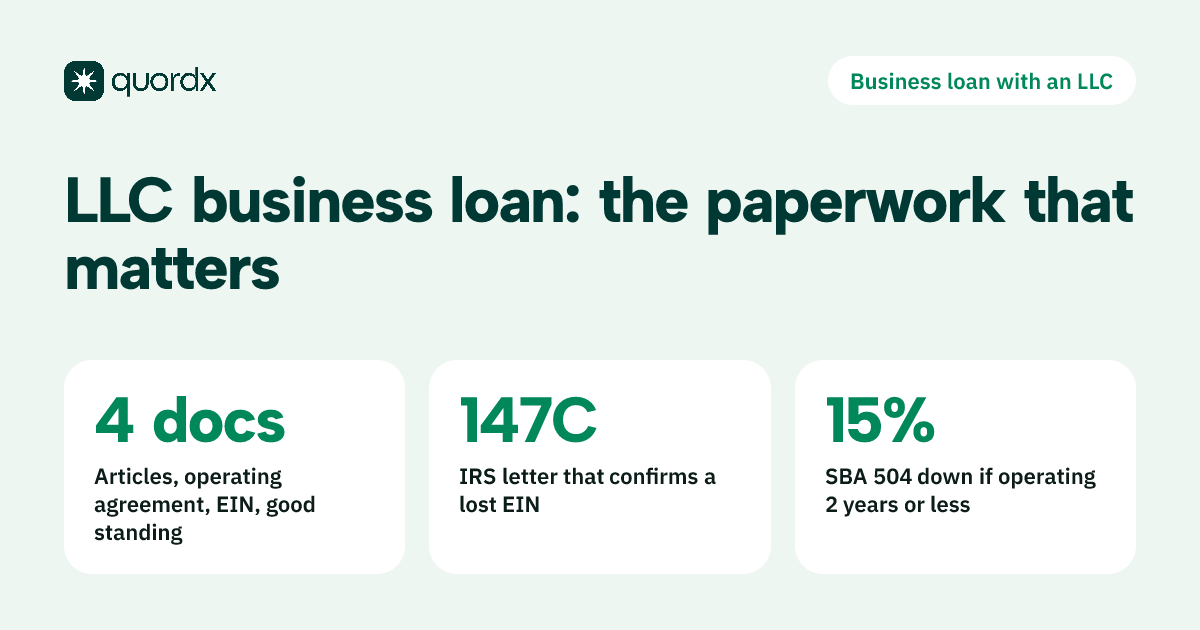
Documents you need for a business loan with an LLC
Every lender asks for the business's financials. An LLC adds a short stack that proves the company is real, current and properly authorized to borrow.
| Document | What it proves to the lender | Where you get it |
|---|---|---|
| Articles of organization (called a certificate of formation in some states) | The LLC exists and when it was formed | Your state's business filing office |
| Operating agreement | Who owns what percentage and who can sign for and borrow on behalf of the LLC | Your own records; if you never wrote one, write one now |
| EIN confirmation (IRS notice CP575 or Letter 147C) | The IRS assigned this number to this LLC | Printed when you applied, downloaded from your IRS business account, or requested by phone |
| Certificate of good standing | The LLC is current on state filings and fees | Your state's business filing office, usually online |
| Business bank statements | Revenue, balances and existing loan payments | Your bank, in the LLC's name |
| Business tax returns | Profit after expenses | Schedule C, Form 1065 or Form 1120-S, depending on how the LLC is taxed |
| Owner ID and personal financial details | Who the guarantors are | Each owner the lender asks to sign |
If you can't find your EIN letter
The IRS issues an EIN free and immediately online and tells you to print the confirmation letter. If that printout is gone, the IRS lists three ways to confirm the number: an entity transcript, a digital CP575 downloaded from your Business Tax Account if you're eligible, or a Letter 147C requested by calling 800-829-4933, Monday to Friday, 7 a.m. to 7 p.m. local time. Order it before you apply, since a mailed letter takes time.
Make every name match
Lenders check that the legal name on the articles, the EIN letter, the bank account and the application is the same company. "Smith Landscaping LLC" on one and "Smith Lawn Care" on another looks like two businesses. If you operate under a trade name, have the trade name filing ready to show how the two connect.
Step by step: applying for a loan as an LLC
- Confirm the LLC is in good standing. States can administratively dissolve an LLC that misses an annual report or fee. Fix that first, because a lender can't lend to a company the state doesn't recognize.
- Run all revenue through the LLC's account. Lenders read deposits. For SBA 7(a) Small loans, for example, SBA requires the lender to review the two most recent months of activity on the primary operating account.
- Pull the tax returns that match your classification. A single-member LLC hands over the owner's Schedule C; a multi-member LLC hands over Form 1065 and K-1s; an LLC taxed as an S corporation hands over Form 1120-S. Our page on whether it's hard for an LLC to get a loan explains what each one tells the lender.
- Update the operating agreement. It should list today's members and percentages. If a member left or joined, the lender will spot the mismatch.
- Decide who will guarantee. On SBA loans, every owner of 20% or more generally signs. Agree on it among members before a lender asks.
- Work out the payment you can carry. Add the new payment to your existing ones and compare the total with your cash flow, using the method in do lenders look at gross or net revenue.
- Apply, then compare total cost. Line up offers on total payback, term and guarantee terms, not the monthly payment alone.
For the full checklist beyond the LLC items, see our list of documents needed for a business loan.
Estimate your funding
Answer a few questions about your business to see a likely range.
How old does an LLC need to be to get a loan?
There are two ages to keep straight: the LLC's, from its formation date, and the business's, from when it started selling. Lenders care about the business, but a young LLC around a young business is where options shrink. Whether forming an LLC resets your history is covered on our LLC loan difficulty page; here is what each stage tends to open up.
- Before the first year: expect lenders to lean on something other than history, such as collateral, the owners' credit, or projections. Equipment financing works here because the machine secures the loan. SBA's 7(a) Small rules let the debt service coverage test run on a historical or projected basis.
- Around 12 months: this is where the cash-flow lenders Quordx works with usually start, because a year of statements shows a full cycle of revenue.
- Two years and up: some banks begin here. SBA 504 also asks less of an older company: for a general-purpose building, the borrower's down payment drops from 15% to 10% once it has operated more than two years.
Worked example: what two years is worth on an SBA 504 loan
Under 13 CFR 120.910, a 504 borrower puts in at least 10% of project cost, at least 15% if it has operated two years or less or the building is limited or single purpose, and at least 20% if both apply. Take a $1,200,000 project for an owner-occupied shop:
| Situation | Minimum down payment | On a $1.2M project |
|---|---|---|
| Operating more than two years, general-purpose building | 10% | $120,000 |
| Operating two years or less, general-purpose building | 15% | $180,000 |
| Operating two years or less, single-purpose building | 20% | $240,000 |
The decision rule: if the business is a few months short of the two-year line and the purchase can wait, waiting saves $60,000 of cash on this project. If it can't wait, plan for the higher injection from day one.
Getting a business loan without an LLC
You don't need an LLC or a corporation to get a business loan. Sole proprietors borrow every day, and so do general partnerships. The difference is liability and paperwork, not eligibility.
What changes without an entity: SBA's guide to business structures notes that a sole proprietorship isn't a separate entity and its owner can be held personally liable for business debts. It also warns that "banks are hesitant to lend to sole proprietorships," which in practice means a sole proprietor's personal credit and bank records carry even more of the file (SBA).
What replaces the entity documents:
- Schedule C on your Form 1040, which is where a sole proprietorship's profit or loss is reported.
- A trade name filing if you operate under a name other than your own, so the lender can tie the business name to you.
- Any business license your city, county or state requires.
- An EIN, which is free from the IRS and gives the business its own tax ID for bank accounts and vendor paperwork.
- A dedicated business bank account, which matters even more without an LLC, since nothing else separates business deposits from personal ones.
Should you form an LLC before applying?
If you need money in the next few weeks: and have solid history as a sole proprietor, apply as you are. Forming an LLC mid-application changes the borrower's legal name, and documents drawn in one name have to be redone in the other.
If you're months away from borrowing: form the LLC first, open the account in its name, and let a few months of statements build up before you apply.
If personal liability is the reason: know that the LLC won't remove a personal guarantee on most small business loans. It protects you from other business debts, not the loan you sign for. More on sole proprietor borrowing in can a sole proprietor get a business loan.
Mistakes that slow down an LLC loan
- Depositing customer payments into a personal account. The lender sees less revenue than you earn.
- An operating agreement that doesn't match reality. A former member still listed, or a new one missing, triggers questions and sometimes new signatures.
- A lapsed annual report. The certificate of good standing comes back negative and the file stops.
- Forming a new LLC during underwriting. The borrower changes and the paperwork starts over.
- Assuming the LLC replaces your credit. Expect your personal credit to be reviewed on most small business loans. To build toward borrowing on the company alone, see small business loans with EIN only.
Applying through Quordx as an LLC or a sole proprietor
Quordx is a broker, not a lender. Its application takes about 10 minutes and asks for the business and ownership details the lenders it works with need, so have the documents above in hand. For most of those lenders, an LLC and a sole proprietorship are equally welcome, though some restrict sole proprietors in certain states.
What they do care about: cash-flow lenders generally start around $17,000 a month in revenue and usually 12 months in business. A brand-new LLC below that line should look at equipment financing or an SBA microloan for now. Above it, lenders review the file and make the decision, and most options can be explored without a hard credit pull. If your business is based in Virginia, Connecticut, Missouri or North Dakota, Quordx does not serve it.
Questions Business Owners Ask Before Applying
Can a brand-new LLC get a business loan?
Sometimes, but not on the LLC's name alone. A new LLC is judged on the owners' credit, any collateral, and the history of the business if it existed before the LLC. Equipment financing and microloans are the usual first options, and SBA's 7(a) Small rules allow coverage to be shown on projections.
Do I need an operating agreement for a single-member LLC loan?
State rules on operating agreements vary, but lenders often ask for one, because it shows who owns the LLC and who can sign. For a single-member LLC it can be short. Writing one before you apply avoids a delay later.
What is a certificate of good standing?
It's a document from your state's business filing office confirming the LLC exists and is current on its filings and fees. Some states call it a certificate of existence or status. Lenders ask for a recent one, so request it close to when you apply.
Can I get a business loan as a sole proprietor instead of an LLC?
Yes. You apply in your own name with your Schedule C and business bank statements, and you're personally liable for the debt by default. Most small business lenders ask LLC owners for a personal guarantee anyway, so the practical gap is smaller than it looks.
Does my LLC need business credit to get a loan?
No. Most small business lenders rely on the owners' personal credit and the business's bank statements. A business credit file helps over time; a free D-U-N-S number is one place to start.
Apply for Funding
No obligation · Initial inquiry doesn't impact credit · Takes about 10 minutes
Sources

Written by
Cody Dreis
Founder, Quordx Capital
Read full bio
Related articles
Keep exploring business loans
Quordx Capital is a business funding broker, not a lender. Lenders make every credit decision and set the rate, fees and terms, and not every business qualifies. Quordx may be paid by a lender when a deal funds. Full disclosures