

Working capital loans: how to measure the gap, size the loan and pick the product
Quordx is a marketplace, not a single lender. Apply once and get matched across 50+ vetted lenders and every major funding type, including working capital loans. Free, transparent, no sales calls, no obligation.
A working capital loan is short-term financing for the day-to-day costs of running a business, such as payroll, inventory, rent and supplier bills, while you wait for sales to turn back into cash. It is a use of money rather than one product: a line of credit, a short-term loan, invoice factoring and a cash advance can each be the "working capital loan" a lender offers you. Which one fits depends on how long your cash stays tied up and whether the gap repeats, and two formulas tell you both before you apply.
The short version: Work out your cash conversion cycle (inventory days plus receivable days minus payable days) and multiply it by what you spend in a day; that is roughly the cash your operation needs to stay funded. A gap that comes and goes fits a line of credit, a gap that grows with sales fits a longer term loan, and a gap caused by slow B2B customers fits invoice financing. Compare offers in total dollars over the time you will actually use the money, not by the headline rate.
Part of our guide to Business Loans.
Last updated · Reviewed by Cody Dreis
50+ Lenders|Funding in as little as 24 hours
See Working capital loans: how to measure the gap, size the loan and pick the product offers you qualify for, free.
One 10-minute application. Matched to 3-7 best-fit lenders from a 50+ network. Decisions in 24-48 hours.
What working capital is: the formula and a worked example
The SEC's beginner's guide to financial statements puts it in one line: working capital = current assets minus current liabilities. Current assets are what you expect to turn into cash within a year (cash, receivables, inventory). Current liabilities are what you expect to pay within a year (supplier bills, accrued payroll and taxes, the next 12 months of loan payments).
Here is a hypothetical distributor with $3,650,000 in annual sales. We will use the same business through the whole page.
| Balance sheet line | Amount |
|---|---|
| Cash | $60,000 |
| Accounts receivable (customers owe you) | $400,000 |
| Inventory | $315,000 |
| Current assets | $775,000 |
| Accounts payable (you owe suppliers) | $210,000 |
| Accrued payroll and payroll taxes | $45,000 |
| Loan payments due in the next 12 months | $70,000 |
| Current liabilities | $325,000 |
| Working capital | $450,000 |
Positive working capital can still mean an empty bank account: This business has $450,000 of working capital and $60,000 of cash. The rest is on shelves and in customers' unpaid invoices, and payroll can't be paid in inventory. That is why the number lenders and owners both watch more closely is how long the cash stays tied up.
Cash conversion cycle: how long your cash is tied up
The cash conversion cycle counts the days between paying for what you sell and collecting for it. Cash conversion cycle = days inventory outstanding + days sales outstanding minus days payables outstanding.
- Days inventory outstanding (DIO) = inventory / annual cost of goods sold x 365
- Days sales outstanding (DSO) = accounts receivable / annual sales x 365
- Days payables outstanding (DPO) = accounts payable / annual cost of goods sold x 365
Our distributor sells $3,650,000 a year ($10,000 a day) and its cost of goods sold is $2,555,000 ($7,000 a day).
| Measure | Math | Days |
|---|---|---|
| Inventory days | $315,000 / $2,555,000 x 365 | 45 |
| Receivable days | $400,000 / $3,650,000 x 365 | 40 |
| Payable days | $210,000 / $2,555,000 x 365 | 30 |
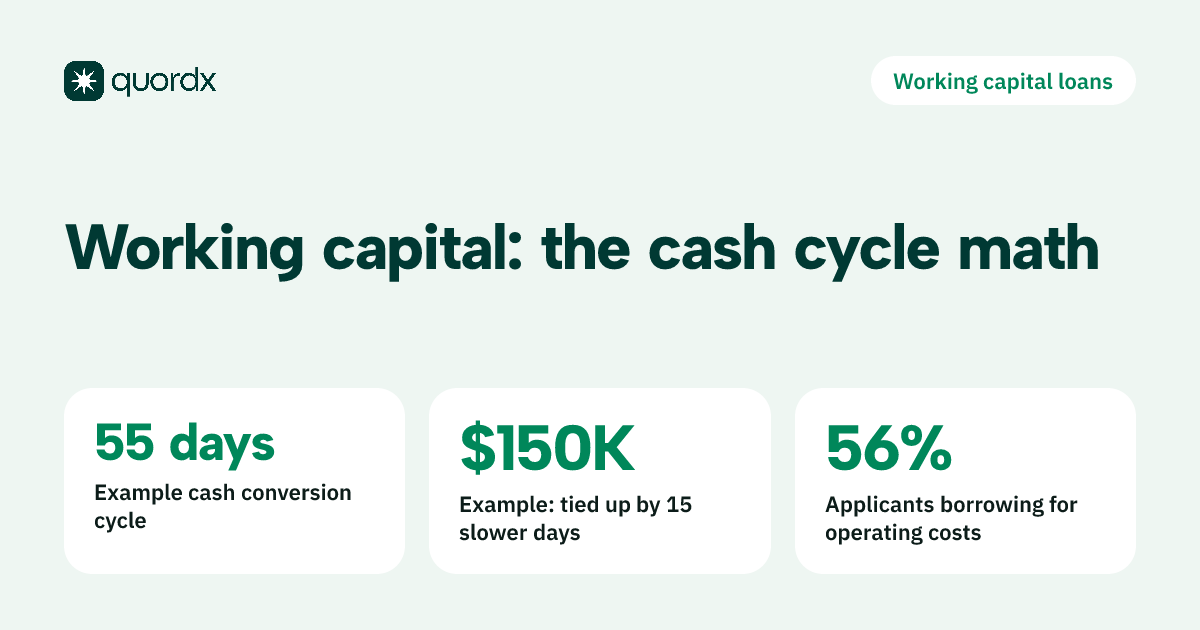
| Cash conversion cycle | 45 + 40 minus 30 | 55 |
Every day in the cycle has a dollar price: Here, one day of receivables is $10,000 of sales. If customers slip from paying in 40 days to 55, another $150,000 sits in receivables, and that is a working capital gap the business did not choose. Collect 8 days faster and $80,000 comes back; win 10 more days of supplier terms and $70,000 stays in the account.
Decision rule: if the cycle got longer because of collections or slow-moving stock, fix that first, because borrowing to fund a slipping cycle only buys time. If the cycle is stable and the gap comes from growth or seasons, financing it is reasonable.
Estimate your funding
Answer a few questions about your business to see a likely range.
How to size a working capital loan
Most owners guess the amount. Lenders ask how you got to it, and a number built from the cycle is easier to defend and less likely to leave you short or paying on cash you never use.
- Name the cause. A season, a new customer, a large order or a one-time hit. Each implies a different term.
- Price the cycle for the new volume, using the formulas above.
- Subtract cash you can spare above a reserve you will not touch, such as one payroll.
- Add a small cushion, then stop. On a lump-sum loan you pay for every dollar from day one.
Worked example: the distributor wins a customer worth $1,095,000 a year, or $3,000 a day in sales at the same 70% cost ratio ($2,100 a day in cost).
| Piece of the cycle | Math | Cash tied up |
|---|---|---|
| Extra inventory | 45 days x $2,100 | $94,500 |
| Extra receivables | 40 days x $3,000 | $120,000 |
| Less extra supplier credit | 30 days x $2,100 | minus $63,000 |
| Working capital the new customer needs | $151,500 |
That $151,500 does not go away while the customer stays: It is a permanent need created by growth, so a six-month loan would have to be refinanced again and again. Fund it with a longer term loan or a line sized to it. A seasonal build that peaks in October and clears by January is different: that is what a line of credit is built for.
Which loans fund working capital
Covering operating costs is the most common reason small firms borrow. In the Federal Reserve's 2026 Report on Employer Firms, firms that applied for financing most often did so to meet operating expenses (56%). The products below all serve that need, in different ways.
| Product | Fits this gap | How it is repaid | Watch for |
|---|---|---|---|
| Business line of credit | Gaps that repeat and clear within months | Interest on what you draw, or a schedule per draw | Reviews that cut or freeze the limit |
| Short-term business loan | A one-time need with a clear payback date | Fixed daily, weekly or monthly payments | Early payoff that saves nothing |
| Term loan | A permanent need from growth | Monthly payments over years | Covenants and prepayment terms |
| Invoice factoring or AR financing | Slow-paying business customers | Settled when your customer pays | Fees that grow while invoices stay unpaid |
| SBA 7(a) CAPLines | Seasonal or contract cycles, at bank pace | Draws repaid as the cycle converts to cash | A longer application at a bank |
| Merchant cash advance | Card-heavy sales when speed matters most | A share of sales or a fixed debit | The highest cost; it is not a loan |
| Supplier terms | Inventory-heavy businesses | Pay the supplier later | Early-pay discounts you give up |
Ask which structure sits under any offer labeled "working capital.": A true loan has an interest rate, a maturity and a promise to repay. A cash advance buys a share of future sales. The difference changes what early payoff saves and what happens in a slow month.
SBA lists four CAPLines (Seasonal, Contract, Builders and Working) on its types of 7(a) loans page, with a maximum maturity of 10 years except Builders. The same page lists a 7(a) Working Capital Pilot of up to $5,000,000 with maturities up to 60 months. Both go through banks. For the line and the term loan in detail, see the business line of credit guide and business term loans; for receivables, see AR financing and invoice factoring.
What a working capital loan costs: one $150,000 need, three structures
Bank lines usually float with prime, which was 7.00% as of October 2026 after the Fed raised its target range at its September 2026 meeting. Online products are more often priced as a fee or a fixed payback. Say the distributor needs $150,000 for about six months and gets these three hypothetical offers.
| Hypothetical offer | What you pay while it is out | Cost for about six months |
|---|---|---|
| Line of credit at 11% (prime 7.00% + 4), 1% setup fee | Interest on the balance, about $1,375 a month on $150,000 | $8,250 interest + $1,500 fee = $9,750 |
| 12-month loan at 15%, monthly payments | $13,538.75 a month | $9,026.25 interest if paid off at month 6 with no penalty; $12,464.96 if run 12 months |
| Fixed-payback advance, 1.25 factor, 39 weekly payments | $4,807.69 a week | $37,500, usually the same however early you pay |
Structure moves the cost more than the rate does: The 12-month loan also starts returning principal in month one, so you never actually have the full $150,000 for six months. The advance costs four times the line because its price is fixed on day one. When the money comes back quickly, ask each lender in writing what early payoff saves.
To compare offers that are priced differently, turn each into dollars and an annual rate. What APR means on a business loan shows how, and the $100K payment guide has the amortization formula behind the monthly figures.
What lenders look at for a working capital loan
Bank statements come first: Lenders read average monthly deposits, how steady they are, overdrafts or returned items, and any daily or weekly debits from other lenders. Run all revenue through one business account so the deposits tell the real story.
Banks add the balance sheet: Expect tax returns, a year-to-date profit and loss statement and balance sheet, and questions about the current ratio and the cycle you just calculated. A bank line may come with covenants that hold for its whole life.
Factoring looks at your customers: For invoice financing, the credit of the business that owes you matters more than your own, along with an aging report that shows how fast each customer pays.
Documents to have ready: three to six months of business bank statements, the last one or two business tax returns, current financial statements, a receivables aging report if you sell on terms, a list of existing debts with payments, owner ID and entity documents.
Working capital mistakes that make the gap worse
Funding a permanent need with short money: The growth example above needs $151,500 for as long as the customer stays. Six-month money for that turns into a renewal every six months, each with new fees.
Stacking advances: A second daily debit to cover the first one shrinks the deposits that both were sized on. If you are already there, read about merchant cash advances before taking another.
Borrowing through a loss: If gross margin doesn't cover overhead, a loan postpones the shortfall and adds a payment to it. Fix pricing or costs first.
Paying payroll with tax money: Withheld payroll taxes are not working capital. If payroll is the gap, read how to cover payroll with a business loan before you touch them.
Where Quordx fits for working capital
Quordx is a broker, not a lender. Lines of credit, short-term and term loans, working capital advances and B2B invoice factoring are all products it places: one application of about 10 minutes reaches lenders whose criteria fit your file, and those lenders set the terms and decide. The lender pays Quordx if a deal funds, so the business pays nothing for the match.
The lenders Quordx works with for cash-flow products generally start around $17,000 a month in revenue and usually want 12 months in business. A distributor like the one above clears that easily; a business below it is better served first by its own bank, a CDFI or an SBA lender. Quordx does not place SBA CAPLines or SBA loans under roughly $400,000, so those go through a bank.
Quordx does not serve businesses in Virginia, Connecticut, Missouri or North Dakota, and California applicants see a state notice first. If your numbers fit, bring your cycle math to the application and ask every lender for its offer in total dollars.
Questions Business Owners Ask Before Applying
What is the difference between working capital and cash flow?
Working capital is a snapshot: current assets minus current liabilities on one date. Cash flow is movement: the cash that came in and went out over a period. A business can show healthy working capital and still run short of cash if most of it is in inventory and receivables.
What is a good cash conversion cycle?
There is no single target; it depends on the industry. Distributors and manufacturers often carry long cycles, while businesses paid at the register can run near zero or below, because they collect before they pay suppliers. Track your own trend: a cycle that keeps lengthening is a warning even if the number looks normal for your industry.
Can a new business get a working capital loan?
It is hard in the first year, because most lenders size working capital loans from a history of deposits. The lenders Quordx works with usually want about 12 months in business. Newer businesses tend to start with supplier terms, a small secured line at their bank, an SBA microloan or, if they sell to businesses, invoice financing based on their customers' credit.
Do working capital loans need collateral?
Often not a specific asset, but most are backed by something. Common backing is a personal guarantee, a blanket lien on business assets filed as a UCC-1, or the receivables themselves in factoring. Read the security section of the agreement before you sign.
Is interest on a working capital loan tax deductible?
Generally yes, when the loan proceeds are used for business expenses, under the rules in IRS Publication 334. The Section 163(j) interest limit doesn't apply to most small businesses, because businesses with average gross receipts of $32,000,000 or less (2026) are generally exempt. Quordx is not a tax advisor, so confirm your situation with a CPA.
Apply for Funding
No obligation · Initial inquiry doesn't impact credit · Takes about 10 minutes
Sources

Written by
Cody Dreis
Founder, Quordx Capital
Read full bio
Related articles
Keep exploring business loans
Quordx Capital is a business funding broker, not a lender. Lenders make every credit decision and set the rate, fees and terms, and not every business qualifies. Quordx may be paid by a lender when a deal funds. Full disclosures