

Can I get a business loan to cover payroll?
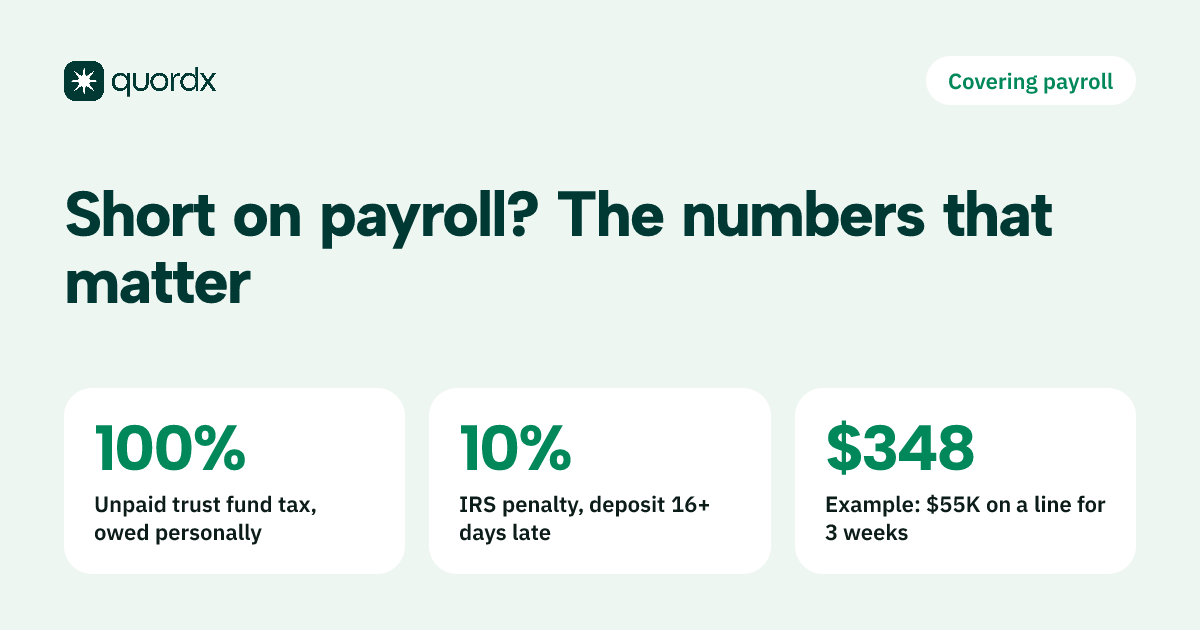
Yes. Lenders treat payroll as an ordinary operating expense, and a line of credit, a short-term loan, invoice factoring or a cash advance can all be used to meet it. The catch is timing: a new application rarely funds within a day or two, and the options that do move fast cost the most. Whatever you choose, don't pay net wages with the payroll taxes you withheld, because the IRS can hold the people who make that call personally liable for 100% of the unpaid trust fund taxes.
The short version: If payroll is due within days, start with what already exists: an open line of credit, cash in other accounts, or customers who will pay early. With a week or more, and customers who are businesses, invoice financing or a short-term loan can work; a merchant cash advance is the expensive last resort, because its daily debit lands on top of the next payroll. If the gap comes back every cycle, the fix is collections, pricing or a standing line, not another loan.
Part of our guide to Business Loans.
Last updated · Reviewed by Cody Dreis
50+ Lenders|Funding in as little as 24 hours
How much cash one payroll really takes
Owners usually size the gap from net paychecks. The real figure is net pay plus the tax deposit that follows a few days later, and the deposit includes money that already belongs to your employees.
Worked example, hypothetical: a commercial cleaning company runs a biweekly gross payroll of $84,000. Social security and Medicare are 6.2% and 1.45% each for the employee and the employer in 2026, per IRS Publication 15. Say federal income tax withheld comes to $9,000.
| Line | Math | Amount |
|---|---|---|
| Gross wages | $84,000 | |
| Employee social security and Medicare withheld | $84,000 x 7.65% | $6,426 |
| Federal income tax withheld (example) | $9,000 | |
| Net pay to employees | $84,000 minus $6,426 minus $9,000 | $68,574 |
| Employer social security and Medicare | $84,000 x 7.65% | $6,426 |
| Federal tax deposit | $6,426 + $9,000 + $6,426 | $21,852 |
| Cash this payroll needs | $68,574 + $21,852 | $90,426 |
Now a $120,000 customer payment arrives three weeks late, and the account holds $40,000 on payday. The shortfall is $50,426, not the $28,574 you would get by looking only at net pay.
The deposit is due after payday. Under the semiweekly schedule, taxes on wages paid Wednesday through Friday are due the following Wednesday; monthly depositors pay by the 15th of the next month. That gap is exactly when the temptation shows up.
Payroll taxes and the trust fund recovery penalty
The income tax, social security and Medicare you withhold from paychecks are trust fund taxes. You hold them for the government; they were never the business's money. In the example, $15,426 of the $21,852 deposit is trust fund money ($6,426 + $9,000).
If they go unpaid, the penalty can follow people, not just the company: Publication 15 says the trust fund recovery penalty is 100% of the unpaid trust fund tax, and that when it can't be collected from the business it may be imposed on everyone the IRS finds responsible for collecting or paying it who acted willfully. A responsible person can be an officer, an employee, a partner, an accountant, or anyone who signs checks or has authority over how business money is spent.
"Willfully" is a low bar: The IRS defines it as voluntarily, consciously and intentionally, and its trust fund recovery penalty page says that paying other business expenses instead of the withheld taxes counts. Paying employees with the tax money is exactly that.
IRS penalties for a late payroll tax deposit
| Deposit made | IRS penalty | On the $21,852 example |
|---|---|---|
| 1 to 5 days late | 2% of the unpaid deposit | $437.04 |
| 6 to 15 days late | 5% | $1,092.60 |
| More than 15 days late | 10% | $2,185.20 |
| More than 10 days after the first IRS notice | 15% | $3,277.80 |
On paper, a 10% penalty can look cheaper than some loans. It isn't the real price: The failure-to-deposit penalty is only the start: interest keeps running, the $15,426 trust fund portion becomes a possible personal debt, and an unpaid balance can turn into a federal tax lien that makes the next loan harder to get. See business loans with a tax lien if that has already happened.
Estimate your funding
Answer a few questions about your business to see a likely range.
Ways to cover payroll, ranked by cost and speed
Ranked roughly from cheapest to most expensive. The right answer is usually the first row you actually have access to.
| Option | How fast | Cost | Best when |
|---|---|---|---|
| Customers pay early | As fast as they agree | Any early-pay discount you offer | You have earned, unpaid invoices |
| Draw on an existing line of credit | Fast, because it is already open | Interest on the draw for the days it is out | The line has room |
| Owner cash or other business accounts | Immediate | What that cash would have earned elsewhere | You can document it as a loan to the business |
| New bank or credit union loan or line | Usually weeks | Low | The gap is weeks away, not days |
| Invoice factoring or payroll funding | Days to set up, faster on later invoices | A fee on each invoice while it is unpaid | Your customers are creditworthy businesses |
| Online short-term loan | Often days | Higher; often a fixed cost set at signing | A one-time gap with steady deposits |
| Merchant cash advance | Often the fastest new money | Highest, with daily or weekly debits | Card-heavy sales and nothing else will fund in time |
Two things are missing from the table on purpose: skipping the tax deposit, for the reasons above, and paying wages late. State law sets when wages are due; the Department of Labor keeps a state-by-state payday table worth checking before you plan any delay.
For how each financed option works in depth, see the business line of credit guide, AR financing and invoice factoring and the merchant cash advance guide.
Worked example: three ways to borrow $55,000 for three weeks
The cleaning company borrows $55,000 (the $50,426 shortfall plus a small cushion) and expects to repay it when the late $120,000 arrives in three weeks. Here is what each route costs under hypothetical terms.
| Route (hypothetical terms) | Payments | Cost for the three-week gap |
|---|---|---|
| Existing line at 11% (prime 7.00% + 4) | Interest only until repaid | $348.08 (55,000 x 11% x 21 / 365) |
| Short-term loan, fixed cost of 8% | 26 weekly payments of $2,284.62 | $4,400, even if repaid early, unless the contract discounts it |
| Cash advance at a 1.30 factor | About $567 a business day for about 6 months | $16,500 |
| Skip the $21,852 tax deposit for 16+ days | None now | $2,185.20 penalty plus interest, and $15,426 of personal exposure |
The line costs less than a tenth of the next option: That is the case for opening one while things are calm, because a line you apply for during the crunch arrives too late to help.
Watch the debit against the next payroll: At about $567 a business day, the advance takes roughly $5,670 out of the account every two-week pay cycle, from the same account that has to find $90,426 again in fourteen days. If one late customer caused the gap, a daily debit can turn it into a recurring one.
Prime moved to 7.00% after the Fed's September 2026 meeting, so a variable line costs a little more than it did this summer: on this draw, a quarter point is about $8.
Is a working capital loan the right way to cover payroll?
It fits a gap with a cause and an end date: A late customer, a seasonal ramp before revenue arrives, or crews and materials on a new contract before the first invoice is paid. You can name when the money comes back, so you can size the loan to it.
It doesn't fit a payroll that is short every cycle: That points to margin, pricing or collection terms, and borrowing each time stacks payments onto the same problem. If you have borrowed for payroll more than once in a few months, fix the cause before taking the next loan.
Businesses whose payroll grows ahead of collections: such as staffing firms and contractors, are usually better served by financing the invoices themselves, because the funding grows with billing. See invoice factoring for staffing agencies. For sizing any operating gap with the cash conversion cycle, see working capital loans.
What lenders ask for when payroll is the reason
Expect the usual file: recent business bank statements, ID, entity documents and, for larger amounts, tax returns and financial statements. The business loan documents checklist has the full list.
Payroll adds a few questions: Lenders may ask for payroll reports and proof that payroll tax deposits and Forms 941 are current, because an unpaid payroll tax balance can come ahead of their own claim. Factoring companies add an aging report and your customer contracts.
Get the taxes current before you apply if you can: A clean tax record and a clear reason for the gap (one late customer, with the invoice to prove it) is a much easier file than a business already behind with the IRS.
Where Quordx fits when payroll is short
Be realistic about the clock first. The lenders Quordx works with typically decide in 24 to 48 hours, and funding typically takes 3 to 7 business days after that, so a new application through Quordx or anyone else is unlikely to meet a payroll due tomorrow. Use what you already have for this one, and apply for the next.
Quordx is a broker, not a lender. For payroll gaps it places lines of credit, short-term loans, working capital advances, and invoice factoring, including payroll funding for businesses that bill other businesses. The lenders set terms and decide; they generally look for about $17,000 a month in revenue and usually 12 months in business. Quordx's fee comes from the lender when a deal funds, never from the business.
Quordx does not serve Virginia, Connecticut, Missouri or North Dakota, and California applicants see a notice before they continue. If your business fits, start an application with the reason for the gap and the date the money comes back, because that is the first thing a lender will ask.
Questions Business Owners Ask Before Applying
Can I pay employees late if I am short on cash?
State law sets how often and when wages are due, and the rules differ by state and type of worker. Check the Department of Labor's state payday table and your state labor agency before planning any delay. Paying late is not a financing strategy.
Am I personally liable for unpaid payroll taxes?
You can be. If withheld income, social security and Medicare taxes go unpaid and can't be collected from the business, the IRS may assess the trust fund recovery penalty, equal to 100% of the unpaid trust fund tax, against each responsible person who acted willfully. Owners, officers and anyone with authority over which bills get paid can be responsible.
What is payroll funding?
It is invoice factoring timed to your payroll: a funder advances cash against invoices you have issued to business customers, often on a schedule that matches your pay dates, and is repaid when those customers pay. It works best for staffing firms, contractors and other businesses that pay workers well before clients pay them.
Can I use an SBA loan for payroll?
SBA 7(a) loans, including the seasonal and contract CAPLines, can fund working capital such as payroll. They go through a bank at bank pace, so they suit a planned need, not an emergency. Quordx generally only places SBA loans of roughly $400,000 and up; for smaller ones, start with your bank.
Is interest on a loan used for payroll tax deductible?
Generally yes, when the loan proceeds pay a business expense such as wages, under IRS Publication 334. Quordx is not a tax advisor, so confirm with your CPA.
Apply for Funding
No obligation · Initial inquiry doesn't impact credit · Takes about 10 minutes
Sources

Written by
Cody Dreis
Founder, Quordx Capital
Read full bio
Related articles
Keep exploring business loans
Quordx Capital is a business funding broker, not a lender. Lenders make every credit decision and set the rate, fees and terms, and not every business qualifies. Quordx may be paid by a lender when a deal funds. Full disclosures