

Business line of credit: how it works, what it costs and how to qualify
Quordx is a marketplace, not a single lender. Apply once and get matched across 50+ vetted lenders and every major funding type, including business lines of credit. Free, transparent, no sales calls, no obligation.
A business line of credit is a credit limit you can draw from, repay and draw from again, paying interest only on the balance you have drawn. The lender sets the limit from your cash flow, credit and any collateral, then reviews the line on a schedule and can renew it, shrink it or close it to new draws. Two lines with the same limit can work very differently: one may let you carry a balance and pay interest monthly, while another turns every draw into its own fixed repayment schedule.
The short version: Before you compare prices, find out how each draw is repaid, what the line costs when you are not using it, and what can trigger a review. Banks usually price a line as prime plus a margin, with covenants and annual reviews; online lenders usually decide faster but price each draw with fees or a rate on a short schedule. Use a line for gaps that repeat and pay themselves back within months, and use a term loan for anything that takes years to earn back.
Part of our guide to Business Loans.
Last updated · Reviewed by Cody Dreis
50+ Lenders|Funding in as little as 24 hours
See Business line of credit: how it works, what it costs and how to qualify offers you qualify for, free.
One 10-minute application. Matched to 3-7 best-fit lenders from a 50+ network. Decisions in 24-48 hours.
How a business line of credit works: draw, repay, renew
Every line goes through the same stages. What changes from lender to lender is how long each stage lasts and what the lender can do at each one.
| Stage | What happens | What to ask |
|---|---|---|
| Approval | The lender sets a limit and signs a credit agreement with you | Is the limit committed, or can it be cut at any time? |
| Draw period | You move money from the line to your checking account, up to the available amount | Is there a minimum draw or a fee per draw? |
| Repayment | Either a minimum payment on the balance, or a fixed schedule for each draw | Which of the two structures does this line use? |
| Review or renewal | The lender rechecks your financials and renews, resizes, reprices or closes the line | How often, and what documents will you want? |
| End of draw period | You can no longer draw, and any balance pays down on set terms | How long is the repayment period after draws stop? |
Available credit is the limit minus what you owe: On a $75,000 line, draw $20,000 for payroll and $15,000 for a supplier, then repay $10,000: you owe $25,000 and can draw $50,000 more. Repaid principal goes back into the pool. Interest and fees do not.
Two ways a draw gets repaid
A revolving balance: you owe one running balance, pay interest on it (often daily accrual, billed monthly) plus any required principal, and pay it down whenever cash comes in. A draw-by-draw schedule: each draw becomes a small installment loan with its own payments, often weekly, over a set number of months. Many online lines work the second way, and it changes what a short need costs.
Here is a $20,000 draw you only need for 60 days, under each structure. The figures are hypothetical, chosen to show the mechanics, not quotes from any lender.
| Hypothetical terms | Revolving balance at 10% a year | 12-month draw schedule, fee of 1% of the draw a month |
|---|---|---|
| Payment while it is out | Interest only, about $167 a month | $1,866.67 a month ($1,666.67 principal plus a $200 fee) |
| Cost if repaid on day 60 | $328.77 (20,000 x 10% x 60 / 365) | $400 if unearned fees are waived on early payoff |
| Cost if early payoff saves nothing | Still $328.77 | $2,400, the full 12 months of fees |
Decision rule: if you expect to repay a draw early, ask in writing whether paying it off early cuts the cost. If the answer is no, the draw costs the same whether you keep the money 2 months or 12. How a revolving line of credit works walks through the revolving mechanics step by step.
Secured vs unsecured business lines of credit
"Unsecured" usually means no specific asset is pledged, not that nothing backs the line. The Federal Reserve's 2026 Report on Employer Firms found that of firms with debt, 59% used a personal guarantee and 51% used business assets to secure it. Expect at least one of the two on almost any line.
| Type | What backs it | How the limit moves |
|---|---|---|
| Unsecured | Your cash flow and credit, usually plus a personal guarantee | Set at approval, changed at review |
| Blanket lien | A lien on business assets in general, filed as a UCC-1 financing statement | Set at approval, changed at review |
| Asset-based (borrowing base) | Specific receivables and sometimes inventory | Recalculated as those assets rise and fall, often monthly |
| Cash-secured | A deposit you place with the bank | Equal to the deposit, until the bank moves you to an unsecured line |
A cash-secured line is an on-ramp, not a funding source: You are borrowing against your own money. Its value is the repayment record it builds with a bank, which some banks review later for an unsecured line. For the tradeoffs in more depth, see secured vs unsecured business lines of credit, and for what signing a guarantee commits you to, read what a personal guarantee means on a business loan.
Run the numbers on your loan
Pick a product, set the amount and term, and see a typical payment.
Bank line of credit vs online line of credit
The split matters more than any single rate quote, because the two kinds of lender build the product differently.
| Bank line | Online lender line | |
|---|---|---|
| How price is set | Usually a variable rate: prime plus a margin | Often a fee or rate on each draw |
| Repayment | Monthly interest or a minimum payment on the balance | Often a fixed schedule per draw, weekly or monthly |
| What they read | Tax returns, financial statements, credit, often an existing deposit relationship | Bank account data and credit, with a connected account read in real time |
| Ongoing conditions | Financial covenants, annual review, reporting duties | Fewer formal covenants; the lender watches account activity |
| Typical pace | Weeks, with more paperwork | Faster, with less paperwork |
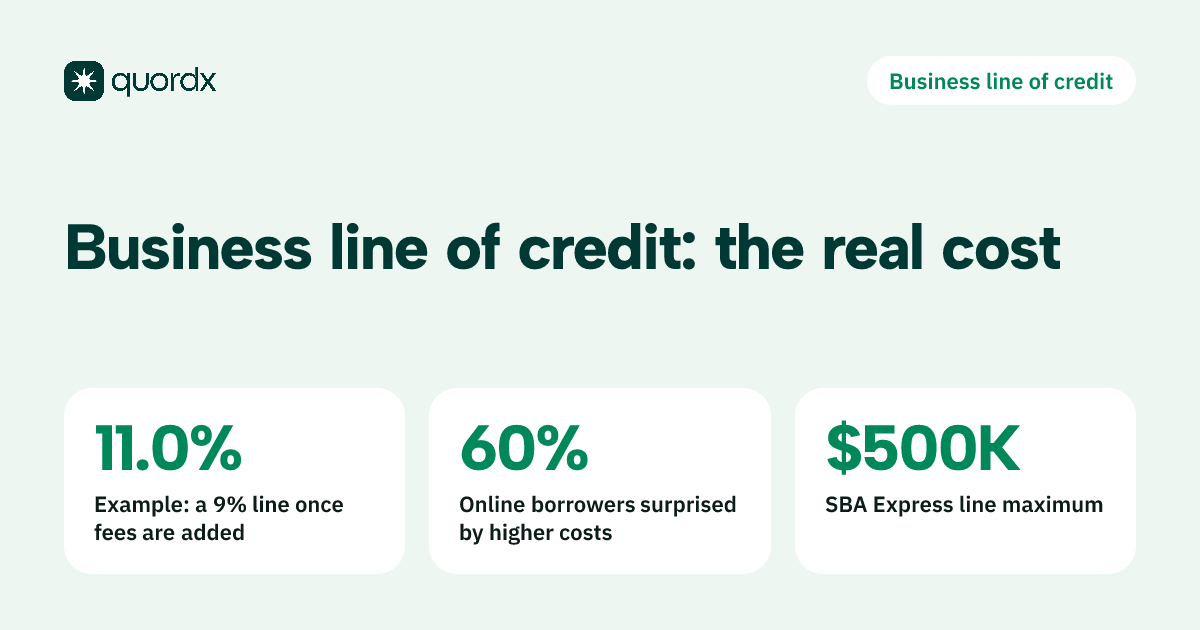
Cost surprises happen more at online lenders: In the same Fed report, 60% of businesses that borrowed from online lenders said actual costs were higher than expected, against 37% at small banks and 32% at large banks. The share of applicants going to online lenders rose from 17% in the 2020 survey to 29% in the 2025 survey, so more owners are meeting draw-by-draw pricing for the first time.
Bank lines tie your cost to prime: Prime was 7.00% as of October 2026, after the Fed raised its target range at its September 2026 meeting. On a variable line, every quarter-point move in prime changes what each drawn dollar costs.
SBA Express lines of credit
A bank can also offer a line under the SBA Express program. SBA's terms page caps Express loans at $500,000, lets revolving lines run up to 10 years, and caps the variable rate by size: prime plus 3% above $350,000 (10.00% at today's prime) up to prime plus 6.5% at $50,000 or less (13.50%).
Those are ceilings, not quotes. The bank decides whether to lend and sets your rate under the cap. What an SBA Express loan is covers the program.
What a business line of credit costs: interest plus fees
The rate is only part of the price. Fees you may see on a line:
- Origination or setup fee: charged once when the line opens.
- Annual or renewal fee: charged each year the line stays open, sometimes waived if you use it enough.
- Draw fee: a percentage of each draw, common on online lines.
- Unused line fee: a small charge on the part of the limit you have not drawn, more common on bank lines.
- Maintenance or monthly fee: a flat charge for keeping the account open.
Worked example, all hypothetical: a $75,000 bank line priced at prime plus 2%, so 9.00% with prime at 7.00%. It carries a 0.50% annual fee on the limit and a 0.25% unused fee on the undrawn part. You keep an average of $25,000 drawn.
| Cost item | Math | Dollars a year |
|---|---|---|
| Interest | $25,000 x 9.00% | $2,250 |
| Annual fee | $75,000 x 0.50% | $375 |
| Unused fee | $50,000 undrawn x 0.25% | $125 |
| Total | $2,750 | |
| Cost per dollar you actually used | $2,750 / $25,000 | 11.0% |
The quoted rate was 9.00%; the money you used cost 11.0%. If prime rises a quarter point, interest on the same $25,000 goes up $62.50 a year. Compare lines on total dollars at the balance you expect to carry, not on the headline rate, and ask every lender for its full fee schedule in writing.
Line of credit covenants and reviews: what can shrink or close your line
A covenant is a promise in the credit agreement that holds for the life of the line. Break one and the lender can freeze draws, cut the limit or call the balance, even if you never missed a payment. Bank lines carry the most.
- Reporting: send tax returns, year-end statements and sometimes quarterly statements by set dates.
- Debt service coverage: keep cash flow at a set multiple of your annual debt payments. See how DSCR is calculated.
- No new debt or liens without consent: a new loan or a cash advance can put the line in default.
- Clean-up period: bring the balance to zero for a stretch of consecutive days each year, which proves the line funds short gaps rather than permanent needs.
- Cross-default: a default on another loan with the same lender counts as a default on the line.
Worked example: say a covenant requires coverage of at least 1.25x. Your cash flow available for debt service is $300,000 and your annual debt payments are $250,000, so coverage is 1.20x and you are out of compliance. To get back to 1.25x you would need payments of $240,000 or less, or cash flow of $312,500 or more. Run this math before you sign any new loan, not after.
Lines without formal covenants still get reviewed: Lenders that read your bank account watch for falling deposits, overdrafts, new advances debiting the account and credit drops, and they can lower or freeze a line when they see them. A line you have kept clean is your strongest position at a review.
How lenders set your line of credit limit
Lenders size a line from what can repay it: your deposits and cash flow, minus the payments you already owe, adjusted for credit and any collateral. Asset-based lines add a second test, a borrowing base built from eligible receivables and inventory.
Because the lender is committing to the whole limit, not just today's balance: many underwrite as if the line were fully drawn. That is why existing loan and advance payments shrink the line you can get, and why first lines often start smaller than owners expect. Our guide to the average business line of credit limit works through the sizing math with examples and covers how to get an increase.
How to apply for a business line of credit
- Decide what the line is for. Write down the largest gap you expect in a year and how fast it repays. That is your target limit, and lenders will ask.
- Gather documents: recent business bank statements, the last one or two business tax returns, a year-to-date profit and loss statement and balance sheet, a list of current debts with payments, owner ID and entity documents. Asset-based lenders add a receivables aging report.
- Clean up the account the lender will read. Run all revenue through one business account and keep personal spending out of it.
- Check your credit before a lender does. Many lines carry a personal guarantee, so your personal score counts. See credit scores for a business line of credit.
- Ask how and when credit is pulled. Some lenders soft-pull to quote and hard-pull at signing or at the first draw. How a business line affects personal credit explains what shows up and when.
- Compare offers on the same expected balance, using the cost table above, and read the covenants and review terms before you sign.
When a line of credit is the wrong tool
Long-lived purchases: a truck, a buildout or an acquisition needs years to pay back, and a line can be reviewed and cut long before that. Price a term loan or equipment financing instead; line of credit vs business loan shows the math side by side.
A balance that never comes down: if the line has been near its limit for a year, it has become a term loan with worse terms and a renewal risk. Refinance the stuck part into fixed payments and keep the line for real gaps.
Slow-paying B2B customers: if the gap is always unpaid invoices, financing the invoices themselves may fit better. See invoice financing vs a line of credit.
Where Quordx fits for a line of credit
Lines of credit are one of the products Quordx places. Quordx is a broker, not a lender: one application of about 10 minutes goes to lenders whose criteria fit your file, and those lenders set the limit and the price. The business pays Quordx nothing; the lender pays a commission if a deal funds.
Be realistic about the starting point. The lenders Quordx works with for lines generally look for around $17,000 a month in revenue and, in most cases, 12 months in business. Below that, a cash-secured line at your own bank is the better first step. Quordx also does not place SBA Express or asset-based lines, so your bank or an asset-based lender is the route for those.
Businesses in Virginia, Connecticut, Missouri and North Dakota are outside Quordx's service area, and California applicants get a state notice before they continue. If your numbers fit, apply through Quordx and compare what comes back against your bank.
Questions Business Owners Ask Before Applying
Is a business line of credit revolving?
Most are. Repaid principal becomes available to draw again until the draw period ends. A non-revolving line lets you draw up to the limit once, and repayments do not restore it, so check which one your agreement describes.
Can a lender lower or cancel my line of credit?
Yes, within the terms of the agreement. At a review, or after a covenant breach, a new lien, falling deposits or a credit drop, a lender can reduce the limit, freeze draws or decline to renew. Read the review and default sections before you sign, and keep the lender informed before a known bad quarter.
Do I need collateral for a business line of credit?
Not always a specific asset, but most lines are backed by something: a personal guarantee, a blanket lien on business assets, specific receivables, or a cash deposit. Unsecured lines usually lean on the guarantee and your cash flow.
How long does a business line of credit last?
It depends on the agreement. Some lines renew every year after a review, some have a multi-year draw period followed by a repayment period, and some online lines are open-ended with each draw on its own schedule. SBA Express revolving lines can run up to 10 years.
Does an unused line of credit cost anything?
There is no interest on an undrawn limit, but some lines charge an annual, maintenance or unused-line fee whether you draw or not. Ask for the full fee schedule and add it to the interest at the balance you expect to carry.
What is a clean-up period on a line of credit?
A covenant that requires you to bring the balance to zero for a set number of consecutive days each year. It shows the lender the line is funding short-term gaps. If you cannot meet it, the need is probably long-term and belongs on a term loan.
Apply for Funding
No obligation · Initial inquiry doesn't impact credit · Takes about 10 minutes
Sources

Written by
Cody Dreis
Founder, Quordx Capital
Read full bio
Related articles
Keep exploring business loans
Quordx Capital is a business funding broker, not a lender. Lenders make every credit decision and set the rate, fees and terms, and not every business qualifies. Quordx may be paid by a lender when a deal funds. Full disclosures