

What is the disadvantage of a business loan?
The main disadvantage of a business loan is that the payment is fixed and your revenue isn't: you owe the same amount in a slow month as in a strong one, and it comes out of cash you could have used to run the business. The other costs hide in the paperwork: a personal guarantee that puts your own assets behind the debt, a lien that can block your next loan, covenants that limit what you can do, and prepayment terms that can make paying early cost extra.
The short version: Before you sign, test the payment against your worst recent month, not your average one, and read four parts of the agreement: the guarantee, the collateral description, the covenants and the prepayment clause. If the payment only works in a good month, or the money would cover ongoing losses instead of something that earns it back, don't borrow yet.
Part of our guide to Business Loans.
Last updated · Reviewed by Cody Dreis
50+ Lenders|Funding in as little as 24 hours
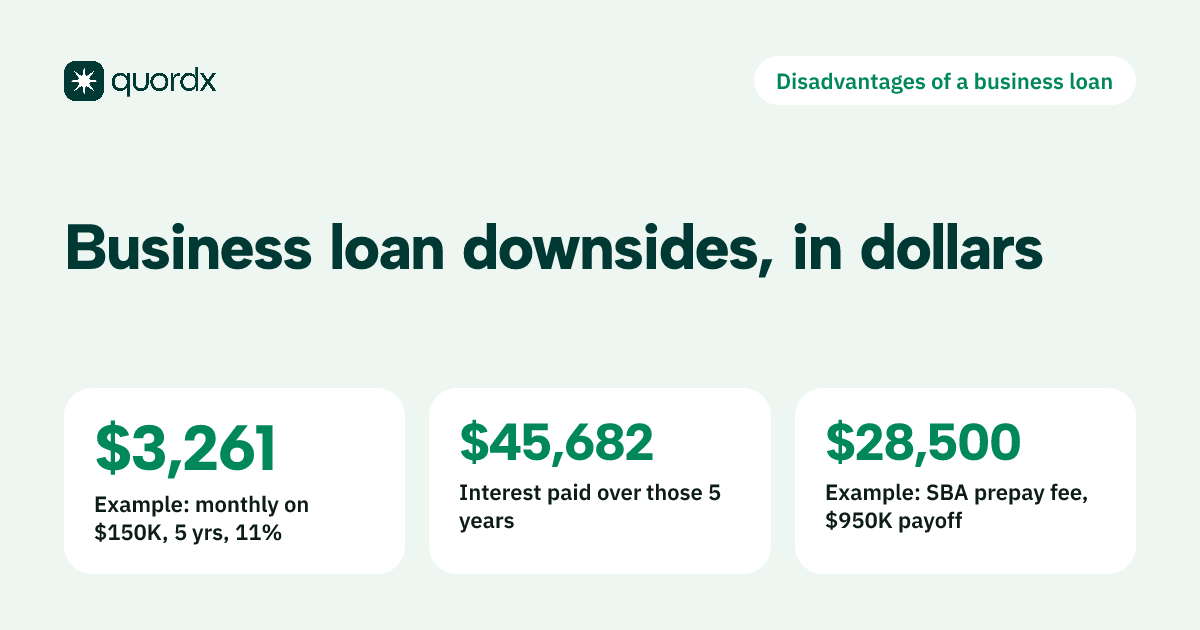
The disadvantages of a business loan at a glance
Each downside below has a worked example further down the page. The examples use hypothetical round numbers, labeled as such, so you can swap in your own.
| Disadvantage | What it means for you | Example on this page |
|---|---|---|
| Cash-flow drag | A fixed payment due in slow months too | $3,261 a month on $150,000, more than a $3,000 slow month |
| Interest cost | You pay back more than you borrowed | $45,682 of interest over 5 years on that loan |
| Personal guarantee | Your own assets back the company's debt | Owner liable for a $10,000 shortfall after repossession |
| Liens | Pledged assets can be taken, and can't easily be pledged again | A blanket lien that puts your next lender in second place |
| Covenants | Rules you can break while paying on time | A DSCR of 1.11x breaching a 1.25x covenant |
| Prepayment terms | Paying early can cost a fee or save nothing | $28,500 SBA fee on a year-two payoff |
Cash-flow drag: what a fixed payment takes from a slow month
Worked example: a landscaping company borrows $150,000 for trucks and equipment at a hypothetical 11% over five years. The payment is $3,261 a month. In an average month the business clears $12,000 before debt payments, so the loan takes 27% of it.
The slow month is the real test: In January the same business clears $3,000, and the payment is still $3,261. That month the loan costs more than the business made, and the difference comes out of reserves or the owner's pocket.
Daily-payment products bite harder: Take a $50,000 advance at an example factor rate of 1.3: you repay $65,000. If that is collected over roughly 126 business days, about six months, the account is debited around $516 every business day, whether sales came in or not.
Decision rule: if the payment doesn't fit inside your three weakest months of the last year, choose a longer term, a smaller amount or a business line of credit that you only draw on when you need it.
Estimate your funding
Answer a few questions about your business to see a likely range.
How much interest a business loan really costs
A shorter term saves interest but raises the payment, so the cheapest loan on paper can be the hardest one to carry.
| $150,000 at a hypothetical 11% | Monthly payment | Total interest |
|---|---|---|
| 3-year term | $4,911 | $26,789 |
| 5-year term | $3,261 | $45,682 |
Variable rates move: Variable-rate bank and SBA loans are commonly priced off the prime rate, which rose to 7.00% on September 17, 2026, a quarter point above where it had been since December 2025. On a $150,000 variable balance, a quarter-point rise adds about $375 of interest a year, and the next move could go either way.
Costs can run higher than expected: In the Federal Reserve's 2025 Small Business Credit Survey, 60% of firms that borrowed from online lenders said their actual borrowing costs were higher than they expected. Ask for the total repayment amount in writing, not just the rate or the payment.
One offset: interest on money used for the business is generally deductible, while interest on personal loans isn't deductible on Schedule C, and a loan used for both has to be split, per IRS Publication 334. Quordx is not a tax advisor, so check the details with your CPA.
Personal guarantees and liens: what you put on the line
The guarantee follows you home: In the same Fed survey, 59% of firms with debt used a personal guarantee to secure it. For SBA loans, owners of 20% or more generally must sign one under 13 CFR 120.160, and an LLC doesn't shield you from a debt you've personally guaranteed.
Worked example: a company finances a $60,000 truck, then defaults with $45,000 still owed. The lender repossesses and sells the truck for $35,000. The $10,000 shortfall, plus collection costs, can be collected from the owner under the guarantee, after the business has already lost the truck.
A lien limits your next move: A lender may file a UCC-1 that covers all business assets, which UCC 9-504 allows. A later lender then sits behind that claim, so the lien from a small loan can make a bigger one harder to get. Our pages on how much collateral a loan needs and loans without a personal guarantee cover how to limit both.
Loan covenants: the rules you agree to live by
Covenants are promises in the loan agreement beyond making payments, and breaking one can put you in default even if every payment is on time. They fall into three groups.
- Financial covenants: keep a ratio above or below a set level, such as a minimum debt service coverage ratio or a maximum debt-to-worth.
- Reporting covenants: send annual financial statements, tax returns or borrowing-base reports by set dates.
- Negative covenants: don't take on new debt, grant new liens, sell major assets, change ownership or pay out more than a set amount to owners without the lender's consent.
Worked example: a loan requires a minimum DSCR of 1.25x (an example covenant). After a hard year, the business has $100,000 available for $90,000 of annual debt payments, a ratio of 1.11x. Payments are current, but the covenant is broken, and the lender can charge a waiver fee, raise the rate or, if the agreement allows, call the loan.
Some obligations come from the program itself. SBA requires hazard insurance on all collateral for 7(a) loans over $500,000, under the same regulation that sets the guarantee rule.
Prepayment penalties: when paying early costs extra
SBA's rule is specific: On 7(a) loans with a maturity of 15 years or more, prepaying 25% or more of the balance in the first three years triggers a fee of 5% of the prepaid amount in year one, 3% in year two and 1% in year three, per SBA's 7(a) terms.
Worked example: a business takes a 25-year SBA loan to buy its building, then sells the building in year two and pays off $950,000. The prepayment fee is 3% of $950,000, or $28,500. Waiting until year four would have cost nothing. More on timing in paying off an SBA loan early.
Fixed-payback products can make early payoff pointless: With a factor rate, the total you owe is set on day one: in the $50,000 example above, paying early may still mean paying the full $65,000 unless the contract offers an early-payoff discount. Other loans charge a flat fee or a percentage, so find the clause and get the number in writing before you sign.
When not to take a business loan
Plenty of businesses run without debt: in the Fed's survey, 31% of employer firms had no outstanding debt at all. Borrowing is a poor fit when one of these is true.
- The money would cover ongoing losses rather than a gap with a clear end date. A loan delays that problem and adds a payment to it.
- The payment only works in a good month. If it doesn't fit your weakest months, the loan is too big or the term too short.
- The return doesn't clear the cost. Equipment that adds $2,000 a month of profit doesn't justify a $3,261 payment until the loan is paid off.
- You'd pledge your home for working capital. That puts the house behind a short-term need.
- You'd borrow to make another loan's payment. Stacking advances to stay current is how manageable debt becomes unmanageable.
- Cheaper money is available, such as customer deposits, better vendor terms or simply growing a little slower.
When the numbers do work, a loan can cost far less than giving up equity, and our page on whether small business loans are a good idea covers that side.
Comparing the fine print with Quordx
The downsides on this page vary from lender to lender, and you only see the guarantee, lien, covenant and prepayment language in real offers. Quordx is a broker, not a lender: one application of about 10 minutes goes to lenders it works with, and the lenders decide.
When offers come back, compare those four clauses next to the payment, because a slightly higher rate with a capped guarantee or no prepayment fee can be the better deal. The cash-flow lenders Quordx works with generally look for around $17,000 a month in revenue and 12 months in business; if your numbers fail the tests above, the honest move is not to apply yet.
Questions Business Owners Ask Before Applying
Is a business loan better than taking on an investor?
A loan costs interest and puts a payment on the books, but you keep all of your ownership once it's repaid. An investor takes no payment and a share of the company for good. If cash flow can carry the payment, debt lets you keep the upside; if it can't, a loan's fixed payment is the bigger risk.
Does a business loan affect my personal credit?
It can. Lenders often check the owner's credit when they underwrite a small business, and some report the loan to the owner's personal file, especially if you've signed a guarantee. Our page on whether a business loan affects personal credit explains how reporting works.
What happens if I can't repay a business loan?
The lender can collect from pledged collateral, then pursue anyone who signed a personal guarantee for the rest, plus collection costs. Before you miss a payment, call the lender about a modification, because options narrow once the loan is in default. For SBA loans, see what happens if you default on an SBA loan.
Is a line of credit less risky than a term loan?
It can be, because you pay interest only on what you draw and owe nothing when the balance is zero. The tradeoff is that lines are typically reviewed periodically, and the lender may be able to reduce or freeze one, and they often carry the same guarantee and lien as a term loan. A line suits recurring gaps; a term loan suits a one-time purchase.
Are business loan payments tax deductible?
The interest generally is, when the money is used for the business, according to IRS Publication 334. If a loan is used partly for personal purposes, the interest has to be split between the two. Ask your CPA how it applies to your return.
Apply for Funding
No obligation · Initial inquiry doesn't impact credit · Takes about 10 minutes
Sources
- Federal Reserve Banks, 2026 Report on Employer Firms (2025 Small Business Credit Survey)
- SBA: 7(a) loan program terms, conditions and eligibility (prepayment)
- 13 CFR 120.160: Loan conditions (guarantees, hazard insurance)
- IRS Publication 334: Tax Guide for Small Business (interest)
- Federal Reserve: FOMC minutes, September 15-16, 2026

Written by
Cody Dreis
Founder, Quordx Capital
Read full bio
Keep exploring business loans
Quordx Capital is a business funding broker, not a lender. Lenders make every credit decision and set the rate, fees and terms, and not every business qualifies. Quordx may be paid by a lender when a deal funds. Full disclosures