

Small Business Funding: Every Source, and Which One Fits Your Stage
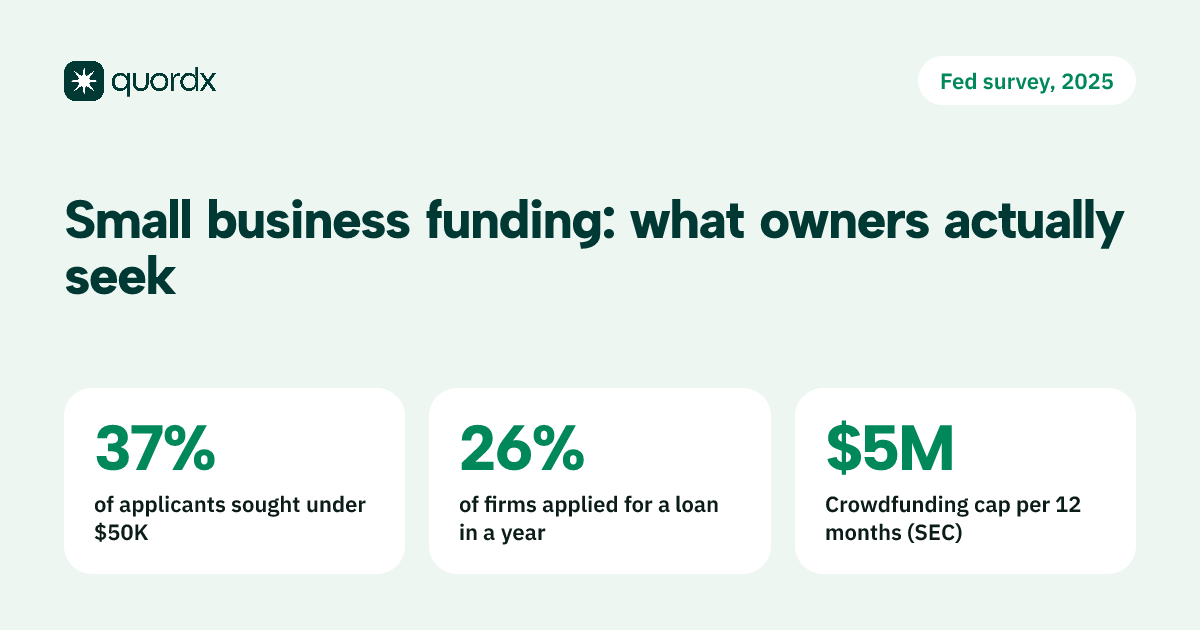
Small business funding comes from three places: debt (loans, credit lines, advances, and financing secured by invoices or equipment), equity from investors, and a thin layer of grants and crowdfunding. Debt is where most owners end up, and the right kind depends on how old the business is, how much you need, and what the money will buy. In the Federal Reserve's 2025 Small Business Credit Survey, 38% of employer firms applied for a loan, line of credit or merchant cash advance in the prior year, and 37% of applicants were after less than $50,000 (Federal Reserve Banks).
The short version: Match the source to the use. Finance an asset with the asset (equipment financing, a 504 loan for a building), finance slow-paying customers with their invoices (factoring), and cover recurring cash gaps with a line of credit. A young business with little revenue should look at savings, SBA microloans and CDFIs first; a profitable business with two or more years of tax returns should start with a bank or an SBA 7(a) lender. Sell equity only if the business can grow fast enough to make an investor's share worth giving up.
Part of our guide to Business Loans.
Last updated · Reviewed by Cody Dreis
50+ Lenders|Funding in as little as 24 hours
Where small businesses get funding: every source in one table
Each source asks a different question. A lender asks whether you can repay, a factor whether your customers will pay, and an investor how big the business can get.
| Source | Who provides it | What it is based on | What you give up |
|---|---|---|---|
| Business term loan | Banks, credit unions, online lenders | Cash flow, credit, time in business | Fixed payments; often a personal guarantee |
| Business line of credit | Banks, credit unions, online lenders | Cash flow and credit | Interest on what you draw; renewals are not automatic |
| Merchant cash advance | Finance companies | Future card or bank deposits | A share of sales until a fixed amount is repaid |
| Invoice factoring | Factoring companies | Your customers' credit | A discount on each invoice; the factor may collect |
| Equipment financing | Banks, finance companies, vendors | The equipment itself | A lien on the asset; usually a down payment |
| SBA 7(a) and 504 loans | Private lenders and Certified Development Companies, with an SBA guaranty | Cash flow, collateral, eligibility rules | SBA fees; more paperwork and time |
| SBA microloan | Nonprofit intermediary lenders | Your plan, credit and the lender's mission | Smaller amounts, up to $50,000 |
| CDFI loan | Treasury-certified community lenders | Flexible underwriting for underserved markets | Usually local or mission-limited |
| Angel investors and venture capital | Individuals and funds | Growth potential | Ownership, and often a board seat |
| Crowdfunding | Many backers through a platform | A product or story people want | Rewards or, under SEC rules, securities |
| Grants | Agencies, states, foundations, companies | A specific purpose the funder cares about | Time on applications; most are competitive |
What owners actually use: In the same Fed survey, 26% of employer firms applied for a loan, 24% for a line of credit and 8% for a merchant cash advance, while 29% sought a credit card, 17% trade credit, 11% a lease and 3% factoring. The most common reasons to seek money were operating expenses (56%) and expansion or a new opportunity (46%).
Which small business funding fits your stage and need
Time in business and the purpose of the money narrow the field faster than anything else. Read across your row, then down the column for what you are paying for.
| Stage | Working capital or cash gaps | Equipment or vehicles | Real estate or a large project | Usual first stop |
|---|---|---|---|---|
| Idea or pre-revenue | Savings, friends and family, rewards crowdfunding | Vendor financing with a down payment, microloan | SBA 504 with a larger down payment, if the plan is strong | SBDC advisor, microlender or CDFI |
| Under 1 year, early sales | Microloan, CDFI loan, invoice factoring if you bill businesses | Equipment financing, often with a down payment | Rarely available yet | Microlender, CDFI, factoring company |
| 1 to 2 years with steady deposits | Online term loan or line of credit, factoring, merchant cash advance as a last resort | Equipment financing | SBA 504 with a 15% injection | Online lenders, credit union, SBA lender |
| 2+ years and profitable | Bank line of credit, SBA 7(a) working capital | Bank equipment loan, SBA 7(a) | SBA 504, bank commercial mortgage | Your bank, then SBA lenders |
| Fast-growing, venture-scale | Venture debt alongside equity | Equipment financing | Usually leased, not bought | Angel investors and venture funds |
Decision rules that save time
- If the money buys a long-lived asset, finance it over the asset's life. Paying for a 10-year machine with a 12-month advance squeezes cash flow for no reason.
- If customers pay you on 30 to 90 day terms, look at factoring before a loan. The factor underwrites your customers, so a young business with strong customers can qualify.
- If the need recurs, use a line, not a lump sum. You pay interest only on what you draw.
- If you can wait several weeks, try the bank or SBA route first. The cheapest money takes the longest and asks the most.
- If no lender will say yes yet, fix the reason instead of paying for speed. A merchant cash advance can turn a weak quarter into a long one.
Estimate your funding
Answer a few questions about your business to see a likely range.
Debt funding: loans, lines of credit, advances and asset-based options
Term loans and lines of credit
A term loan is a lump sum repaid on a fixed schedule, best for a project with a known cost. A business line of credit works like a credit card limit you draw and repay, best for payroll gaps, seasonal inventory and slow-paying months. Banks and credit unions price these lowest but ask for the most history; online lenders decide faster on bank statements and charge more for it.
Merchant cash advances
A merchant cash advance is a purchase of future sales, not a loan, and its cost is quoted as a factor rate. Example: a 1.3 factor on $50,000 means $65,000 comes out of your deposits, no matter how quickly. Because the cost is fixed, paying it back fast makes the effective annual rate higher, not lower.
Invoice factoring
With invoice factoring, you sell unpaid invoices to a factor, which advances most of the face value now and pays the rest, less its fee, when your customer pays. It fits B2B firms such as staffing agencies, trucking companies and contractors whose customers pay on terms. It does not work for cash or card sales to consumers.
Equipment financing
With equipment financing, the machine, truck or system is the collateral, which is why newer businesses can often qualify. For tax year 2026, Section 179 lets a business expense up to $2,560,000 of qualifying equipment, phasing out above $4,090,000 placed in service, and the deduction is limited to business income (IRS Revenue Procedure 2025-32). Quordx is not a tax advisor, so check the details with your CPA.
Government-backed funding: SBA loans, microloans and CDFIs
SBA guarantees; private lenders lend: A 7(a) loan can reach $5 million, and SBA's guaranty to the lender is up to 85% at $150,000 and under, 75% for anything larger (SBA 7(a)). The 504 program pairs a bank with a Certified Development Company for buildings and major equipment, and the borrower usually puts in at least 10%.
A $200,000 7(a) example, approved in fiscal year 2027: The guaranteed portion is 75%, or $150,000. Loans between $150,001 and $700,000 carry an upfront fee of 3% on the guaranteed share, so $4,500, and it drops to 0% for manufacturers and rural businesses at this size. The maximum variable rate for a loan of $50,001 to $250,000 is prime plus 6.0%, which is 13.00% with prime at 7.00% as of October 2026; at that ceiling, a 10-year payment would be about $2,986 a month, and your lender can price below it.
Microloans for small amounts: SBA microloans go up to $50,000 and average about $13,000, with terms of up to seven years, made by nonprofit intermediaries that also offer business assistance (SBA microloans). See what an SBA microloan is for how they work.
CDFIs are community lenders certified by the U.S. Treasury: They include community development banks, credit unions, loan funds and venture funds that primarily serve low-income and underserved markets, and there are certified CDFIs in all 50 states (CDFI Fund). The CDFI Fund does not lend to businesses itself; it funds the CDFIs that do. For grants, research awards and state programs, see our guide to government funding for startups.
Equity funding: angel investors, venture capital and SBICs
Equity is money you never repay, paid for with a share of the company. SBA notes that venture capital is normally offered for an ownership share and an active role, and that almost all venture capitalists want at least a board seat (SBA). Angel investors are individuals, and they usually come earlier and in smaller amounts.
The math of giving up ownership: Say an angel invests $250,000 for 20% of your company. That values the business at $1.25 million after the investment, and if you later sell for $5 million, the investor's 20% is worth $1 million. Debt would have cost interest; equity costs a permanent slice of the outcome.
SBICs sit in between: Small Business Investment Companies are privately owned funds licensed and regulated by SBA that invest through debt, equity or both, typically $100,000 to $5 million, and they usually target mature, profitable businesses with enough cash flow to pay interest (SBA investment capital). For a venture-backed company, venture debt can stretch the runway between equity rounds.
Crowdfunding and grants for small businesses
Rewards crowdfunding: raises money from many backers who get a product, perk or recognition instead of ownership, and if the project fails you are typically under no obligation to repay them. It works best for a consumer product people can preorder. See crowdfunding for small business for more.
Investment crowdfunding is regulated: Under the SEC's Regulation Crowdfunding, a company can raise up to $5 million in a 12-month period, the offering must run online through an SEC-registered broker-dealer or funding portal, and non-accredited investors face limits on how much they can put in (SEC).
Grants are narrow: SBA does not provide grants to start or expand a business, and federal grants are listed on Grants.gov. Anyone who charges a fee to get you a grant is running a scam. Build the plan on money you can qualify for, and treat any grant you win as a bonus.
What is the best small business funding?
The best funding is the cheapest money you qualify for that matches how the asset or need pays you back. For a qualified borrower, your own cash, bank and SBA loans, and credit union or CDFI loans are usually the cheapest; online loans, factoring and especially merchant cash advances charge more for speed and looser requirements. Equity can cost the most of all if the business succeeds, because the investor's share grows with it.
How to choose between two offers: Compare the total dollars repaid, the payment frequency (daily, weekly or monthly), any prepayment terms and what you sign as collateral or guarantee. A cheaper rate with daily payments can strain cash flow more than a pricier monthly loan.
How small businesses get funding, in order: Decide the amount and use, check which sources in the tables above fit your stage, gather the documents for that product, and apply to a short list of well-matched lenders. Our guide on how to apply for small business funding walks through each step, and if you want to start close to home, see small business lenders near me.
Where Quordx fits in small business funding
Quordx is a broker, not a lender, so it covers only part of this map. Its lender panel handles term loans, lines of credit and working capital advances, B2B invoice factoring (including trucking and construction subcontractors), equipment financing, bridge and commercial real estate loans in some states, venture debt for SaaS companies with roughly $2.5 million or more in annual recurring revenue, and SBA 7(a) requests of about $400,000 and up.
It cannot help with grants, crowdfunding, equity, microloans, smaller SBA loans, SBA Express, 504 loans, purchase order or inventory financing. Cash-flow products on its panel generally start at about $17,000 a month in revenue and 12 months in business, so a younger or smaller business is better served by the microlenders, CDFIs and SBDCs above. If your business fits, one application of about 10 minutes reaches the lenders that match, and the lender makes the decision. Quordx does not serve Virginia, Connecticut, Missouri or North Dakota.
Questions Business Owners Ask Before Applying
What is the easiest small business funding to get?
The easiest products are the ones underwritten on something other than your business history: equipment financing leans on the asset, factoring on your customers' credit, and merchant cash advances on your sales. Easier usually means more expensive, so check the total repayment in dollars before you sign.
Can I get small business funding with no revenue?
Rarely from a conventional lender. Pre-revenue businesses usually fund themselves with savings, friends and family, SBA microloans, CDFIs, equipment financing with a down payment, or rewards crowdfunding. An SBDC advisor can help you build the plan most of those lenders ask for.
Is small business funding free money?
Almost never. Loans and advances are repaid with interest or fees, and investors take ownership. Grants are the only free money, and they fund specific purposes such as research, not general startup costs.
How much funding can a small business get?
It depends on the source and on your cash flow. Program ceilings include $5 million for an SBA 7(a) loan, $50,000 for an SBA microloan and $5 million every 12 months under Regulation Crowdfunding, but lenders size most loans to what your deposits and profits can repay.
Do I have to give up ownership to get funding?
Only with equity. Loans, lines, factoring, equipment financing and SBA loans leave ownership with you, though most require a personal guarantee from owners. Angel and venture investors buy a share of the company, and venture capitalists usually want a board seat too.
Apply for Funding
No obligation · Initial inquiry doesn't impact credit · Takes about 10 minutes
Sources

Written by
Cody Dreis
Founder, Quordx Capital
Read full bio
Keep exploring business loans
Quordx Capital is a business funding broker, not a lender. Lenders make every credit decision and set the rate, fees and terms, and not every business qualifies. Quordx may be paid by a lender when a deal funds. Full disclosures