

How to Apply for Small Business Funding: Steps, Documents and Why Applications Get Denied
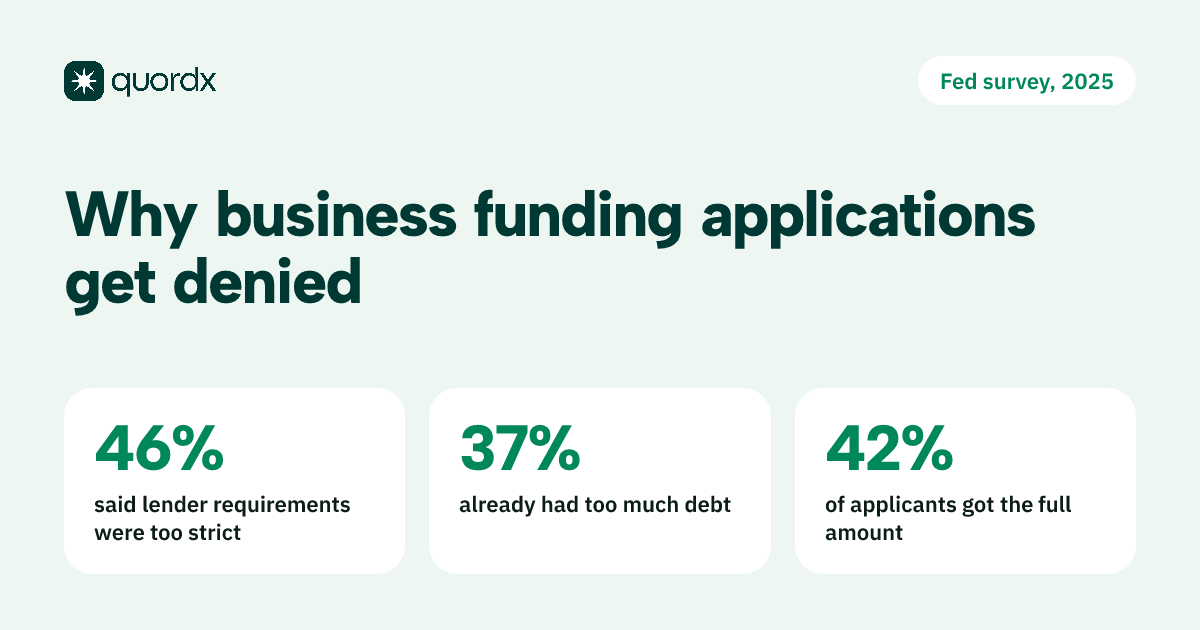
To apply for small business funding, pick the product that fits the need, check that you clear the lender's basic requirements, gather the documents that product calls for, and submit a complete file to a short list of lenders that fit your profile. After that, the lender underwrites the file, asks follow-up questions, makes an offer and closes. Getting the order right matters: in the Federal Reserve's 2025 Small Business Credit Survey, only 42% of applicants received the full amount they sought, 36% got some or most of it, and 22% got nothing (Federal Reserve Banks).
The short version: Know your amount, your use of funds and your numbers before you talk to anyone. Apply where your profile fits: your own bank or an SBA lender if you have two or more profitable years, an online lender or factor if you need speed or have a shorter history, and a microlender or CDFI if you are new. Send everything at once, answer follow-up requests the same day, and if you are declined, ask for the reasons.
Part of our guide to Business Loans.
Last updated · Reviewed by Cody Dreis
50+ Lenders|Funding in as little as 24 hours
Before you apply: a pre-application checklist
Most of the work happens before the application. Underwriters decline files for problems the owner could have spotted in an afternoon.
- Write down the amount and the use. "$80,000 for a second delivery van and its first six months of insurance" gets a better hearing than "working capital".
- Pull your personal credit reports. Lenders check the owner, and new businesses are often judged mostly on the owner's personal credit, as SBA notes (SBA). Dispute errors before a lender sees them.
- Run every dollar through a business bank account. Lenders read deposits to confirm revenue, and mixed personal and business spending makes that hard.
- File your tax returns. Bank and SBA lenders often pull transcripts straight from the IRS, so an unfiled year stops the file.
- List every debt you owe, with balance, payment and payoff date. Undisclosed debts that show up in your bank statements look worse than the debt itself.
- Confirm the business is in good standing with your state, and that the legal name and EIN match on every document.
- For SBA loans, check ownership first. Under SBA's policy in effect since March 1, 2026, all owners of a 7(a) or 504 borrower, direct or indirect, need U.S. citizenship or U.S. national status and a principal residence in the U.S. or its territories; green card holders no longer qualify.
- Know what you can pledge. SBA's Lender Match checklist warns that lenders may want collateral such as property or inventory (SBA Lender Match).
Check your own debt coverage first
Bank and SBA lenders ask whether your cash flow covers all your debt payments, new loan included, with room to spare. Example: a business with $180,000 a year of cash available for debt, $60,000 of existing annual payments and a proposed loan costing $48,000 a year has $108,000 of payments. Divide $180,000 by $108,000 and coverage is 1.67 times. If your number is close to 1.0, shrink the request or pay down debt before you apply.
Where to apply for small business funding
Where you apply should follow from your profile, not from whichever ad you saw first. In the Fed survey, applicants most often went to large banks, followed by online lenders and small banks, and the share applying at online lenders rose from 17% in the 2020 survey to 29% in the 2025 survey. Bank applicants mostly chose their lender because of an existing relationship, while online lender applicants put speed and their chance of being funded first.
| Where to apply | How you apply | Best when |
|---|---|---|
| Your own bank or credit union | Through your banker or online portal | Two or more profitable years and a deposit history there |
| An SBA lender | Find one with SBA Lender Match, then apply to the lender | Long terms, a large amount, or a bank said no without the guaranty |
| A microlender or CDFI | Directly, often with an advisor's help | New businesses and loans of $50,000 or less |
| An online lender | Online application with bank statements or a bank connection | You need speed and have steady deposits |
| A factoring company | Submit invoices and your customer list | Your customers are businesses that pay on terms |
| An equipment lender or vendor | Credit application plus the equipment quote | You are buying a specific machine or vehicle |
| A broker or marketplace | One application shared with several lenders | You want to compare lenders without filling out each form |
Apply to a few, not a dozen: Each formal application can mean another credit inquiry, and a scattered search wastes the weeks you were trying to save. Our guide to how many lenders to apply to covers the tradeoff, and does applying for a business loan hurt your credit explains soft and hard pulls.
Estimate your funding
Answer a few questions about your business to see a likely range.
Documents you need, by type of funding
The document list grows with the size of the loan and the lender's cost of being wrong. Have the full list for your product ready before you start, because a missing document can stall a file for days.
| Product | Core documents | Often added |
|---|---|---|
| Online term loan, line of credit or advance | ID, application, the last 3 to 6 months of business bank statements, business tax ID | Voided check, a live bank connection, proof of ownership |
| Bank term loan or line of credit | Recent business and personal tax returns, year-to-date profit and loss and balance sheet, debt schedule | Personal financial statement, entity documents, lease |
| SBA 7(a) loan | SBA Form 1919, personal financial statement (SBA Form 413), business and personal tax returns, financial statements, business plan and projections for newer businesses | IRS Form 4506-C, resumes, collateral details, purchase agreement if buying a business |
| SBA 504 loan | The 7(a)-style financial package plus the project details | Purchase contract, appraisal, environmental report, cost estimates |
| SBA microloan or CDFI loan | Business plan, personal credit, any financial statements you have | Projections, proof of training or advising |
| Equipment financing | Application, equipment quote or invoice | Bank statements, tax returns for larger amounts, proof of insurance |
| Invoice factoring | Invoices, accounts receivable aging report, customer list | Proof of delivery, purchase orders, contracts |
What the SBA forms are: SBA Form 1919 is the borrower information form that every 7(a) applicant completes and gives to the lender (SBA Form 1919). SBA Form 413 is the personal financial statement SBA uses to judge repayment ability for 7(a), 504 and other programs. IRS Form 4506-C lets the lender pull your tax transcripts directly from the IRS, with your consent. Our full checklist of documents needed for a business loan goes line by line.
How to apply for small business funding, step by step
- Choose the product and the amount. Match the term to the use: short money for short needs, long money for long-lived assets. See every source of small business funding if you are unsure which product fits.
- Prequalify where you can. Some online lenders and marketplaces quote with a soft credit check. Ask before you consent whether the lender will run a hard pull and when.
- Pick one to three lenders that fit. Check each one's published requirements for time in business, revenue and credit, and skip any you clearly miss.
- Submit a complete file. Upload every document on the lender's list at once, with a short note explaining anything unusual, such as a one-time dip in revenue.
- Answer underwriting questions the same day. Lenders ask for missing items, called conditions or stips, and a file that sits waiting for them often goes stale.
- Compare offers on total cost. Ask for the total repayment in dollars, the payment schedule, fees taken from the proceeds, prepayment terms and what you are guaranteeing.
- Close and fund. You sign the note, any personal guarantee and security documents, and the lender usually files a UCC lien before sending the money.
What happens after you apply
Underwriting: The lender checks your credit, verifies revenue from bank statements and, for larger or SBA loans, tax transcripts. It reviews existing debt, any collateral and your industry, and may order an appraisal or a site visit.
How long it takes: Online lenders working from bank statements often decide in days. SBA lists a turnaround of 5 to 10 business days for a standard 7(a) loan it reviews, on top of the lender's own underwriting, and lenders with delegated authority can decide without SBA review (SBA terms).
The offer and the guarantee: Expect to sign a personal guarantee: of firms with debt in the Fed survey, 59% used one, and 51% pledged business assets. Read the offer for the payment frequency and any prepayment penalty, not just the rate. See what lenders look for in bank statements to know what the underwriter is reading.
Why small business funding applications get declined
The Fed asked applicants that were turned down for at least some of the financing they sought why it happened. Respondents could pick more than one reason.
| Reason given for denial | Share of denied applicants | What usually fixes it |
|---|---|---|
| Lender requirements too strict | 46% | Apply where your profile clears the published minimums, or wait until it does |
| Too much debt already | 37% | Pay down or consolidate first; ask for less |
| Low credit score | 30% | Correct report errors, lower card balances, then reapply |
| Insufficient collateral | 29% | Offer other assets, add a larger down payment, or use a product secured by the asset you are buying |
| Weak sales | 29% | Wait for stronger months, or size the request to current revenue |
| Lenders do not fund businesses like mine | 29% | Find a lender that specializes in your industry or business type |
Some owners never apply: Of firms that did not apply because they expected a denial, 63% blamed weak business financials. If that is you, the fix is the same as for a denial: improve the numbers lenders read, then apply where they fit.
Ask for the reasons in writing: Under Regulation B, a lender that denies a business with $1 million or less in revenue must give the reasons or tell you how to request them, and larger businesses can request written reasons within 60 days (CFPB, 12 CFR 1002.9). Then use our guide on what to do after a denied business loan.
Applying through Quordx
Quordx is a broker, not a lender: you fill out one application of about 10 minutes and it goes to the lenders on Quordx's panel whose criteria your file matches, so you skip filling out a separate form for each. Most options can be explored without a hard credit pull, and the lenders, not Quordx, decide; they typically answer in 24 to 48 hours.
It fits best when the business has about 12 months of history and roughly $17,000 a month or more in revenue, or needs B2B factoring, equipment financing, or an SBA 7(a) loan of about $400,000 and up. For a smaller SBA loan, a microloan or a startup with no revenue, apply through SBA Lender Match, a microlender or a CDFI instead. Businesses in Virginia, Connecticut, Missouri and North Dakota cannot apply through Quordx, and California applicants get a notice before they begin.
Questions Business Owners Ask Before Applying
How long does it take to get small business funding after applying?
It depends on the product. Online lenders that work from bank statements can decide in days, while bank and SBA loans take longer because they verify tax returns, financial statements and collateral. Sending a complete file and answering follow-up requests quickly is the part you control.
Can I apply to more than one lender at a time?
Yes, and comparing two or three offers is sensible. Applying to many lenders can stack credit inquiries and multiply paperwork, so pick lenders whose published requirements you meet and ask each one whether it runs a soft or hard pull.
Do I need a business plan to apply for funding?
For startup funding, usually yes: SBA notes that most lenders expect a business plan from a new business, along with projections. An established business applying for a short-term loan is judged more on its bank statements and tax returns. See our guide on whether you need a business plan for a loan.
What is the difference between prequalification and approval?
Prequalification is an estimate based on what you report and, often, a soft credit check. Approval comes after underwriting verifies your documents, and the final amount and terms can differ from the estimate.
Where do I apply for an SBA loan?
With an SBA-approved lender, not with SBA itself. SBA's free Lender Match tool shares a short summary of your request with participating lenders and sends you a list of interested ones two business days later. Our guide on how to apply for an SBA loan covers the rest.
Apply for Funding
No obligation · Initial inquiry doesn't impact credit · Takes about 10 minutes
Sources
- Federal Reserve Banks: 2026 Report on Employer Firms (2025 Small Business Credit Survey)
- U.S. Small Business Administration: Lender Match
- U.S. Small Business Administration: SBA Form 1919, Borrower Information Form
- Consumer Financial Protection Bureau: Regulation B, 12 CFR 1002.9 Notifications
- IRS: Income Verification Express Service (Form 4506-C)

Written by
Cody Dreis
Founder, Quordx Capital
Read full bio
Related articles
Keep exploring business loans
Quordx Capital is a business funding broker, not a lender. Lenders make every credit decision and set the rate, fees and terms, and not every business qualifies. Quordx may be paid by a lender when a deal funds. Full disclosures