

Business term loans: how they work, what they really cost and what you agree to
Quordx is a marketplace, not a single lender. Apply once and get matched across 50+ vetted lenders and every major funding type, including term loans. Free, transparent, no sales calls, no obligation.
A business term loan is a lump sum you borrow once and repay on a fixed schedule over a set number of months or years, with each payment usually covering interest plus a slice of principal. Terms run from a few months at many online lenders to 10 years for most SBA 7(a) loans and up to 25 years when real estate is involved. What the loan really costs depends on four things the quoted rate leaves out: fees taken at closing, the length of the term, what early payoff saves and the covenants you agree to keep.
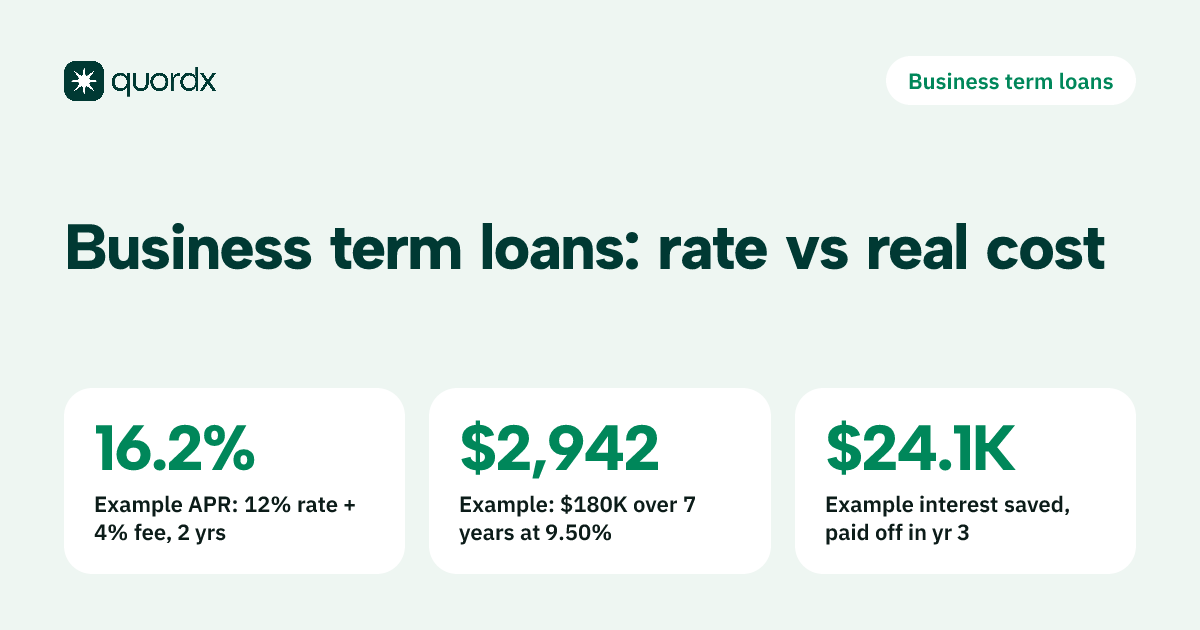
The short version: Match the term to what the money buys, then compare offers by APR and total dollars rather than the quoted rate. A fee taken from the proceeds can add several points: in our example, a 12% two-year loan with a 4% fee works out to a 16.2% APR. Before you sign, read the prepayment clause, the covenants and the personal guarantee.
Part of our guide to Business Loans.
Last updated · Reviewed by Cody Dreis
50+ Lenders|Funding in as little as 24 hours
See Business term loans: how they work, what they really cost and what you agree to offers you qualify for, free.
One 10-minute application. Matched to 3-7 best-fit lenders from a 50+ network. Decisions in 24-48 hours.
How a business term loan works: amortization in one example
Most term loans are fully amortizing: the payment stays the same, but early payments are mostly interest and later ones mostly principal, until the balance reaches zero on the last payment.
Worked example, all hypothetical: a restaurant group borrows $180,000 to open a second location. The bank offers 7 years (84 monthly payments) at 9.50%, which is prime of 7.00% plus 2.5. The payment is $2,941.92 a month. In month one, $1,425.00 of it is interest and $1,516.92 goes to principal.
| Year | Interest paid | Balance at year end |
|---|---|---|
| 1 | $16,286.12 | $160,983.08 |
| 2 | $14,398.73 | $140,078.77 |
| 3 | $12,324.05 | $117,099.78 |
| 4 | $10,043.41 | $91,840.15 |
| 5 | $7,536.46 | $64,073.57 |
| 6 | $4,780.69 | $33,551.22 |
| 7 | $1,751.43 | $0.00 |
| Total | $67,120.89 |
After three years you have paid $105,909 and still owe $117,100: That is normal amortization, and it is why prepayment terms matter more than most borrowers expect. The formula behind every payment here is worked through step by step in the $100K payment guide, and the loan payment calculator runs your own numbers.
Fixed vs variable rate term loans
A fixed rate locks the payment. A variable rate resets with an index, usually prime, so the payment moves when prime does. If prime rises 0.25 point after year one on the loan above, the rate becomes 9.75% on the remaining $160,983.08 and the payment rises from $2,941.92 to $2,962.09, about $20 a month. Prime was 7.00% as of October 2026, after a quarter-point increase at the Fed's September 2026 meeting.
How long is a business term loan? Matching the term to the use
The term should be long enough that the payment fits the cash the purchase brings in, and no longer than the purchase lasts.
| What the money buys | Term that usually fits | Why |
|---|---|---|
| Inventory or a short cash gap | Months to about 2 years | The money comes back when the stock sells or invoices are paid |
| Equipment | About the equipment's useful life | You stop paying around when it stops earning |
| Buildout, expansion or an acquisition | Several years; SBA 7(a) allows up to 10 | It pays back slowly, out of profit |
| Real estate | Up to 25 years under SBA 7(a) | Long life, large amount, low payment |
Decision rule: if the payment on the shortest sensible term leaves less than a comfortable cushion each month, lengthen the term rather than borrowing less than the project needs. If a short-term loan is being used for a long-lived purchase, expect to refinance it, and price that in. For working capital sizing, see working capital loans; for the trade-off against a revolving line, see line of credit vs business loan.
Bank vs online vs SBA term loans
The three sources build the same product differently. Knowing which one you are talking to tells you what to ask.
| Bank | Online lender | SBA 7(a) (through a bank or lender) | |
|---|---|---|---|
| How it is priced | Usually prime plus a margin, or a fixed rate | Often a fixed rate or total payback, plus an origination fee | Variable rate capped at prime plus 3% to 6.5%, by size |
| Payments | Monthly | Often daily or weekly | Monthly |
| Terms | Years | Months to a few years | Up to 10 years; 25 for real estate |
| What they read | Tax returns, financial statements, cash flow coverage | Bank account activity and credit | Bank-style file plus SBA eligibility rules |
| Pace | Weeks | Often days | Weeks; more paperwork than a bank loan |
Small banks are worth asking: In the Federal Reserve's 2026 Report on Employer Firms, applicants that went to small banks were more likely to be fully approved (57%) than those at other lenders.
SBA 7(a) term loan caps and fees
SBA caps the variable rate by loan size on its 7(a) terms page. At prime of 7.00%, the ceilings work out as follows:
| Loan size | Maximum spread | Ceiling at 7.00% prime |
|---|---|---|
| $50,000 or less | Prime + 6.5% | 13.50% |
| $50,001 to $250,000 | Prime + 6.0% | 13.00% |
| $250,001 to $350,000 | Prime + 4.5% | 11.50% |
| Over $350,000 | Prime + 3.0% | 10.00% |
If the restaurant group's $180,000 were an SBA 7(a) loan approved in fiscal 2027, the upfront guaranty fee would be 3% of the guaranteed portion. SBA guarantees up to 75% above $150,000, so that is $180,000 x 75% x 3% = $4,050. Since March 1, 2026, SBA also requires every direct and indirect owner to be a U.S. citizen or national living in the U.S., which rules out businesses with any green card holder as an owner.
Run the numbers on your loan
Pick a product, set the amount and term, and see a typical payment.
Term loan fees and APR: what the quoted rate leaves out
Fees you may see on a term loan:
- Origination fee: a percentage of the loan, often taken out of the proceeds so you receive less than you repay.
- Documentation or packaging fee: a flat charge for preparing the loan.
- SBA guaranty fee: on SBA loans, set by SBA and sometimes financed into the loan.
- Closing costs: appraisal, legal review, lien filing and title work on secured loans.
- Prepayment fee: covered in the next section.
The APR may not be on your paperwork: The federal Truth in Lending rules that force an APR onto consumer loans exempt credit extended mainly for a business purpose (12 CFR 1026.3(a)). If an offer shows only a rate or a total payback, calculate the APR yourself or ask for it in writing.
Worked example, hypothetical: a $80,000 two-year loan at 12% with a 4% origination fee taken from the proceeds. You receive $76,800, pay $3,765.88 a month for 24 months, and repay $90,381.12. Interest is $10,381.12 and the fee is $3,200, so the loan costs $13,581.12 for $76,800 of usable cash: an APR of 16.2%.
| Hypothetical loan | Quoted rate | Fee from proceeds | APR |
|---|---|---|---|
| $180,000, 7 years | 9.50% | 2% | 10.1% |
| $180,000, 7 years | 9.50% | 4% | 10.8% |
| $80,000, 2 years | 12.00% | 4% | 16.2% |
The shorter the term, the more a fee costs: A 4% fee spread over seven years adds about 1.3 points; the same 4% over two years adds about 4.2. Compare short offers on APR and total dollars, never on the quoted rate alone. What APR means on a business loan covers the method.
Paying off a term loan early: prepayment penalties and what you save
On an amortizing loan with no prepayment fee, paying early saves the interest you have not been charged yet. Pay off the restaurant loan after three years and you skip about $24,112 of scheduled interest. With a hypothetical 2% prepayment fee on the $117,099.78 balance ($2,342), you still save about $21,770.
| Prepayment terms | What early payoff saves |
|---|---|
| No penalty, interest on the declining balance | All interest not yet charged |
| Declining percentage of the amount prepaid | Remaining interest minus the fee |
| Make-whole or yield maintenance on some fixed-rate bank loans | Often little, because the fee tracks the lender's lost interest |
| Fixed total payback set at signing | Often nothing, unless the contract gives a discount |
SBA's own prepayment fee is narrow: It applies only to loans with maturities of 15 years or more, when you voluntarily prepay 25% or more of the balance within three years of first disbursement: 5% in year one, 3% in year two, 1% in year three. Say you sell a building financed with a 25-year 7(a) loan and pay off a $575,000 balance in year three: the fee is 1%, or $5,750. In year two it would be $17,250. More on that in paying off an SBA loan early.
Term loan covenants: what you promise until it is paid
Covenants are promises in the loan agreement that last for the whole term. Break one and the lender can declare a default even if every payment was on time. Bank and SBA loans carry the most; online loans usually fewer, with the lender watching your account instead.
- Debt service coverage: keep cash flow at or above a set multiple of annual debt payments. How DSCR is calculated shows the formula.
- Reporting: send tax returns and financial statements by set dates each year.
- No new debt or liens without consent: a later loan or cash advance can trip this.
- No major asset sales, ownership changes or large owner distributions without the lender's approval.
- Cross-default: a default on another loan with the same lender counts here too.
Worked example: the restaurant group has $96,000 a year of cash available for debt service and already pays $30,000 a year on other loans. Adding the new loan's $35,303 a year brings debt service to $65,303, so coverage is $96,000 / $65,303 = 1.47x. Under a hypothetical 1.25x covenant, cash flow could fall to $81,629, about 15%, before the loan is in breach. Run this before you sign, using a bad month, not an average one.
The guarantee sits beside the covenants: Most small business term loans include a personal guarantee, and many add a blanket lien on business assets. Read what a personal guarantee means before you sign one.
What lenders check before approving a term loan
A clear use of funds: Lenders want to see what the money buys and how it pays back, especially for longer terms.
Cash flow that covers the new payment: Banks and SBA lenders test coverage from tax returns and financial statements; online lenders read deposits and existing debits from your bank statements.
Credit and history: Personal credit matters because of the guarantee, and time in business matters because most lenders size the loan from past results.
Documents: two or three years of business tax returns for bank and SBA loans, recent bank statements, year-to-date financial statements, a debt schedule, owner ID, entity documents, and quotes or a project budget for what you are buying.
Where Quordx fits for a term loan
Term loans are one of the products Quordx places. Quordx is a broker, not a lender: you fill in one application of about 10 minutes, it goes to lenders whose criteria fit, and those lenders price the loan and decide. Quordx is paid by the lender if the loan funds, not by you.
Expect the lenders Quordx works with to look for around $17,000 a month in revenue and, in most cases, a year in business. For SBA term loans, Quordx can generally only help from roughly $400,000 up; for a smaller SBA loan, SBA's own Lender Match tool or your bank is the better route. Quordx does not place bank commercial real estate loans either.
Businesses in Virginia, Connecticut, Missouri and North Dakota are outside Quordx's service area, and California applicants see a state notice first. If your file fits, apply through Quordx and put every offer through the APR and prepayment math above before choosing.
Questions Business Owners Ask Before Applying
What is the difference between a term loan and a line of credit?
A term loan pays out once and you repay it on a fixed schedule; a line lets you draw, repay and draw again, paying interest only on what is out. Term loans suit one-time purchases with a known cost. Lines suit gaps that repeat.
Are business term loan rates fixed or variable?
Either. Banks and SBA lenders often use a variable rate tied to prime, while many online lenders quote a fixed rate or a fixed total payback. On a variable loan, ask how often the rate resets and whether there is a floor.
How much can I borrow with a business term loan?
Lenders size the loan from the payment your cash flow can carry, then check credit and collateral. Working backward from the coverage example above is a good way to estimate your own limit. SBA 7(a) loans go up to $5,000,000.
Can I get a business term loan with bad credit?
Sometimes, mainly from online lenders that weigh bank deposits more heavily, at a higher price and with shorter terms. Banks and SBA lenders look harder at credit because of the personal guarantee. If the offers you get are expensive, a smaller loan or a secured one may cost less.
Does an SBA term loan have a prepayment penalty?
Only on loans with maturities of 15 years or more, and only when you prepay 25% or more of the balance in the first three years. The fee is 5%, 3% or 1% of the prepayment depending on the year. A standard 10-year working capital or equipment 7(a) loan has no SBA prepayment fee.
Apply for Funding
No obligation · Initial inquiry doesn't impact credit · Takes about 10 minutes
Sources

Written by
Cody Dreis
Founder, Quordx Capital
Read full bio
Related articles
Keep exploring business loans
Quordx Capital is a business funding broker, not a lender. Lenders make every credit decision and set the rate, fees and terms, and not every business qualifies. Quordx may be paid by a lender when a deal funds. Full disclosures