

Manufacturing business loans: financing machines, materials and the wait to get paid
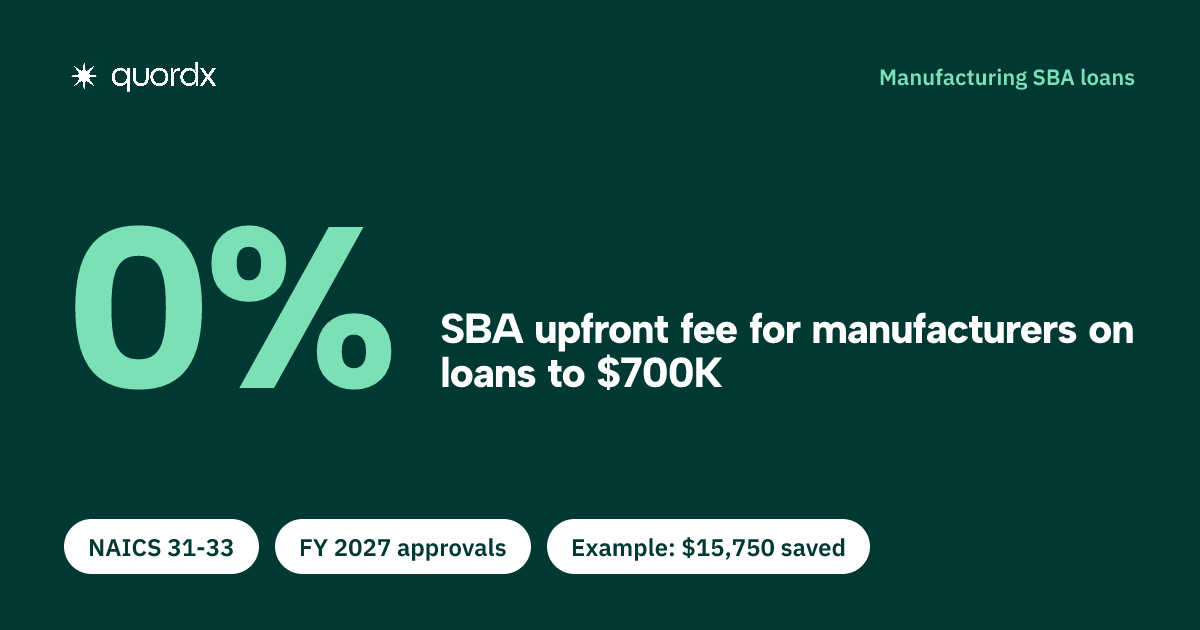
A manufacturing business loan is usually two or three products, not one: equipment financing for machines, a line of credit or term loan for raw materials and payroll during production, and invoice factoring or receivables financing to close the wait between shipping and getting paid. For SBA 7(a) loans approved between October 1, 2026 and September 30, 2027, manufacturers pay no upfront guaranty fee on loans of $700,000 or less, which saves $15,750 on a $700,000 loan with a 75% guarantee. What lenders weigh most is how concentrated your customers are, how predictable your orders are, and what your machinery would sell for.
The short version: Finance machines with equipment financing or SBA 504, matched to how long they'll run. Cover the gap between buying materials and collecting on invoices with a line of credit, and add factoring if your customers pay on long terms. If an SBA 7(a) loan fits and you're near $700,000, size it carefully: one dollar over loses the fee waiver on the whole loan.
Part of our industry guide: Industry Financing.
Last updated · Reviewed by Cody Dreis
50+ Lenders|Funding in as little as 24 hours
Common Reasons Operators Apply
Manufacturing operations commonly use Quordx-matched funding for situations like these:
- ERP, MRP, and shop-floor system upgrades
- Bridging the gap between order fulfillment and customer payment
- Production equipment, tooling, and automation
- Raw materials and inventory buys for large orders
The manufacturing cash gap: why a profitable order can drain your account
Manufacturers pay for materials and labor weeks or months before the customer pays them. The bigger the order, the deeper the hole, which is why a shop can be growing and short on cash at the same time.
Worked example: a $250,000 purchase order
Say a fabricator wins a $250,000 order. It pays its steel supplier $100,000 when it orders materials, spends $60,000 on labor and overhead across a six-week production run, ships in week 10 and invoices the customer on net 60 terms. All figures are hypothetical.
| Week | What happens | Cash out so far | Cash in |
|---|---|---|---|
| 0 | PO received, steel ordered and paid | $100,000 | $0 |
| 2 to 8 | Production run: labor and overhead | $160,000 | $0 |
| 10 | Ships and invoices, net 60 | $160,000 | $0 |
| About 19 | Customer pays | $160,000 | $250,000 |
The fabricator needs $160,000 for roughly four and a half months: to earn $90,000. If it takes a second order of the same size in week 4, the peak need roughly doubles. That's the number to bring to a lender: your peak cash need across overlapping jobs, not the size of one order.
Which product covers which stage
| Stage | Product that fits | When it's the wrong tool |
|---|---|---|
| Buying materials for a confirmed order | Supplier terms or a line of credit | Purchase order financing is generally built for finished goods bought and resold, not parts you make yourself |
| Production labor and overhead | A business line of credit or working capital term loan | A term loan for a one-time gap leaves you paying after the cash is back |
| Waiting on invoices | Factoring or receivables financing | Customers who pay in a week or two don't need it |
| New or replacement machines | Equipment financing or SBA 504 | Short-term working capital for long-life machines strains cash flow |
Decision rule: if the gap is mostly the wait after you invoice, factoring or AR financing is built for it, because the lender looks at your customers' credit. If the gap starts with the materials, you need a line of credit or supplier terms, because there's no invoice yet to borrow against.
Manufacturing equipment financing: CNC machines, presses and lines
Machines are the asset lenders understand best in manufacturing, but not all machines are equal as collateral. A widely traded CNC mill or press brake has a resale market; a custom fixture line built for one customer's part may be worth little to anyone else.
- New or used: used machines can be financed, but expect an inspection or appraisal and a closer look at hours and maintenance records.
- Soft costs matter more here than in most industries. Rigging, foundations, electrical work, tooling, installation and testing can add a meaningful share to a machine's price. Ask whether the lender finances them, or you'll pay them from working capital.
- Sale-leaseback: if you own machines free and clear, some equipment lenders will buy them and lease them back, turning paid-off equipment into cash.
- Specialized machinery: expect more cash down or a lender that specializes in your type of equipment, since fewer buyers exist if it ever has to be sold.
Equipment you buy and place in service in 2026 may also qualify for Section 179 expensing up to $2,560,000 or for 100% bonus depreciation. Our equipment financing guide covers loans vs leases, soft costs and those tax rules with worked numbers.
Estimate your funding
Answer a few questions about your business to see a likely range.
Financing raw materials and inventory
Lenders value inventory by how easily they could sell it: Commodity raw materials such as standard steel stock or resin hold value better than work in process, which is a half-finished part almost no one else can use. Finished goods built to a single customer's spec fall in between and depend on that customer.
That's why inventory loans for manufacturers lend against a fraction of book value: if at all, and come with monitoring such as regular inventory reports. Our guide on how to get inventory financing explains how these lines are sized.
Often a better route: negotiate longer supplier terms on materials and use a line of credit for the rest. Supplier terms cost nothing unless you give up an early-payment discount, and you already have the relationship.
SBA loans for manufacturers in FY 2027
The 0% upfront fee: SBA Information Notice 5000-881797 sets the upfront guaranty fee at 0% for 7(a) loans of $700,000 or less to manufacturers in NAICS sectors 31 to 33, for loans approved October 1, 2026 through September 30, 2027. Above $700,000 the normal fee applies to the whole loan, not just the amount over the line.
| Loan amount | Guaranteed portion at 75% | Normal upfront fee | Fee for a manufacturer |
|---|---|---|---|
| $500,000 | $375,000 | $11,250 (3%) | $0 |
| $700,000 | $525,000 | $15,750 (3%) | $0 |
| $750,000 | $562,500 | $19,687.50 (3.5%) | $19,687.50 |
Don't plan to split a loan to stay under the line: The same notice says two or more 7(a) loans approved for the same applicant within 90 days of each other count as one loan for the fee. A $700,000 loan plus a $50,000 loan a month later is priced as a $750,000 loan.
Other SBA terms that matter to manufacturers:
- Size: most manufacturers with 500 employees or fewer count as small, but SBA sets the standard by NAICS code, so check yours on SBA's size standards page.
- MARC loans: SBA's Manufacturers' Access to Revolving Credit combines features of Standard 7(a) term loans and SBA Express revolving loans, is limited to manufacturers, and goes up to $5 million, per SBA's 7(a) terms page.
- 504 for buildings and long-life machinery: SBA's portion is capped at $5 million per borrower, or $5.5 million per project for small manufacturers with all production facilities in the US, under 13 CFR 120.931. The job standard is one job created or retained per $150,000 guaranteed by SBA for small manufacturers, against $95,000 for most borrowers. Compare the two programs on SBA 7(a) vs 504.
- Rate cap: on a 7(a) loan over $350,000, the maximum variable rate is the base rate plus 3%, or 10.00% with prime at 7.00% as of October 2026.
What lenders look at when a manufacturer applies
- Customer concentration. If one customer is a large share of sales, the lender is partly underwriting that customer. Have their payment history and contract terms ready.
- Order book. Signed purchase orders and repeat-customer history show revenue the bank statements don't yet reflect.
- Gross margin by job. A lender wants to see that a bigger order makes money after materials and labor, since growth on thin margins deepens the cash gap.
- Machinery list. Make, model, year, condition and any liens for each major machine, so the lender can value the collateral without a site visit.
- Existing liens. An all-assets lien from an earlier loan covers your machines and inventory too, and a new lender will see it in the UCC search.
Manufacturing is one of the industries where how you get paid shapes the loan more than the industry label; our guide to industry-specific lending compares it with other sectors.
What Quordx can place for a manufacturer
For a manufacturer, the strongest fit through Quordx is machinery: its lenders finance general equipment from about $15,000, harder-to-place deals from $150,000, and large-ticket projects from $250,000 where software and soft costs can be included, plus sale-leasebacks. It can also place factoring on invoices to business customers, and term loans or lines of credit for shops with about $17,000 a month or more in revenue and usually 12 months of history.
Its SBA option typically starts around $400,000, so a 7(a) loan between roughly $400,000 and $700,000 is where a manufacturer can use Quordx and still get the 0% fee. Below roughly $400,000, SBA's Lender Match tool connects you with SBA lenders directly, and the 0% fee applies to any qualifying 7(a) loan you get that way. Quordx does not place PO financing or inventory loans. It is a broker, the application takes about 10 minutes, and lenders make the decision.
Questions Business Owners Ask Before Applying
Can I finance used manufacturing equipment?
Yes. Lenders finance used machines regularly, but expect an inspection or appraisal and questions about hours, maintenance and who is selling it. Widely traded machines are easier to finance than custom ones.
Do I qualify for the SBA 0% fee as a manufacturer?
If your business is in NAICS sectors 31 to 33 and the 7(a) loan is $700,000 or less, approved between October 1, 2026 and September 30, 2027, the upfront fee is 0%. Confirm your NAICS code with your lender, because the waiver depends on it.
How do I fund a large order before the customer pays?
Split the gap in two. Use supplier terms or a line of credit for materials and production, then factor or borrow against the invoice once you ship. If the order is for goods you resell rather than make, PO financing may also fit.
What counts as manufacturing for SBA purposes?
SBA uses NAICS sectors 31 to 33, which cover businesses that transform materials, substances or components into new products, as the BLS describes the sector. Your NAICS code, not how you describe your business, decides it.
Can I get equipment financing and a line of credit at the same time?
Usually, but sequence matters. If the line comes with an all-assets lien, ask for a carve-out for equipment you plan to finance separately, or the equipment lender may not be able to take a first lien on the machine.
Apply for Funding
No obligation · Initial inquiry doesn't impact credit · Takes about 10 minutes
Sources

Written by
Cody Dreis
Founder, Quordx Capital
Read full bio
Keep exploring industry financing
Quordx Capital is a business funding broker, not a lender. Lenders make every credit decision and set the rate, fees and terms, and not every business qualifies. Quordx may be paid by a lender when a deal funds. Full disclosures