

Industry-specific lending: how your industry changes a business loan
Industry-specific lending means a lender judges your business against others in the same industry, and your industry decides four things before your numbers do: whether the lender will consider you at all, how it reads your revenue, which licenses it checks, and what it accepts as collateral. A landscaping company with $720,000 a year in sales can look like a $216,000 business or a $1.08 million business depending on the month it applies, and a lender who knows the industry knows which picture is real. That gap between the raw numbers and what they mean is what specialty lenders are built to read.
The short version: First, confirm your industry isn't on the lender's restricted list, and for SBA loans on the federal ineligible list. Then hand the lender the context its standard review misses: 12 months of statements for a seasonal business, current licenses, and a plain explanation of how and when your customers pay. Pick a product that matches how your industry actually turns work into cash, using the industry guides below.
Last updated · Reviewed by Cody Dreis
50+ Lenders|Funding in as little as 24 hours
See Industry-specific lending: how your industry changes a business loan offers you qualify for, free.
One 10-minute application. Matched to 3-7 best-fit lenders from a 50+ network. Decisions in 24-48 hours.
Restricted industries: who lenders won't fund
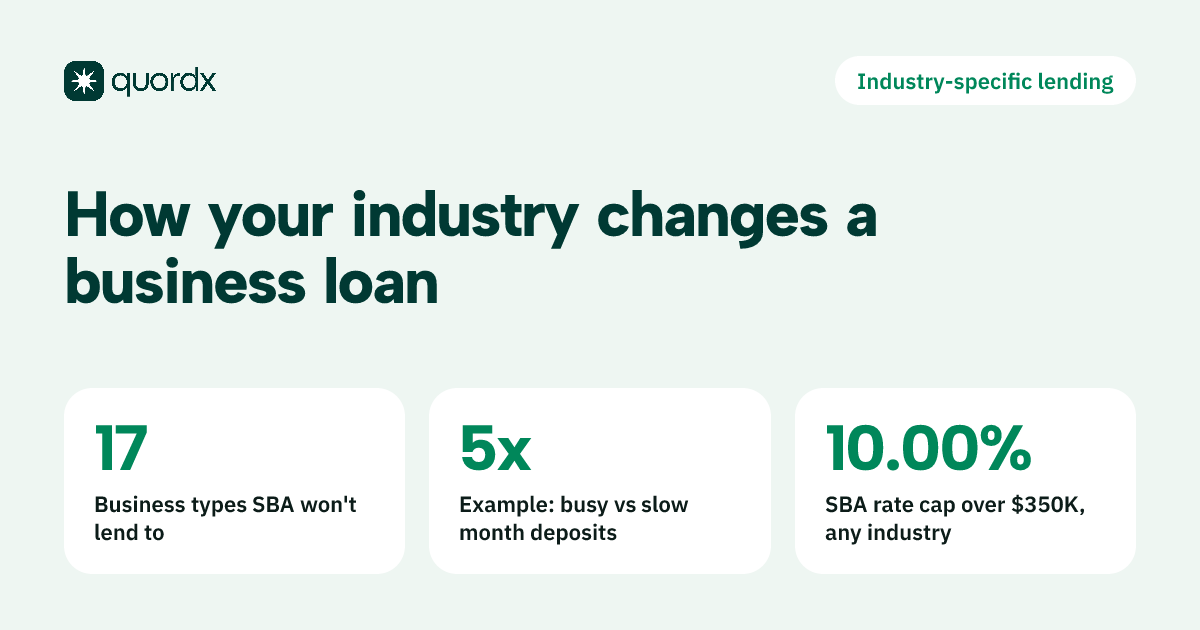
SBA has a fixed list: Under 13 CFR 120.110, 17 categories of business are ineligible for SBA business loans. They include lenders and factors, passive real estate holders, life insurers, pyramid sales plans, businesses earning more than one-third of gross annual revenue from legal gambling, speculative ventures such as oil wildcatting, businesses primarily in political or lobbying work, and any business doing something that violates federal, state or local law.
Private lenders write their own lists, and they differ: On the lender panel Quordx submits to, several cash-flow lenders exclude trucking outright, one lends only to brick-and-mortar businesses in industries on its approved list, and one lends only to tech and software companies. A decline from one lender on industry grounds says nothing about the next one, so ask for the restricted list before you send statements.
Restricted is not the same as harder: Some industries are allowed but priced as higher risk or limited to certain products. A trucking company turned away by a cash-flow lender may still be a fit for freight-invoice factoring or a truck loan from a lender that finances transportation equipment.
Seasonal businesses: how lenders read uneven revenue
Many lenders size a loan from your recent bank deposits. That works for a business with flat monthly sales and misleads in both directions for one with a busy season.
Worked example: one landscaping company, three answers
Say a landscaping company deposits $90,000 a month from April through October and $18,000 a month from November through March. That's $630,000 plus $90,000, or $720,000 for the year, and a true monthly average of $60,000.
| When it applies | Last 3 months of deposits | Monthly average the lender sees | What that implies for the year |
|---|---|---|---|
| February | Nov, Dec, Jan | $18,000 | $216,000 |
| Late September | Jun, Jul, Aug | $90,000 | $1,080,000 |
| Any month, with 12 months of statements | Full year | $60,000 | $720,000 |
Applied in February: the company looks too small for the loan it needs. Applied in late September, it can be offered more than the winter months can repay, which is how seasonal businesses end up with daily or weekly payments they can't cover in January. The fix is to send 12 months of statements with a month-by-month revenue schedule, and to ask whether the lender offers payments that rise and fall with the season.
Decision rule: borrow for the slow season before it starts, sized to the full-year average, and repay from the busy months. SBA's CAPLines program includes a seasonal line for exactly this, described on SBA's 7(a) terms page, and our guide to the seasonal business working capital loan covers the private options.
Estimate your funding
Answer a few questions about your business to see a likely range.
Licensing and permits lenders check by industry
In regulated industries the license is part of the collateral, because the business can't earn without it. Lenders verify it is current and in the business's or owner's name before funding.
- Medical and dental practices: the clinicians' professional licenses, and often the practice's standing with the insurers that pay it.
- Daycare and child care: the state child care license and the capacity it allows, since enrollment can't grow past it.
- Construction, roofing, HVAC and plumbing: contractor and trade licenses, and sometimes bonding and insurance certificates.
- Trucking: active operating authority and how long it has been active, along with insurance on the equipment.
- Restaurants and bars: health permits, and a liquor license where alcohol is a large share of sales.
A lapsed license can stop a deal that otherwise works: Check expiration dates before you apply, and have renewal paperwork ready if one is coming due.
Collateral and payment timing by industry
What a lender can take as collateral, and how your customers pay you, shape which product fits. The table links to a dedicated guide for each industry.
| Industry | What lenders focus on | Collateral or repayment source that matters |
|---|---|---|
| Restaurants | Card sales trends, lease term, buildout costs | Card receipts; kitchen equipment, which lenders value conservatively |
| Construction | Backlog, progress billing, retainage held until completion | Receivables from general contractors; heavy equipment |
| Trucking | Age of operating authority, who the brokers and shippers are | Titled trucks and trailers; freight invoices |
| Medical and dental | Licenses, payer mix, the lag before insurers pay | Insurance receivables; imaging and clinical equipment |
| Salons and barbershops | Employee or booth-rental model, card deposits | Mostly cash flow; little hard collateral |
| Gyms and fitness studios | Membership retention, recurring billing, lease | Recurring payments; fitness equipment |
| Landscaping | Seasonality, maintenance contracts | Trucks, trailers and mowers |
| Retail stores | Inventory turnover, holiday peak | Inventory, discounted heavily; card sales |
| Auto repair shops | Car count, parts spending, lift and diagnostic gear | Shop equipment; card deposits |
| Daycare | State license capacity, enrollment, subsidy payments | Tuition and subsidy income; the facility |
| Manufacturing | Customer concentration, purchase orders, raw material costs | Machinery; invoices to business customers |
| Staffing agencies | Weekly payroll against clients who pay on terms | Invoices to client companies |
| Roofing | Insurance-claim work, storm seasons, deposits | Receivables; trucks and equipment |
| HVAC and plumbing | Service agreements, peak-season demand | Service vans; parts inventory; maintenance contracts |
The pattern to notice: businesses paid on invoice terms (construction, staffing, manufacturing, trucking) can borrow against the invoices themselves, while businesses paid at the register (restaurants, salons, retail) are underwritten mostly on deposits.
Worked example: retainage in construction and roofing
Say a roofing subcontractor bills $200,000 on a commercial job and the contract holds back 10% as retainage until the project is accepted. The percentage is an example; contracts and state law set the real figure.
The sub collects $180,000 on its progress bills and waits for the last $20,000 until the whole project closes, which can be months after its own work ends. A lender that treats total billings as cash coming in will overstate what the sub can repay, while one that knows construction counts the retainage separately. When you apply, list retainage receivable on its own line, with the expected release date for each job. Our guide to accounts receivable financing for construction shows how factors handle it.
SBA rules that change by industry, and one that doesn't
Fees change by industry: For SBA 7(a) loans approved from October 1, 2026 through September 30, 2027, the upfront guaranty fee is 0% on loans of $700,000 or less to manufacturers (NAICS 31 to 33), listed food supply chain businesses and businesses in rural areas, per SBA Information Notice 5000-881797. On a $700,000 loan with a 75% guarantee, that is $15,750 a manufacturer doesn't pay.
Size standards change by industry: SBA assigns a size standard to each NAICS code, typically a cap on employees for manufacturers and on average annual receipts for most other businesses, so check your code before assuming you qualify.
Rate caps don't change by industry: SBA's maximum variable rate depends on loan size: on a 7(a) loan over $350,000 it is the base rate plus 3%, which is 10.00% with prime at 7.00% as of October 2026. A restaurant and a dental practice face the same ceiling, though each lender prices below it as it sees fit.
Owner-based programs: veterans
Some programs turn on who owns the business rather than what it does. SBA Express loans to businesses owned and controlled by a veteran or a veteran's spouse carry a $0 upfront fee by statute, under the same SBA notice. Our veteran business loan guide covers that and the other routes open to veteran owners.
How to apply when your industry is the hard part
- Screen out restricted lists first. Ask each lender whether it funds your industry and your product before you share statements or agree to a credit pull.
- Explain the pattern before the lender finds it. One page covering your season, how customers pay, and any retainage or insurance lag saves a decline based on a misread month.
- Match the product to how you get paid. Invoices support factoring or receivables lines; card sales support deposit-based loans; long-life equipment supports equipment financing.
- Bring the licenses with the application. Current copies, with expiration dates, remove a common closing delay.
How Quordx handles industry fit
Quordx is a broker, not a lender, and the industry question is the first filter it applies: it aims to send your file only to lenders on its panel that accept your industry and product, because a lender that excludes your industry will decline no matter how good your numbers are. The panel covers equipment financing, factoring for businesses that invoice other businesses (including trucking, plus a lender that works only with construction subcontractors), and term loans and lines of credit for businesses with about $17,000 a month or more in revenue, usually after 12 months.
It does not place purchase order financing, inventory financing or SBA loans under roughly $400,000. Most options can be explored without a hard credit pull, the application takes about 10 minutes, and the lenders make every credit decision.
Questions Business Owners Ask Before Applying
What industries are considered high risk for business loans?
There's no single list. Each lender writes its own restricted and higher-risk lists, and they differ widely, so an industry one lender excludes another may fund. SBA's own ineligible list, in 13 CFR 120.110, is fixed and public.
Is a specialty lender always cheaper than a general lender?
No. A specialty lender's advantage is usually that it will say yes and structure the deal around how your industry gets paid. Its price can still be higher than a bank's, so compare the total cost of every offer.
Can I get a business loan in the off-season?
Yes, but plan for how the lender will read your statements. Send 12 months of deposits with a month-by-month revenue schedule so the lender sizes the loan on the full year, not on your slowest quarter.
Does my industry change SBA loan rates?
SBA's maximum rates are set by loan size, not industry, so the ceiling is the same for every eligible business. Industry does change SBA eligibility, size standards and, for FY 2027, the upfront fee for manufacturers, food supply chain businesses and rural businesses on loans of $700,000 or less.
What if my industry isn't listed here?
Use the same checks: whether lenders restrict it, how seasonal your deposits are, which licenses you need, and how your customers pay. Those four answers point to the right product for almost any business.
Apply for Funding
No obligation · Initial inquiry doesn't impact credit · Takes about 10 minutes
Sources

Written by
Cody Dreis
Founder, Quordx Capital
Read full bio
Related articles
Quordx Capital is a business funding broker, not a lender. Lenders make every credit decision and set the rate, fees and terms, and not every business qualifies. Quordx may be paid by a lender when a deal funds. Full disclosures