

Equipment financing: how loans and leases work, and what they cost
Quordx is a marketplace, not a single lender. Apply once and get matched across 50+ vetted lenders and every major funding type, including equipment financing. Free, transparent, no sales calls, no obligation.
Equipment financing is a loan or lease that pays for business equipment, with the equipment itself as the main collateral, repaid over a term matched to how long the machine stays useful. The decision that matters most is the structure: a loan or a $1 buyout lease makes you the owner for tax purposes from day one, while a fair market value (FMV) lease lets you use the equipment and choose at the end whether to buy it, renew or hand it back. Lenders decide on your cash flow and credit, and on what the equipment would bring if they had to take it back and sell it.
The short version: If you'll still be running the machine after it's paid off, a loan or $1 buyout lease usually costs less in total and lets you use Section 179 or 100% bonus depreciation in 2026. If it will be outdated before the term ends, an FMV lease keeps payments lower and leaves the exit open. Before you sign, get three things in writing: the total of all payments, what happens at the end of the term, and whether freight, installation and other soft costs are included.
One option in our guide to Alternative Financing.
Last updated · Reviewed by Cody Dreis
50+ Lenders|Funding in as little as 24 hours
See Equipment financing: how loans and leases work, and what they cost offers you qualify for, free.
One 10-minute application. Matched to 3-7 best-fit lenders from a 50+ network. Decisions in 24-48 hours.
How equipment financing works
The equipment secures the deal: The lender pays the vendor, you make fixed monthly payments, and the lender files a lien on that specific piece of equipment until you've paid. If payments stop, the lender's first move is to repossess and sell the asset, which is why the equipment's resale value matters as much as your credit.
The term follows the asset: A lender won't want you still paying for a machine after it has worn out, so terms track useful life: a server rack gets a shorter term than an excavator. Our page on how long you can finance equipment goes asset by asset.
It only pays for the equipment: Equipment financing covers the machine and, with some lenders, the costs of getting it running. It doesn't cover payroll, materials or the slow months while the new machine ramps up, so plan that cash separately.
Equipment loan vs lease: FMV lease or $1 buyout
Three structures cover almost every deal you'll be quoted. The names vary by lender, so read the end-of-term clause rather than the title on the contract.
| Structure | Who owns it during the term | End of term | Usual tax treatment |
|---|---|---|---|
| Equipment loan | You, with the lender holding a lien | Lien released, you own it outright | You depreciate it; Section 179 or bonus depreciation may apply; interest is a business expense |
| $1 buyout lease (capital lease) | The lessor on paper | You buy it for $1 | Generally treated as a purchase, so you depreciate it like a loan |
| Fair market value (FMV) lease | The lessor | Buy at fair market value, renew, or return it | Payments generally deductible as rent; you don't depreciate it |
Why a $1 buyout counts as a purchase: The IRS says an agreement may be a conditional sales contract, not a lease, when you can buy the property at a nominal price compared with its value or with the total you pay. A $1 option is about as nominal as it gets, so you treat the equipment as bought and recover the cost through depreciation instead of deducting the payments as rent.
Worked example: one $120,000 machine, three structures
Assume a $120,000 machine, a 60-month term and the same hypothetical 9% rate on all three, chosen only to make the math easy to check. It is not a market rate; your quote depends on your credit, the equipment and the lender. The FMV lease assumes the lessor expects the machine to be worth $24,000 at the end.
| Loan, 10% down | $1 buyout lease | FMV lease | |
|---|---|---|---|
| Cash at signing (example) | $12,000 | $0 | $0 |
| Monthly payment | $2,242 | $2,491 | $2,173 |
| Total of payments | $134,514 | $149,460 | $130,368 |
| Cost to own it at the end | $146,514 | $149,461 | $154,368 if you buy at $24,000 |
| Cost if you hand it back | Not an option | Not an option | $130,368 |
How to read it: if you plan to keep the machine, the FMV lease is the most expensive way to end up owning it, because you pay down most of its value and then buy the rest. If you'll replace it at month 60, the FMV lease is the cheapest path because you never pay for the last $24,000 of value. The fuller decision guide is on equipment lease vs loan.
- You'll run it well past payoff (trucks, machining centers, kitchen lines): take a loan or $1 buyout lease.
- It will be outdated in a few years (computers, some medical imaging, tech that turns over): look hard at an FMV lease.
- You need the lowest payment now and can't put cash down: a lease, then compare the total of payments, not only the monthly figure.
- You want the 2026 tax deduction this year: you need to own it for tax purposes, so a loan or $1 buyout.
Run the numbers on your loan
Pick a product, set the amount and term, and see a typical payment.
What lenders check before approving equipment financing
Equipment lenders look at two things at once: whether your business can carry the payment, and whether the collateral would cover them if it couldn't.
- Time in business and cash flow. Bank statements and, for bigger tickets, tax returns and financial statements show whether the new payment fits. A newer company can still get approved, often with more cash down; see equipment financing for a new business.
- Personal and business credit. Credit sets the price and the down payment more than the yes or no on many equipment deals. Our credit score guide for equipment financing covers what changes as your score drops.
- The equipment itself. General-purpose, widely traded equipment is easier to finance than custom or specialized machinery, because more buyers exist if the lender has to sell it.
- New or used, dealer or private seller. Used equipment and private-party sales get more scrutiny: lenders may want an inspection, photos, serial numbers or an appraisal. See financing used equipment.
- Existing liens. A blanket lien from an earlier loan can cover newly bought equipment too. Search your state's UCC filings before you apply so you're not surprised.
- Your industry. Some lenders limit or exclude certain industries. Our guide to industry-specific lending explains how industry changes underwriting.
Down payments and soft costs: what equipment financing really covers
Down payments vary by deal, not by rule: No single standard exists. Stronger credit, longer time in business and general-purpose equipment tend to lower what a lender asks for, while used, specialized or private-party equipment tends to raise it. Leases often replace the down payment with one or two payments collected upfront.
Soft costs are the line items around the machine: shipping, rigging, installation, testing, sales tax, and sometimes software and training. Some lenders finance them in the same contract and others only finance the hard cost on the vendor's invoice, leaving you to pay the rest in cash.
| Line on the quote (example) | Amount | Financed if the lender covers only hard cost? |
|---|---|---|
| Machine | $120,000 | Yes |
| Sales tax (example 6%) | $7,200 | No |
| Freight and rigging | $3,500 | No |
| Installation and testing | $6,000 | No |
| Total project | $136,700 | $16,700 out of your pocket, plus any down payment |
Soft costs also count for tax: IRS Publication 551 says the cost of property you buy includes what you pay in cash and debt obligations, plus sales tax, freight, and installation and testing. So the $136,700 is the basis you'd depreciate in this example, whether or not the lender financed every line. Ask each lender, in writing, which lines its offer includes.
Section 179 and bonus depreciation for equipment in 2026
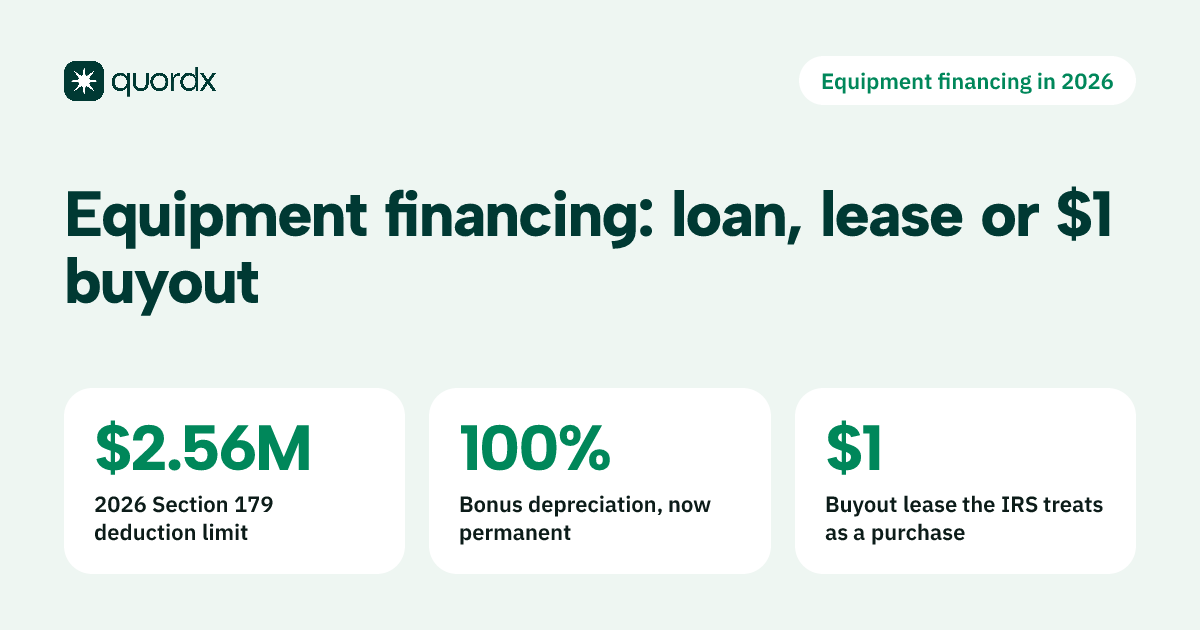
Section 179 lets you deduct up to $2,560,000: of qualifying equipment placed in service in a tax year beginning in 2026, per IRS Revenue Procedure 2025-32. The limit shrinks dollar for dollar once you place more than $4,090,000 of Section 179 property in service that year, and the cost of a qualifying sport utility vehicle counts only up to $32,000.
Bonus depreciation is 100%, permanently: for qualified property acquired and placed in service after January 19, 2025, under the 2025 tax law described in IRS Notice 2026-11. The old phase-down schedule was repealed. Property bought under a written binding contract signed before January 20, 2025 is treated as acquired on that earlier date, so the contract date matters.
Financing doesn't stop you from deducting the full cost: Section 179 requires that the property be acquired by purchase and used in your business, per IRS Publication 946, and the borrowed part of the price is part of your cost. A lessee under a true FMV lease doesn't own the equipment, so it deducts rent instead.
Worked example: the first-year cash vs the first-year deduction
Take the $120,000 machine bought with the loan above, placed in service in 2026, and say the business's combined tax rate is 25% (an assumption for the example). If the business has at least $120,000 of taxable business income, a Section 179 election on the full cost cuts its tax bill by about $30,000 for 2026. Its first-year cash out is $12,000 down plus 12 payments of $2,242, or $38,903, so the deduction covers most of what the machine cost in cash that year.
When the income isn't there, the two deductions part ways: Section 179 is capped at your taxable income from the active conduct of a business, with the excess carried to the next year (Publication 946). Bonus depreciation has no income cap and can create a loss. If the same business had only $70,000 of taxable income, Section 179 would deduct $70,000 and carry $50,000 forward, while bonus depreciation could deduct the full $120,000.
Quordx is not a tax advisor. Have your CPA confirm the election before you time a purchase around it, and see our page on equipment financing and Section 179 for more on the deduction.
Where to get equipment financing: dealer, bank or finance company
The best equipment financing for a small business depends on which kind of lender is built for your deal. Compare at least two of these before you sign anything at the dealer's desk.
| Source | Built for | Watch for |
|---|---|---|
| Dealer or manufacturer financing | New equipment from that brand, sometimes with promotional terms | Promotions may come instead of a cash discount, so price the deal both ways |
| Bank | Established businesses with full financials and an existing banking relationship | More paperwork and a longer process; may ask for a blanket lien |
| Independent equipment finance company | Used, specialized or private-party equipment, newer businesses, mixed credit | Pricing varies widely between companies; compare the total of payments |
| SBA 7(a) or 504 | Equipment bought as part of a bigger project, such as a buildout or a building | Slower and more documents; 504 is for long-life fixed assets |
If the equipment sits inside a larger project, compare the SBA routes on SBA 7(a) vs 504 before you split the project across several lenders.
Mistakes that make equipment financing cost more
- Comparing monthly payments instead of totals. A longer term or an FMV residual lowers the payment and can raise what you pay overall, as the example above shows.
- Signing an FMV lease on equipment you'll keep for years. You pay down most of the value, then pay market price for the rest.
- Assuming the lease is a tax deduction. A $1 buyout lease is generally treated as a purchase, so you depreciate it rather than deducting the payments as rent.
- Forgetting the soft costs. If the lender finances only the hard cost, freight, tax and installation come out of your working capital.
- Missing the automatic renewal clause. Some leases renew month to month unless you give notice before the term ends. Put the notice date in your calendar the day you sign.
Where Quordx fits on equipment deals
Equipment is one of the products Quordx places most directly. The lenders it submits to cover general equipment from about $15,000, larger deals from $150,000 where the credit has a story that needs explaining (that lender talks to the borrower and the vendor directly), and large-ticket deals from $250,000, where a history of profitability matters and software and soft costs can be included.
Below $15,000, dealer financing or your own bank is the better first call. Quordx is a broker, not a lender: you complete one application in about 10 minutes, the lenders decide and price the deal, and Quordx is paid by the lender only if a deal funds, not by you.
Questions Business Owners Ask Before Applying
Can I get equipment financing with no money down?
Sometimes. Leases often skip a down payment and collect one or two payments upfront instead, and some lenders finance the full cost for strong borrowers. Weaker credit, a young business or used and specialized equipment usually means the lender asks for cash in.
Is it better to lease or buy equipment for taxes?
Buying, or a $1 buyout lease, front-loads the deduction: in 2026 you may expense up to $2,560,000 under Section 179 or take 100% bonus depreciation in the first year. An FMV lease spreads the deduction across the term as rent. A big first-year deduction is worth more when you have the taxable income to use it, so ask your CPA.
What happens at the end of an FMV lease?
You usually choose to buy the equipment at its fair market value, renew the lease, or return it. Read how fair market value is set and whether you must give notice before the term ends, because some leases renew automatically if you don't.
Can I finance equipment from a private seller?
Yes, with some lenders. Expect more checks than a dealer sale: proof of ownership and that no lien sits on the equipment, an inspection or photos, and a bill of sale. Not every lender finances private-party sales, so ask before you apply.
What happens if I can't make the payments?
The lender can repossess and sell the equipment. If the sale brings less than you owe, you can still owe the difference, and a personal guarantee makes you personally liable for it. Call the lender before you miss a payment, while there is still time to talk about a revised schedule.
Apply for Funding
No obligation · Initial inquiry doesn't impact credit · Takes about 10 minutes
Sources
- IRS Revenue Procedure 2025-32, section 4.24: 2026 Section 179 limits
- IRS Notice 2026-11: interim guidance on 100% bonus depreciation under section 168(k)
- IRS Publication 946: How to Depreciate Property (Section 179 rules, leased property)
- IRS FAQ: lease vs conditional sales contract for equipment
- IRS Publication 551: Basis of Assets (cost includes freight, installation, sales tax)

Written by
Cody Dreis
Founder, Quordx Capital
Read full bio
Related articles
Keep exploring alternative financing
Quordx Capital is a business funding broker, not a lender. Lenders make every credit decision and set the rate, fees and terms, and not every business qualifies. Quordx may be paid by a lender when a deal funds. Full disclosures