

Venture Debt for Startups: What Each Stage Can Get
Most startups can get venture debt only after raising an institutional equity round, and the options widen as revenue grows. A seed company without an institutional investor is usually too early, a Series A company with committed investors and cash to spare is the classic borrower, and a bootstrapped software company can skip venture debt and borrow against its recurring revenue instead. What changes from stage to stage is what the lender is betting on: your investors first, then your revenue.
The short version: Pre-seed and most seed startups should use other funding. At Series A, arrange venture debt right after the round closes, size it so you still hold a real cash cushion when principal payments start, and read the covenants before the rate. Bootstrapped SaaS companies with steady recurring revenue should compare recurring-revenue lenders and revenue-based financing, which don't need a VC on the cap table.
One option in our guide to Alternative Financing.
Last updated · Reviewed by Cody Dreis
50+ Lenders|Funding in as little as 24 hours
Common Reasons Operators Apply
Venture-backed startup operators commonly use Quordx-matched funding for situations like these:
- Extending runway between equity rounds without dilution
- Capex for infrastructure, hardware, and compute
- Funding go-to-market initiatives ahead of revenue
- Acquiring complementary products or teams
Venture debt by startup stage
The question isn't whether startups can borrow. It's what a lender can underwrite at your stage, and that shifts as the company grows.
| Stage | What the lender is betting on | Realistic options | Watch out for |
|---|---|---|---|
| Pre-seed, or seed with no institutional investor | Very little yet: no sponsor and little revenue | Equity, SAFEs, grants, founder-backed loans | Expensive short-term money sold as startup funding |
| Seed with an institutional lead | Investor commitment and a credible path to Series A | Some venture lenders, once a first institutional round is committed | A loan that starts amortizing before Series A closes |
| Series A | Investors on the board, a fresh round, early revenue | Venture debt from specialist lenders | Interest-only ending before your Series B |
| Series B and later | Revenue and growth, plus investors and assets | Larger term loans, equipment financing, recurring-revenue lines | Liquidity covenants and limits on new debt |
| Bootstrapped SaaS | Recurring revenue and retention | Recurring-revenue lines and revenue-based financing | Revenue-share costs rising as you grow |
Can a pre-seed or seed startup get venture debt?
Usually not, and that says nothing bad about your company. A venture lender gets repaid from the next equity round or from revenue, so with neither in sight there is nothing to lend against.
One publicly traded venture lender is direct about this in its 2025 annual report: it generally requires companies to be beyond the seed stage and to have received, or expect, commitments for their first institutional equity round (2025 Form 10-K). A seed round led by an institutional fund, with Series A in view, is where real conversations can start.
What to use instead at seed: equity or SAFEs from investors, and if you already have revenue, a small business loan sized to it. Our guides to startup business loans and funding a startup with no revenue cover those routes.
Estimate your funding
Answer a few questions about your business to see a likely range.
Venture debt for a Series A startup
Series A is usually the first point where a startup matches the criteria venture lenders publish: institutional investors involved in the company, a new round in the bank, and progress toward revenue. The decisions that matter are timing, size and the length of the interest-only period.
When to take it: right after the round closes
Lenders want to see cash well beyond the loan itself. That same lender requires an operating plan that covers operating expenses and debt service for an additional six to twelve months, through cash flow or new capital. That's easiest to show the month after a round closes and hardest when you're running low, so run the debt process alongside the equity, not a year later.
How much to borrow: a worked runway example
The common mistake is dividing the loan by monthly burn and calling that the runway gain. Principal payments take much of it back.
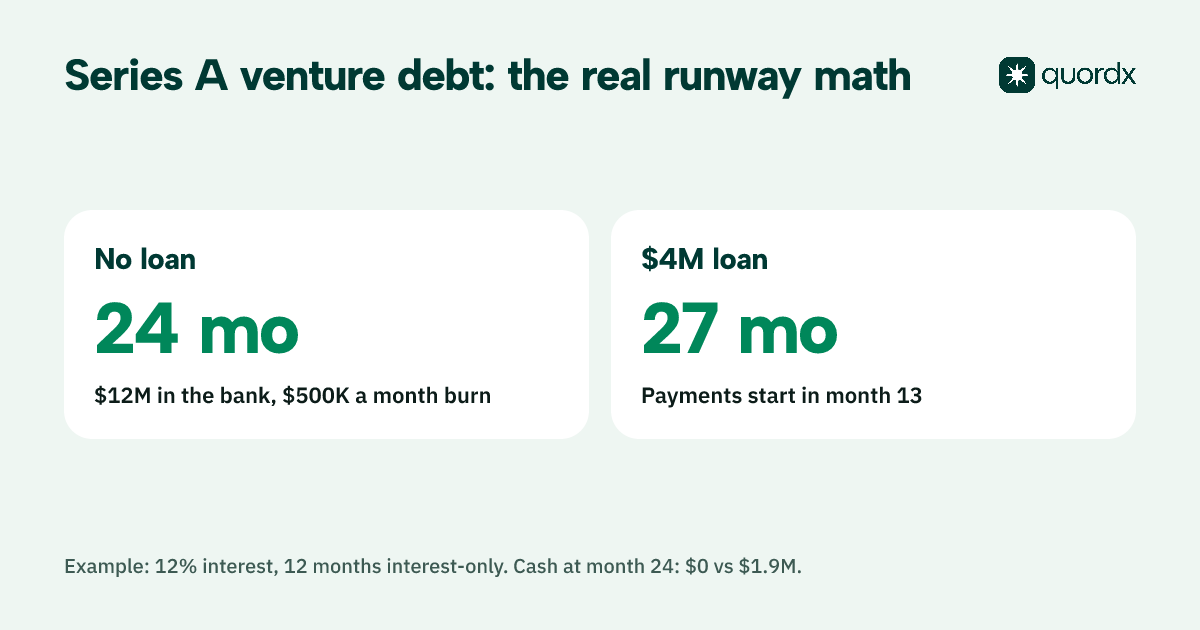
This is a hypothetical example with round numbers, not a quote. The company: a Series A startup with $12 million in the bank and $500,000 of monthly burn has 24 months of runway. Say it borrows $4 million at 12% interest, with 12 months interest-only and then 36 months of amortization.
| Period | Monthly cash out | Cash at the end |
|---|---|---|
| No loan, months 1 to 24 | $500,000 of burn | $0 at month 24 |
| With the loan, months 1 to 12 | $540,000: burn plus $40,000 of interest | $9,520,000 (from $16,000,000) |
| With the loan, months 13 to 24 | $632,857: burn plus a $132,857 loan payment | $1,925,713 |
| With the loan, after month 24 | $632,857 | Runs out about 3 months later |
Simple division says $4 million buys eight more months: The real gain is about three months of total runway, because the loan payments start in month 13. The bigger benefit is $1.9 million still in the bank at month 24, the month the company would otherwise hit zero, which is a far stronger position to raise a Series B from.
Decision rule: choose the loan size and interest-only period so the cash left on the day amortization starts still covers several months of burn plus payments. Interest-only periods vary widely: one public lender's 2025 annual report shows three to eighteen months or longer, and another's up to 36 months (2025 Form 10-K). If yours ends before your next round can realistically close, ask for longer or borrow less.
What a Series A lender will ask for
- Your cap table and the signed documents from the round you just closed.
- Monthly financial statements and a month-by-month operating model showing burn and runway, with and without the loan.
- Board materials and a clear view of how your investors plan to support the company. At least one public venture lender says it looks for investor representatives on the board as a sign of commitment.
- Proof that the company owns its intellectual property, since venture lenders typically take a lien on it or a promise not to pledge it elsewhere.
Venture debt for Series B and later-stage startups
By Series B the lender can underwrite revenue as well as investors, and the menu widens. One public venture lender, for example, defines its target borrowers as companies with significant sponsor ownership and expected annual revenues of up to $100 million, and offers equipment financing alongside its term loans.
Match the loan to the asset when you can: If the money is for servers, GPUs, lab equipment or other hardware, an equipment financing can sit next to a term loan. That lender's annual report says its equipment financings generally amortize from the start over up to 60 months, which ties the payments to the life of the hardware rather than to your next round.
Read the covenants as closely as the rate: Public venture lenders list ones like minimum liquidity, regular financial reporting, and limits on new debt, asset sales and mergers without their consent. Our guide to venture debt financing breaks down the interest, fees, final payments and warrants on a $5 million loan.
Venture debt for bootstrapped startups with no VC
Classic venture debt leans on your investors, so a company with no institutional round usually can't get it. A bootstrapped software company with real recurring revenue has a different route: lenders that underwrite the revenue itself.
Recurring-revenue lines: One SaaS lender states that its borrowers don't need to be venture-backed, and publishes minimums of $250,000 in monthly recurring revenue, $3 million in annual revenue and 85% retention (published criteria). It lends $2 million to $15 million, made available at 5x to 8x MRR, with most facilities committed for two years.
Revenue-based financing: One revenue-based lender publishes a floor of $200,000 in ARR, repayment as a fixed percentage of monthly revenue, and no equity or personal guarantee (example). Payments rise as revenue grows, so you pay back faster in your best months. Our page on how revenue-based financing works shows how to compare its cost.
Decision rule: if your revenue is recurring, contracted and growing, get a quote from a recurring-revenue lender and an RBF provider before raising equity just to fund growth. If your revenue is one-off or project-based, these lenders are the wrong fit, and a term loan or line of credit sized to cash flow is the better comparison.
Mistakes startups make with venture debt
- Borrowing when cash is already low. Lenders want room beyond the loan, so the best terms come right after a round, not a few months before you run out.
- Counting the loan as runway. As the Series A example shows, payments that start in year two take back most of the months the loan seemed to add.
- Not pricing the warrants. Warrants with 10% coverage on a $4 million loan are $400,000 of stock at your last round's price. Ask whether coverage applies to the full facility or only to what you draw.
- Skimming the default triggers. A material adverse change clause, a minimum cash covenant or a cross-default can turn one slow quarter into a lender negotiation. Test each one against your worst case.
- Forgetting the final payment. One public lender's filing says its end-of-term payments are due at maturity and on any prepayment, so paying the loan off early with Series B money doesn't avoid them.
Where Quordx fits for startup venture debt
Quordx is a broker, not a lender, and for venture debt it can help only a narrow group of startups: technology and SaaS companies at roughly $2.5 million or more in ARR, or about $4 million in annual revenue. That bar is about revenue, not your round, so a bootstrapped SaaS company that clears it fits as well as a venture-backed one.
Below that line, a Quordx application won't produce a venture debt offer, and it's better to know that now. A seed or Series A company should ask its investors to introduce it to venture lenders they've worked with. A startup with about a year of operating history and roughly $17,000 a month in revenue may fit a term loan or business line of credit through Quordx instead.
If you do clear the bar, the application takes about 10 minutes and costs you nothing: the lender pays Quordx if the loan closes. Quordx does not serve businesses in Virginia, Connecticut, Missouri or North Dakota.
Questions Business Owners Ask Before Applying
Can a Series A startup get venture debt?
Yes, Series A is usually the first stage where a startup meets venture lenders' criteria: institutional investors who stay involved, a new round in the bank, and enough cash to cover expenses and debt service well past the loan. Arrange it soon after the round closes, and make sure the interest-only period runs past the date you expect to raise your Series B.
Can a pre-revenue startup get venture debt?
Only with strong institutional backing and visible progress. One public venture lender says it expects companies to show progress in product development or a path toward revenue, not revenue itself, and about 23% of its portfolio by fair value was in drug discovery and development companies at the end of 2025. Without institutional investors, a pre-revenue startup has nothing for a venture lender to underwrite.
Is venture debt for AI startups any different?
The lender's criteria are the same: investors, runway and growth. What differs is the spending, since servers and GPUs are equipment that can be financed on their own, and some venture lenders offer equipment financing next to their term loans. Pairing the two keeps the term loan for costs that have no resale value.
How long should the interest-only period be?
Long enough that principal payments start after your next round should have closed, with room to spare. Two public lenders' 2025 annual reports show ranges from three to eighteen months or longer at one to up to 36 months at the other, so the period is worth negotiating.
Should a bootstrapped SaaS company use venture debt or revenue-based financing?
Without institutional investors, classic venture debt is usually out of reach, so the real choice is a recurring-revenue line or revenue-based financing. Recurring-revenue lines suit larger companies with high retention, while revenue-based financing starts at lower revenue but costs more as you grow. Get quotes from both before you decide.
Apply for Funding
No obligation · Initial inquiry doesn't impact credit · Takes about 10 minutes
Sources

Written by
Cody Dreis
Founder, Quordx Capital
Read full bio
Related articles
Keep exploring alternative financing
Quordx Capital is a business funding broker, not a lender. Lenders make every credit decision and set the rate, fees and terms, and not every business qualifies. Quordx may be paid by a lender when a deal funds. Full disclosures