

What Is Venture Debt Financing?
Venture debt financing is a term loan made to a startup that has already raised venture capital, from a specialist lender that underwrites the company's investors and growth rather than its profits. You repay it with interest, usually after an interest-only period, and the lender also takes warrants: the right to buy a small amount of your stock at the price of your last round. Founders use it to make an equity round last longer, so the next raise can wait for better numbers and a higher valuation. It costs far less ownership than equity, but it adds fixed payments, covenants and a lien on what the company owns.
The short version: Venture debt fits a company whose institutional investors are still committed, that has a clear milestone to hit, and that will still have cash to spare once loan payments begin. Price it as interest plus fees plus the final payment plus the warrants, never by the rate alone. If you have no institutional investors, look at revenue-based financing or a recurring-revenue lender instead.
One option in our guide to Alternative Financing.
Last updated · Reviewed by Cody Dreis
50+ Lenders|Funding in as little as 24 hours
See Venture Debt Financing offers you qualify for, free.
One 10-minute application. Matched to 3-7 best-fit lenders from a 50+ network. Decisions in 24-48 hours.
How venture debt financing works
It is a term loan with a startup-shaped schedule: Most facilities start with an interest-only period, then the principal pays down over the rest of the term. One publicly traded venture lender's 2025 annual report says its loans may include an interest-only period of three to eighteen months or longer, with maturities typically between 36 and 48 months (2025 Form 10-K).
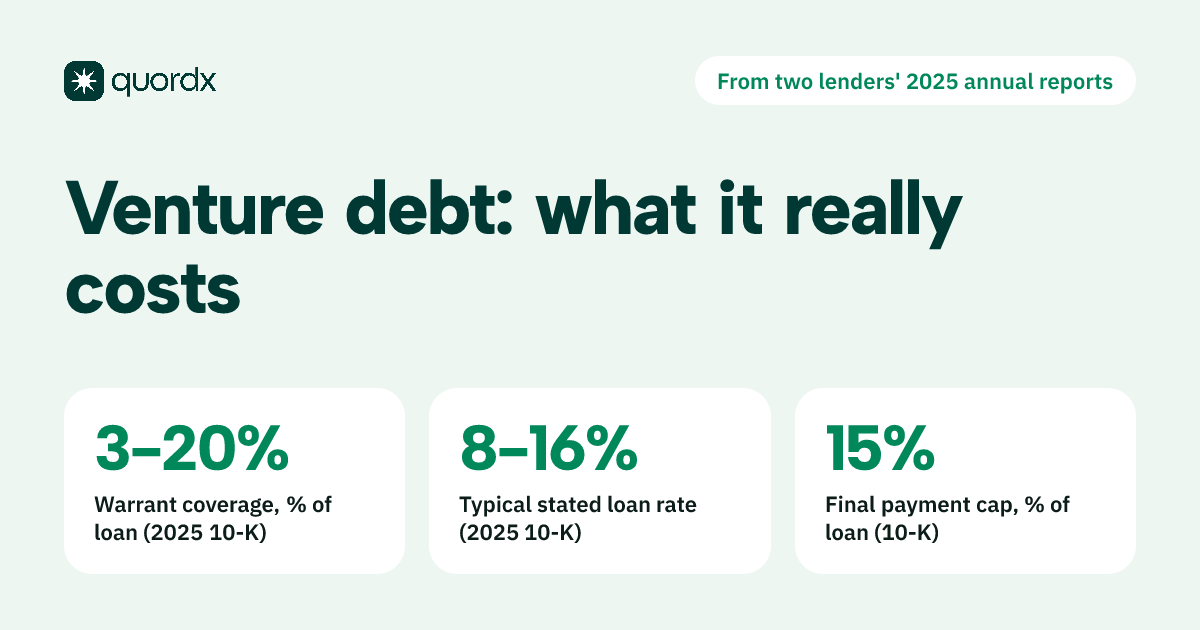
The rate usually floats: That lender prices its warrant-bearing loans off the Prime Rate, SOFR or a similar benchmark plus a spread, with a floor, so the rate can rise with the market but never drops below a set minimum. A second public venture lender's 2025 annual report says the stated annual rate on its term loans has typically ranged from 8% to 16% (2025 Form 10-K).
The lender takes security in nearly everything: The first lender says it often seeks a first-priority lien on all of a company's tangible and intangible assets. Where it can't take the intellectual property, it may ask for a negative pledge instead, which is your promise not to pledge the IP to anyone else.
Warrants come with the loan: A startup's assets may not cover the loan if the company fails, so the lender asks for a small piece of the upside to balance that risk. That trade is the whole idea: the lender accepts more risk than a bank would, and you give up far less ownership than an equity investor would ask for.
| Term | Public lender A | Public lender B |
|---|---|---|
| Interest-only period | 3 to 18 months or longer | Up to 36 months |
| Total term | Typically 36 to 48 months | Up to 60 months |
| Interest rate | Prime, SOFR or similar plus a spread, with a floor | Stated rate typically 8% to 16% a year |
| Fees beyond interest | Exit, commitment, success or prepayment fees, among others | Upfront fees up to 2%; final payments up to 15% of principal |
| Warrants | 3% to 20% of principal, strike generally at the last round's price | Scaled to the loan; priced at the last VC round or current option price |
| Collateral | Often a first-priority lien on all assets, or a negative pledge on IP | Seeks a security position in all assets |
What venture debt really costs: a worked example
The interest rate is the number founders compare, and it's only one line of the bill. Add up every piece before you decide whether the loan is cheap.
This example uses hypothetical round numbers that sit inside the ranges in the table above. It is an illustration with stated assumptions, not a market rate or a quote.
The deal: a Series B software company whose last round valued it at $50 million borrows $5 million. Say the lender quotes 12% interest, 12 months interest-only, then 36 months of amortization, a 1% upfront fee, a 5% final payment, and warrants with 10% coverage at the Series B share price.
| Cost line | Amount | How it is worked out |
|---|---|---|
| Upfront fee | $50,000 | 1% of $5,000,000 |
| Interest, months 1 to 12 | $600,000 | 12% of $5,000,000 for one year, paid as $50,000 a month |
| Interest, months 13 to 48 | $978,576 | 36 payments of $166,072, minus the $5,000,000 of principal they repay |
| Final payment | $250,000 | 5% of $5,000,000, due at maturity or on payoff |
| Total cash cost | $1,878,576 | The four lines above added together |
| Warrants | $500,000 of stock | 10% of $5,000,000, at the Series B price |
What the warrants cost in ownership: At the $50 million price of the last round, $500,000 of stock is 1% of the company. Raising the same $5 million in a new round at a $50 million pre-money valuation would sell about 9.1% of it ($5 million divided by $55 million post-money).
What the debt costs in cash: The company pays back about $6.88 million for $5 million, and the warrants sit on top of that. Every dollar of it comes out of the runway the loan was meant to extend, which is why debt service belongs in your cash forecast from day one.
Decision rule: compare the total cash cost plus the warrants against the stake you would sell by raising more equity now. If you expect your valuation to rise well before the loan is repaid, debt tends to win on ownership. If you're unsure the next round will come, the payments and covenants are a real risk, and borrowing less may be the better answer.
Estimate your funding
Answer a few questions about your business to see a likely range.
Venture debt warrants, explained
A warrant is a right, not a share. It lets the lender buy a set dollar amount of your stock at a fixed price for a long period, so the lender makes money on it only if your company ends up worth more than that price.
Coverage is the warrant's size as a percent of the loan: One public venture lender's 2025 annual report puts its coverage at generally 3% to 20% of the principal invested, with a strike price generally equal to your most recent equity round. Another says it scales its warrants to the size of the loan and typically allows seven to 10 years to exercise them.
Check what the coverage is calculated on: Coverage on the full committed facility costs more than coverage on the amount you actually draw. If part of the facility is a later tranche you may never use, ask which base applies before you sign.
Some lenders use a much smaller instrument: One lender that lends against SaaS recurring revenue lists a nominal penny warrant in its pricing (published criteria). Some revenue-based lenders say no equity is required at all (example).
What venture debt lenders look for
Venture lenders read a startup the way an investor would, then add a lender's question: will there be cash to repay us if the next round is late? One public venture lender lays out its investment criteria in its 2025 annual report, and they make a useful checklist.
- Investors who are still involved. It generally lends where established financial sponsors have invested and keep contributing, and it looks for sponsor representatives on the board as a sign of commitment.
- A company past the seed stage. It generally requires companies to be beyond seed and to have received, or expect, commitments for their first institutional round.
- Cash beyond the loan. It requires an operating plan that can cover operating expenses and debt service for an additional six to twelve months, from cash flow or new capital.
- Progress you can show: product development, a path to revenue, or growing revenue and operating cash flow. Growth also drives how the lender values its warrants.
- Assets with some value in a downside, including intellectual property, customer lists, receivables and equipment, even though the lender says it does not intend to operate as an asset-based lender.
Expect to share your cap table, the documents from your last round, monthly financial statements, a month-by-month operating model showing burn and runway, and recent board materials. The lender will want to understand exactly when your cash would run out with and without the loan.
Venture debt covenants and terms to negotiate
Covenants are where venture debt goes from cheap to painful. The same annual report lists the ones its loans may include: cross-default, material adverse change provisions, periodic financial and operating reports, minimum liquidity, and limits on taking on more debt, selling assets or completing a merger or recapitalization without its consent.
Material adverse change: A MAC clause lets the lender declare a default if your business takes a serious turn for the worse. Push for a narrow, specific definition and a chance to cure before it can be used.
Minimum liquidity: A minimum cash covenant can trip at exactly the moment you need to spend. Test it against your worst-case burn, not your plan.
Final and prepayment payments: One public lender's filing says its end-of-term payments are due at maturity and also on prepayment, so paying the loan off early with new equity doesn't avoid them. Another lists prepayment penalties among its terms, so price early payoff before you sign.
Draw conditions: If part of the facility is available later, find out what has to be true for you to draw it. A tranche tied to a milestone you might miss is not runway you can count on.
Venture debt vs revenue-based financing and recurring-revenue loans
Three kinds of lenders get called venture debt providers, and they underwrite different things. Pick the one that matches what your company actually has: investors, recurring revenue, or both.
| Venture debt | Recurring-revenue line | Revenue-based financing | |
|---|---|---|---|
| Built for | VC- or PE-backed companies | Scaled SaaS companies, VC not required | Smaller recurring-revenue companies |
| Underwrites | Investors, runway, growth and assets | Monthly recurring revenue and retention | Recurring revenue |
| Repayment | Interest-only, then fixed amortization | Draw as needed, then renew or amortize | A fixed percentage of monthly revenue |
| Equity cost | Warrants, often plus a final payment | Can include a small warrant | Often none |
| Published example | Past seed, sponsor-backed | $250K MRR and $3M revenue | $200K ARR |
Recurring-revenue lines: size the loan to your subscription revenue. One SaaS lender, for example, publishes facilities of $2 million to $15 million, made available at 5x to 8x monthly recurring revenue, and says its borrowers don't need to be venture-backed.
Revenue-based financing: collects a fixed share of each month's revenue until the agreed amount is repaid, so payments fall in a slow month and rise in a strong one. Our guide to revenue-based financing covers how that cost adds up.
When venture debt makes sense, and when it doesn't
- Take it right after an equity round, when cash is highest and investor support is freshest. That's when you most easily show the six to twelve months of extra cash that at least one public venture lender's filing says it requires.
- Tie it to a milestone that should lift your valuation before amortization starts: a revenue target, a product launch, a regulatory approval.
- Treat it as insurance against a slow fundraise if the facility lets you draw later, and draw only if you need to.
- Skip it if your investors are wavering on the next round, your burn has no end in sight, or the loan only works if every part of the plan goes right.
- Skip it if you have no institutional investors. A bootstrapped company is better matched to a recurring-revenue lender, revenue-based financing, or a conventional business line of credit once it has steady revenue.
Debt amplifies a good trajectory and strains a shaky one. For how this plays out at seed, Series A and Series B, including a runway example, see venture debt for startups.
Can Quordx help with venture debt?
Sometimes, and it's worth being precise about when. Quordx is a broker, not a lender, and the venture debt lender it works with focuses on technology and SaaS companies with roughly $2.5 million or more in ARR, or about $4 million in annual revenue. Venture backing helps, but that lender's criteria don't require it.
If your company clears that bar, one application of about 10 minutes puts your numbers in front of it, and your side costs nothing because the lender pays Quordx if the loan closes. If you're below it, or pre-revenue with a fresh seed round, a Quordx application won't produce a venture debt offer. Ask your investors which venture lenders they've worked with, or compare the options in our guide to startup business loans.
Quordx does not serve businesses in Virginia, Connecticut, Missouri or North Dakota.
Questions Business Owners Ask Before Applying
Is venture debt cheaper than equity?
In ownership, almost always: in the example above, warrants on a $5 million loan cost about 1% of the company, against about 9.1% to raise the same money as equity. In cash, it costs more, because you repay the principal plus interest, fees and a final payment. Which matters more depends on how confident you are in your next round.
How much dilution do venture debt warrants cause?
Multiply the loan by the coverage percent, then divide by the company's valuation at the warrant's strike price. One public venture lender's 2025 annual report puts its coverage at 3% to 20% of principal, so 10% coverage on a $5 million loan at a $50 million valuation is $500,000 of stock, or 1% of the company.
Do venture debt lenders require a personal guarantee?
Institutional venture debt is generally lent on the company's credit and secured by the company's assets, including its intellectual property. Some revenue-based lenders state that they require no personal guarantee. Read every term sheet anyway, since the guarantee and collateral terms are set deal by deal.
Why won't a regular bank lend to my startup?
One public venture lender's annual report describes the problem: technology companies often spend heavily on research and development and project fast growth, and much of their balance sheet is intellectual property that is hard to value. It also notes that traditional lenders tend to impose restrictive covenants and require a significant deposit relationship. Venture lenders price that risk with warrants and higher rates instead.
What happens if we can't raise the next round?
The loan is still due, and covenants such as minimum liquidity or a material adverse change clause can put you in default sooner. Because the lender usually holds a lien on the company's assets, a default can end with the lender taking or selling them. Talk to the lender as soon as the round slips, since changes to the schedule are easier to agree before a covenant breaks.
How long does venture debt take to close?
Neither of the public venture lenders whose filings we reviewed publishes a standard closing timeline, and diligence covers your model, cap table, investors and collateral. Plan the debt process alongside your equity round rather than waiting until cash is short.
Apply for Funding
No obligation · Initial inquiry doesn't impact credit · Takes about 10 minutes
Sources

Written by
Cody Dreis
Founder, Quordx Capital
Read full bio
Related articles
Keep exploring alternative financing
Quordx Capital is a business funding broker, not a lender. Lenders make every credit decision and set the rate, fees and terms, and not every business qualifies. Quordx may be paid by a lender when a deal funds. Full disclosures