

Merchant cash advance with no credit check: what funders still look at
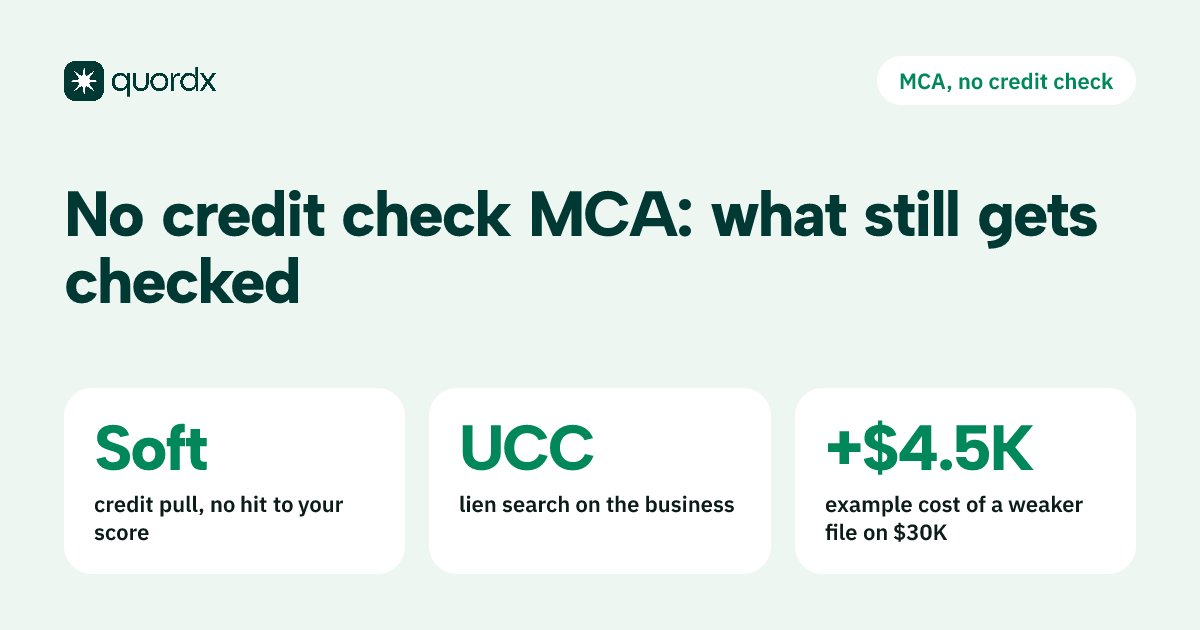
A merchant cash advance with truly no credit check is rare; what "no credit check" usually means is no hard pull and no minimum credit score, not no review. Funders typically run a soft pull on the owner, which doesn't change your score, and then decide mostly from your bank statements, existing debts, and public lien and judgment records. A low score rarely ends the conversation on its own, but it does tend to show up in the price.
The short version: Expect a soft credit pull, a close read of several months of bank statements, and a search for UCC filings, tax liens and judgments against the business. A hard pull can still happen later, often when you accept an offer, so ask each funder when it pulls. If your score is low, clean statements and no open advances matter more than the number.
One option in our guide to Alternative Financing.
Last updated · Reviewed by Cody Dreis
50+ Lenders|Funding in as little as 24 hours
What "no credit check" means on a merchant cash advance
Usually it means a soft pull, not no pull: The CFPB describes a soft inquiry as a review of your credit file that doesn't affect your score, and notes that soft inquiries are visible only to you. A hard inquiry, the kind lenders run after you apply for credit, can lower your score.
Sometimes it means no score cutoff: Some funders will look at the report but have no fixed minimum, so a low score is weighed against everything else rather than used as a gate. That is a real difference from bank lending. It is not the same as nobody checking.
It almost never means no underwriting: An MCA is repaid out of your deposits, so the funder's main question is whether those deposits can carry a daily debit. That question gets answered from your bank account, not your credit report, which is why the credit check can be light while the rest of the review is not.
What MCA funders check instead of your credit score
| What they check | What they're looking for | Touches your credit score? |
|---|---|---|
| Owner's credit (soft pull) | Recent defaults, collections, bankruptcies, overall pattern | No |
| Business bank statements | Steady deposits, ending balances, overdrafts and returned items | No |
| Existing advances and loans | Other daily or weekly debits already coming out | No |
| UCC filings | Liens other funders or lenders already hold on your receivables or assets | No |
| Tax liens and judgments | Unpaid tax debts or court judgments that could get paid ahead of the funder | No |
| Identity and the business | That the owner, entity and bank account are real and match | No |
| Hard pull (some funders, some stages) | A full credit report, often at offer or funding | Yes, it can |
The UCC search matters more than most owners expect: When a funder takes a security interest in your receivables, it files a UCC financing statement with the state, and a new funder will look for it. Under the Uniform Commercial Code, competing secured parties generally rank by who filed or perfected first, so an existing filing tells a new funder it would be standing in line behind someone.
Bank statements are the real application: A funder reading a few months of statements can see your average deposits, your lowest balances, every returned payment, and every daily debit to another funder. That last item is why hiding an existing advance doesn't work: the debits are right there on the statement.
See what you could qualify for
Four answers about your business. No credit pull.
Can you get a merchant cash advance with a 500 credit score?
Possibly, if the rest of the file is strong: A 500 score doesn't automatically end the conversation at a funder with no score cutoff, but it pulls the other items in the table above to the front. What tends to sink a low-score file is not the score itself but what sits behind it.
- An open default on another advance. A funder will see it in your statements or in a lien search, and it usually matters more than the score.
- Frequent overdrafts or returned debits. These tell the funder its own debit may bounce.
- Unpaid tax liens or judgments. These can be paid ahead of the funder, so they reduce what it can safely advance.
- Two or more advances already running. Each one shrinks the deposits left for a new debit.
Expect it to cost more: Funders price risk, so a weaker credit file typically means a higher factor rate, a shorter term, a smaller amount, or all three. The next section shows how much that difference can be in dollars. For other options at this score, see business loans with a 500 credit score.
What a weaker credit file can cost: a worked example
Say two business owners each take a $30,000 advance. These are made-up numbers to show the math, not quotes or market rates. The stronger file gets a 1.25 factor collected over about 9 months. The weaker file gets a 1.40 factor collected over about 6 months.
| Stronger file (example) | Weaker file (example) | |
|---|---|---|
| Advance | $30,000 | $30,000 |
| Factor rate | 1.25 | 1.40 |
| Total paid back | $37,500 | $42,000 |
| Dollar cost | $7,500 | $12,000 |
| Daily debit (business days) | $198.41 (189 debits) | $333.33 (126 debits) |
| Monthly drain | about $4,167 | about $7,000 |
| APR, before any fees | about 62% | about 142% |
The weaker file pays $4,500 more and carries a debit two-thirds bigger: For a business depositing $40,000 a month, the second offer takes about 17.5% of deposits every month, versus about 10.4% for the first. Before signing, compare that monthly drain to what the business actually keeps after expenses, not to revenue.
Decision rule: if the debit is bigger than what the business clears in a typical month, ask for a smaller amount or a longer term, or walk away. A no-credit-check advance you can't carry ends up costing more than the credit check would have.
Red flags in no credit check MCA offers
- A promise that you will be approved. A funder that hasn't seen your statements can't know whether your account can carry its debit. Treat that promise as marketing.
- Fees before funding. State disclosure rules expect a funder's fees to come out of the funding at closing and show up on the disclosure. Paying anyone up front to "secure" an offer is a warning sign.
- No written cost breakdown. Several states now require a standard disclosure of the funding amount, total payback and payments. New York's version, 23 NYCRR 600, also requires an estimated APR. Ask for the numbers in writing anywhere.
- A confession of judgment clause. It lets a funder get a court judgment without suing you first. Virginia's sales-based financing law makes these clauses unenforceable in its contracts, and if you see one elsewhere, get advice before you sign.
- Pressure to sign today. A real offer still holds after you've read it and run the math.
Better options when your credit is the problem
If you invoice other businesses: invoice factoring leans mostly on your customers' credit, so your own score carries less weight, and there is no daily debit from your account.
If you're buying equipment: the equipment itself backs the financing, which can offset a thin credit file.
If you have six months or more before you need the money: fixing the bank statement items (overdrafts, low balances) and paying down an open collection often does more for an MCA offer than a few points of score. Our roundup of loans for bad credit compares the realistic options side by side.
If an MCA is still the right tool: read how much a merchant cash advance costs before you compare offers, and make sure you understand how merchant cash advances work, including reconciliation.
How Quordx handles a low-score MCA request
Quordx is a broker, not a lender, so it can't waive a lender's credit review. Most options can be explored without a hard credit pull, and the lender decides if and when one happens later, so ask before you accept anything. Its cash-flow products start at around $17,000 a month in revenue and usually 12 months in business, and the panel lenders that offer advances want more revenue than that. If you are below those levels, Quordx is unlikely to find you an MCA, and a CDFI or local lender is a better first call.
If you clear that bar, one application of about 10 minutes reaches lenders offering advances, term loans and lines of credit, so a cheaper product has a chance to show up next to the MCA. Lenders typically come back in 24 to 48 hours. Business owners pay Quordx nothing; lenders pay it when a deal funds. Businesses in Virginia, Connecticut, Missouri and North Dakota are not served.
Questions Business Owners Ask Before Applying
Does a merchant cash advance check your credit?
Usually yes, with a soft pull on the owner that doesn't affect your score. Some funders also run a hard pull at the offer or funding stage, so ask each one when it pulls. Either way, your bank statements carry more weight than the score.
Will a soft credit pull show up to other lenders?
No. According to the CFPB, soft inquiries appear only when you view your own credit report, and they don't affect your score. Hard inquiries are visible to lenders and can lower your score.
What is a UCC lien search and why does an MCA funder run one?
It is a search of state filings that show which lenders or funders already claim a security interest in your business assets or receivables. A new funder runs it to see whether it would be standing behind someone else, because secured parties generally rank by who filed first.
Can I get a merchant cash advance with a 500 credit score?
Some funders have no fixed score minimum, so it can be possible with steady deposits, few overdrafts and no open advances. Expect a higher price, a shorter term or a smaller amount than a stronger file would get, and run the monthly drain against what the business keeps.
Does taking a merchant cash advance hurt my credit?
The soft pull does not. A hard pull, if the funder runs one, can lower your score a little. Our guide on whether a merchant cash advance affects your credit covers reporting and what happens if you fall behind.
Apply for Funding
No obligation · Initial inquiry doesn't impact credit · Takes about 10 minutes
Sources

Written by
Cody Dreis
Founder, Quordx Capital
Read full bio
Related articles
Keep exploring alternative financing
Quordx Capital is a business funding broker, not a lender. Lenders make every credit decision and set the rate, fees and terms, and not every business qualifies. Quordx may be paid by a lender when a deal funds. Full disclosures